7 Best Dust Extractors for Woodworking (November 2026)
The best best dust extractor for woodworking include the Makita XCV11Z 18V LXT Lithium-Ion Brushless Cordless for cordless tool dust control, the Festool 578441 CT 15 Dust Extractor for Festool system users, and the Fein Turbo I Set Wet/Dry Dust Extractor for quiet indoor extraction.
On this page (11 sections)
- Our top dust extractor picks for woodworking
- Side by side comparison of the top picks
- How we compared these dust extractors
- What CFM and water lift mean for wood dust
- Which extractor fits your main power tool?
- Cordless, corded or Bluetooth: which power source fits?
- How important is HEPA filtration for woodworking?
- Capacity, footprint and emptying time
- Brand picks for Makita, Milwaukee, Metabo and Mirka users
- How much power does your saw actually use?
- Verdict: which dust extractor should you buy?
The best dust extractor for woodworking for most shops is the Makita XCV11Z, because you can carry it to a saw, router or sander without dragging a cord. Its 2 gallon canister suits short jobs, and its HEPA filter captures fine dust that a shop vacuum may let through.
Wood dust capture starts at the tool port. For a fixed workshop setup, compare dust collectors for woodworking shops.
For a closer look at a 1,300 CFM collector, read the WEN DC1300 dust collector review. A good dust extractor for power tools works best when the hose fits the port, the shroud sits close and the filter stays clean.
Suction numbers matter, but fit and airflow matter too.
If you are still deciding between a wall mounted dust collector and a portable extractor, read our dust collector guide first. Portable extractors move with you, while a larger dust collector machine suits a fixed shop with duct runs.
Our picks at a glance
-
1
 Best for cordless tool dust control
Makita XCV11Z 18V LXT Lithium-Ion Brushless Cordless
9.7/10 our score
See it on Amazon -
2
-
3
 Best for quiet indoor extraction
Fein Turbo I Set Wet/Dry Dust Extractor
9.3/10 our score
See it on Amazon
- 4
 Check it
Festool 574837 Ct Midi I Hepa Bluetooth
Best for Bluetooth tool start - 5
 Check it
Makita VC4210L 11 Gallon Wet/Dry HEPA Filter
Best for large shop capacity - 6
 Check it
DEWALT FLEXVOLT 60V MAX* Dust Extractor
Best for wireless remote start - 7
 Check it
BOSCH VAC140AH Portable 14 Gallon Dust Extractor
Best for auto filter cleaning
Our top dust extractor picks for woodworking
We compared extractors for wood dust capture across common workshop power tools. The picks below cover cordless portability, corded power, Bluetooth start and large capacity.
Makita XCV11Z 18V LXT Lithium-Ion Brushless Cordless: Best for cordless tool dust control
- 57 CFM and 27 inches water lift
- 2 gallon capacity
- HEPA filter captures 99.97% of particulates 3 microns and larger
- Up to 60 minutes with 5.0 Ah battery
- 10.1 pounds with battery
A compact cordless extractor for small jobs and moving between tools. Its HEPA filter and brushless motor make it a strong pick for spot dust control.
Pros
- Cordless and portable at 10.1 pounds
- HEPA filtration for fine particles
- LED battery indicator
Cons
- Battery not included
- 2 gallon canister fills faster than shop units
The Makita XCV11Z 18V LXT Lithium-Ion Brushless Cordless suits woodworkers who switch tools often. At 57 CFM and 27 inches of water lift, it pulls dust through a hose for sanders, routers and small saws.
Its 2 gallon canister is small, so it fits car jobs, punch lists and garage work where space is tight.
Makita says the HEPA filter captures 99.97% of particulates 3 microns and larger. That fine filtration matters when sanding hardwood or MDF, where the dust you cannot see can linger in the air.
The filter cleaning system helps maintain suction as fine dust builds on the cartridge.
At 10.1 pounds with a 5.0 Ah battery, this is the easiest extractor here to carry up stairs or across a site. Run time reaches up to 60 minutes with that battery, and an LED indicator shows charge level.
The brushless motor runs cooler and more efficiently than a brushed motor, which helps in daily use.
The hose, upholstery nozzle, crevice nozzle, HEPA filter and pre filter set are included, so you can start with bench cleanup and spot sanding right away. The trade-off is clear: the 2 gallon canister fills fast during long saw work, and the battery is not included.
A cyclone dust separator for woodworking can separate debris before it reaches a vacuum or extractor.
For a small shop, see our best dust extractor for small workshop guide for layout ideas.
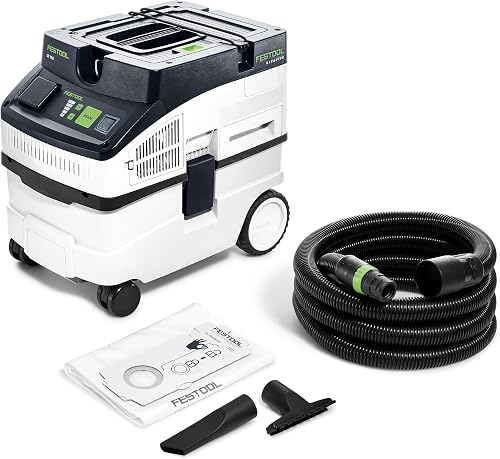
Festool 578441 CT 15 Dust Extractor: Best for Festool system users
- 15 liter container
- HEPA filter
- Automatic tool start
- AutoClean system
- Crevice and upholstery cleaning tools included
A mobile corded extractor with a 15 liter container and tool start. It fits a Festool workflow and keeps fine dust contained during sanding and cutting.
Pros
- 15 liter capacity for longer work
- Automatic tool start
- Cleaning tools stored on the unit
Cons
- Corded, so outlet placement matters
- One power level limits suction adjustment
The Festool 578441 CT 15 Dust Extractor suits users who already work in the Festool system. Its 15 liter container gives you more room than the 2 to 4 gallon portable picks.
That extra capacity means fewer stops to empty during sanding, routing and cutting sessions.
Festool lists HEPA filtration, automatic tool start and an AutoClean system. Automatic tool start means the extractor runs when your power tool runs, so you do not need a separate switch.
Touch operation keeps control simple, and the flat top gives you a place to set small tools and parts.
Crevice and upholstery cleaning tools are included and stored on the unit. That helps with clean up around a bench and inside a cabinet, though a woodworker may add a sanding hose and tool adapters for a saw or router.
The SELFCLEAN filter bag helps protect the filter and contain dry dust when you empty it.
The trade-off is power source and control: this is corded, and it has one power level, so you cannot dial suction down for delicate work. Its compact footprint and sturdy chassis help on the go, but outlet placement still matters.
If you use Festool sanders, pair it with our best festool dust extractor and sander combo guide.
Fein Turbo I Set Wet/Dry Dust Extractor: Best for quiet indoor extraction
- 151 CFM and 98 inches water lift
- 5.8 gallon capacity
- 66 dB operating level
- 19 ft power cord and 13 ft hose
- Autostart outlet with power-on delay
A strong corded extractor with a long cord and hose for reach. Its low noise level helps in shared or indoor spaces.
Pros
- High suction at 151 CFM
- Low 66 dB noise level
- Long cord and hose for reach
Cons
- 25 pounds is heavier to move
- 5.8 gallons still needs regular emptying
The Fein Turbo I Set Wet/Dry Dust Extractor suits indoor work where noise matters. Fein rates it at 151 CFM and 98 inches of water lift, strong numbers for pulling dust through a 13 ft hose.
At 66 dB, it runs quieter than most corded extractors in this group.
A 19 ft power cord and 13 ft vacuum hose give you reach without moving the canister as often. The autostart outlet syncs suction with a power tool, and a built-in power-on delay helps prevent current spikes.
That hands-free start is useful when both hands are on a router table or sander.
The 5.8 gallon capacity sits between the small cordless picks and the 11 to 14 gallon shop units. Large swivel wheels help in tight spaces, and an anti-static function with optional accessories helps limit electrostatic buildup.
The included tool coupling with suction control lets you adjust airflow at the tool end.
The trade-off is weight and capacity: at 25 pounds, it is not a one-hand carry, and the canister still needs regular emptying on long jobs. For a 1100W turbine, that reach and quiet running make it a strong indoor pick.
If you drill often, compare the best dust extractor for drilling options for smaller ports and adapters.
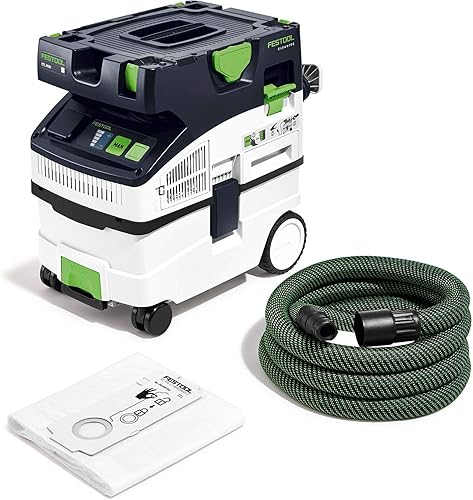
Festool 574837 Ct Midi I Hepa Bluetooth: Best for Bluetooth tool start
- 130 CFM suction
- 3.9 gallon container
- Bluetooth start from battery packs or remote
- Smooth suction hose
- Sys-Dock with T-Loc
A portable HEPA extractor that starts from a Bluetooth battery pack or remote. It suits users who want to start suction without walking to the canister.
Pros
- Bluetooth start saves trips to the extractor
- Smooth hose reduces snagging
- T-Loc dock for stacking
Cons
- 24.9 pounds is less easy to carry
- 3.9 gallon container is mid-size
The Festool 574837 Ct Midi I Hepa Bluetooth suits users who want to start suction from the tool. Bluetooth start from a battery pack or remote saves a trip to the extractor, which helps when you are on a ladder, at a bench or moving around a room.
Festool rates suction at 130 CFM with a 3.9 gallon container. That balance fits mid-size jobs: enough capacity for sanding a table top, but still portable enough to move between rooms.
The smooth suction hose has conical geometry that reduces snagging on bench edges and workpieces.
A Sys-Dock with T-Loc lets you connect storage sustainers quickly. Touch operation keeps the controls simple, and an internal hose holder helps with transport.
The cable holder and SELFCLEAN filter bag are included, which helps keep the hose and filter contained when you move to another job.
The trade-off is weight and size: at 24.9 pounds, it is heavier than the Makita cordless pick and harder to carry for long distances. Its AC power means you still need an outlet, even though start is wireless.
For drywall work specifically, see the best festool dust extractor for drywall guide.
Makita VC4210L 11 Gallon Wet/Dry HEPA Filter: Best for large shop capacity
- 148 CFM and 92 inches water lift
- 11 gallon capacity
- 12 AMP motor
- Automatic filter cleaning
- Tool-activated outlet with 10 second off delay
- 60 dB sound level
An 11 gallon wet and dry extractor with strong suction and a tool-activated outlet. It suits larger sanding and cutting jobs where emptying matters.
Pros
- 11 gallon capacity for longer jobs
- 148 CFM with 92 inches water lift
- Tool-activated outlet clears remaining debris
Cons
- 35.3 pounds is the heaviest here
- Large footprint in a small shop
The Makita VC4210L 11 Gallon Wet/Dry HEPA Filter suits shops that run long sanding and cutting sessions. Its 12 AMP motor delivers 148 CFM and 92 inches of water lift.
That power helps when you connect a table saw, planer or wide belt sander through a longer hose.
At 11 gallons, the canister holds far more dust than the 2 to 4 gallon picks. You will empty it less often, which matters with MDF and sanding dust that builds up fast.
An automatic filter cleaning system helps maintain suction, and a two stage filtration system works with the HEPA main filter.
The included 13 foot anti-static hose, crevice nozzle, fleece filter bag, diffuser and adapters cover a wide range of ports. The HEPA filter captures 99.97% of particles 0.3 microns and larger, while the main flat filter captures 99.95% of particles 2 microns and larger.
The on-board tool-activated outlet starts and stops the extractor with your tool, and a 10 second off delay clears remaining debris from the hose. At 60 dB, it is quiet for its size.
The trade-off is size: at 35.3 pounds, it takes more floor space and is harder to move. For table saw setups, check the best dust extractor for table saw guide.
DEWALT FLEXVOLT 60V MAX* Dust Extractor: Best for wireless remote start
- 125 CFM suction
- Automatic filter cleaning with dual filters
- HEPA filters included
- Wireless tool control remote
- 8 foot anti-static hose
- Wet or dry use
A cordless extractor with wireless start and HEPA filtration. It suits jobsite and workshop use where a cord would get in the way.
Pros
- Wireless on and off from the tool
- HEPA filters included
- Automatic filter cleaning
Cons
- Battery purchased separately
- 20 pounds is heavier than the Makita cordless pick
The DEWALT FLEXVOLT 60V MAX* Dust Extractor suits users who want wireless control. At 125 CFM, it pulls dust from saws, sanders and grinders through an 8 foot anti-static hose with the AIRLOCK system.
Wireless tool control lets you turn the extractor on and off from the tool or remote.
DEWALT includes HEPA filters and dual filters with automatic filter cleaning. That helps maintain suction during long jobs.
The extractor can handle wet or dry applications, which gives it range beyond wood dust. It also meets the EPA lead rule for HEPA vacuums when used with the included HEPA filter.
The included fleece bag helps contain dry dust and protect the filters. T-Stak compatibility lets you stack the unit with other DEWALT storage, which helps in a crowded van or shop.
Built in hose wrap offers convenient hose storage when not in use.
At 20 pounds, it is lighter than the large corded shop units but heavier than the Makita cordless pick. The battery is purchased separately, so factor that into your cost.
If you already own DEWALT batteries, this pick fits your kit. For more DEWALT options, see the best dewalt dust extractor guide.
BOSCH VAC140AH Portable 14 Gallon Dust Extractor: Best for auto filter cleaning
- 150 CFM and 97 inches static water lift
- 14 gallon capacity
- Auto filter cleaning every 15 seconds
- HEPA filter captures 99.97% at 0.3 microns
- Power tool activation and Power Broker dial
A 14 gallon extractor that cleans its filter every 15 seconds. It suits long sanding sessions where suction loss is a problem.
Pros
- Largest capacity here at 14 gallons
- Auto filter cleaning maintains suction
- Power Broker dial matches suction to the job
Cons
- 38 pounds is bulky to move
- 22.5 x 14.75 x 34.1 inches takes floor space
The BOSCH VAC140AH Portable 14 Gallon Dust Extractor suits heavy sanding work where suction loss is a concern. Bosch rates it at 150 CFM with 97 inches of static water lift.
Automatic filter cleaning runs every 15 seconds to help maintain maximum suction power.
The included HEPA filter captures 99.97% of particles at 0.3 microns or larger. A fleece filter bag helps protect the filter and contains dry dust and debris.
At 14 gallons, this is the largest capacity here, so you can run a planer, sander or saw for a long session before emptying.
Power tool activation lets your tool switch the extractor on and off. A Power Broker dial matches suction force to the application, which helps when you move from a sander to a saw.
The included 9.85 ft vacuum hose, bend nozzle and power tool adapter nozzle help you connect to common ports.
The trade-off is size: at 38 pounds and 22.5 x 14.75 x 34.1 inches, it needs real floor space and a clear path to empty. At 65 dB, it runs quietly for a unit this size.
For sanding specifically, compare the best dust extractor for sanding guide.
Side by side comparison of the top picks
The table below puts suction, capacity and power source in one place. Use it to match an extractor to your main tool, not just to the highest suction number.
| Product | Best for | Suction | Capacity | Power source | Our score |
|---|---|---|---|---|---|
| Makita XCV11Z 18V LXT Lithium-Ion Brushless Cordless | cordless tool dust control | 57 CFM | 2 gallons | 18V LXT Lithium-Ion, tool only | 9.7 |
| Festool 578441 CT 15 Dust Extractor | Festool system users | 15 liters | Corded Electric | 9.6 | |
| Fein Turbo I Set Wet/Dry Dust Extractor | quiet indoor extraction | 151 CFM | 5.8 gallons | 9.3 | |
| Festool 574837 Ct Midi I Hepa Bluetooth | Bluetooth tool start | 130 CFM | 3.9 gallons | 9.1 | |
| Makita VC4210L 11 Gallon Wet/Dry HEPA Filter | large shop capacity | 148 CFM | 11 gallons | 8.8 | |
| DEWALT FLEXVOLT 60V MAX* Dust Extractor | wireless remote start | 125 CFM | 8.6 | ||
| BOSCH VAC140AH Portable 14 Gallon Dust Extractor | auto filter cleaning | 150 CFM | 14 gallons | 8.3 |
How we compared these dust extractors
We checked specs for suction, filtration, capacity, hose length, weight and power source. We looked at how each model fits common woodworking tools, from sanders and routers to saws and grinders.
Our score weighs specs, features and buyer feedback against what you're shopping for. A high score means strong specs for wood dust capture, useful features for power tools and good fit for everyday shop work.
We did not test these units hands on. Claims about suction, filtration and run time come from the brands.
Buyer patterns come from product feedback, and we note where a spec changes the buying decision.
What the specs do not show
Specs do not show how well a shroud fits your saw or how a hose bends around a bench. A short, straight hose usually gives stronger suction than a long hose with tight bends, even on the same extractor.
What CFM and water lift mean for wood dust
CFM measures air volume, and water lift measures pulling power through restrictions. A dust extractor for power tools needs both, because a hose, adapter and shroud all add resistance.
For a sander, steady airflow through a narrow hose matters most. For a table saw, higher water lift helps pull chips through a larger port and longer hose.
Compare both numbers, not just CFM.
If your main tool is a miter saw, check what size miter saw do I need for a workshop before you size the extractor. A larger saw blade throws more chips and needs more hose diameter.
Which extractor fits your main power tool?
Sanding and routers
Sanders make fine dust that stays airborne. A HEPA filter and steady suction through a narrow hose help most here.
The Makita XCV11Z and Festool CT 15 both suit sanding, with the Festool giving more capacity.
Routers throw chips and fine dust at the same time. A corded extractor with tool start, like the Fein Turbo I or Makita VC4210L, keeps suction running while both hands guide the tool.
Saws and grinders
Table saws and miter saws throw larger chips. A larger canister, like the 11 or 14 gallon picks, means fewer stops to empty.
Check port size before you buy, because adapters can restrict airflow.
Grinders make fine metal and abrasive dust. For that work, our best dust extractor for grinder guide covers port fit and filtration.
A cordless pick helps when the grinder moves around the shop.
Cordless, corded or Bluetooth: which power source fits?
Cordless extractors move anywhere, but run time depends on the battery. The Makita XCV11Z gives up to 60 minutes with a 5.0 Ah battery.
That suits short jobs and spot clean up.
Corded extractors run all day and give steady suction. The Fein Turbo I, Makita VC4210L and Bosch VAC140AH all use corded power with tool activation.
They suit fixed shop work where you can park the canister.
Bluetooth and wireless start save trips to the canister. The Festool CT Midi I starts from a Bluetooth battery pack, and the DEWALT extractor starts from a remote.
That helps when the tool is far from the extractor.
How important is HEPA filtration for woodworking?
HEPA filters capture 99.97% of particles at 0.3 microns or larger. That level of filtration helps with fine sanding dust that a basic filter may miss.
Every pick here uses HEPA filtration, though the exact rating wording differs by brand.
For a shop where you sand MDF or hardwood often, HEPA filtration is worth the upgrade. Empty canisters and change bags in a way that does not raise dust back into the air.
Wear a respirator during clean up if dust rises.
If you want the finest filtration, our best dust extractor with hepa filter guide compares HEPA models in more detail.
Capacity, footprint and emptying time
A 2 gallon canister fills fast during saw work. It suits a cordless pick for short jobs, but you will empty it often.
A 15 liter or 11 to 14 gallon extractor suits long sessions.
Footprint matters in a small shop. The Bosch VAC140AH is 22.5 x 14.75 x 34.1 inches and 38 pounds.
The Makita VC4210L is 35.3 pounds. Both need floor space and a clear path to empty.
For a small shop layout, read our best dust extractor for small workshop guide. For heavy fixed work, our dust extractor industrial guide covers larger systems.
Brand picks for Makita, Milwaukee, Metabo and Mirka users
Makita users may want the XCV11Z for cordless portability or the VC4210L for shop capacity. Our best makita dust extractor guide compares Makita models across more sizes.
Milwaukee users should check the best milwaukee dust extractor guide for battery platform fit. Metabo users can read the metabo dust extractor review for system details.
Mirka users who sand often may want the best mirka dust extractor guide for sander specific hose and suction fit. Portable users should also check the best portable dust extractor guide.
How much power does your saw actually use?
Saw power affects how much dust an extractor must handle. A larger blade and motor throw more chips per cut.
Check how much power does a miter saw use to match saw size to extractor capacity.
A high power saw paired with a small 2 gallon canister means frequent emptying. If you run a large saw for hours, a corded 11 to 14 gallon extractor will save time.
Verdict: which dust extractor should you buy?
Pick the Makita XCV11Z if you want cordless portability and HEPA filtration for small to mid-size jobs. Pick the Festool CT 15 if you work in the Festool system and want a larger corded canister.
Pick the Fein Turbo I for quiet indoor work with long reach. Pick the Makita VC4210L or Bosch VAC140AH for long sanding and saw sessions where capacity matters most.
For the top pick in this best dust extractor for woodworking roundup, start with the Makita XCV11Z if portability is your priority. If you run a fixed shop with daily sanding, the larger corded picks will save you time on emptying and filter cleaning.
Our top 3 picks at a glance
-
1
Best for cordless tool dust control
Makita XCV11Z 18V LXT Lithium-Ion Brushless Cordless
9.7/10 our score
See it on Amazon -
2
-
3
Best for quiet indoor extraction
Fein Turbo I Set Wet/Dry Dust Extractor
9.3/10 our score
See it on Amazon
Frequently asked questions
What is the best dust extractor for woodworking?
The best dust extractor for woodworking depends on your tools and shop size. A cordless 2 gallon HEPA unit suits small jobs and moving between tools.
A corded 11 to 14 gallon extractor suits long sanding and saw work where capacity and suction matter more.
What CFM do I need in a dust extractor for power tools?
For power tools, compare CFM with water lift and hose size. Higher CFM helps move air through a hose, while water lift helps pull through restrictions.
A shroud and a short hose often matter as much as the headline suction number.
Is HEPA filtration needed for wood dust?
HEPA filtration helps capture fine particles that standard filters can miss. Makita, Festool, Bosch and others in this group use HEPA filters rated to capture 99.97% of particles at 0.3 microns or larger.
Empty and clean filters with care to avoid raising dust.
Can one extractor serve a table saw and a sander?
Yes, if capacity and hose adapters fit both tools. A larger canister helps with a table saw, while a sander needs steady suction through a smaller hose.
Check the hose diameter and tool adapters before you buy, and plan on moving the hose between tools.


