9 Best Detail Sanders for Woodworking (November 2026)
The best detail sanders for woodworking include the SKIL Corded Multi-Function Detail Sander with Micro-Filter for versatile woodworking details, the WEN 6307 Variable Speed Detailing File Sander for narrow contours, and the BLACK+DECKER Detail Sander for mouse-sander beginners.
On this page (9 sections)
- How we chose the best detail sander for woodworking
- The best detail sanders for woodworking
- What type of detail sander is best for corners?
- Is a detail sander better than an orbital sander?
- Should you choose a corded or cordless detail sander?
- How do you use a detail sander on wood?
- How do you maintain a mouse or palm detail sander?
- More guides on this topic
- Which detail sander should you choose?
The best detail sander for woodworking is the SKIL Corded Multi-Function Detail Sander, thanks to its 4-in-1 attachments, 14,500 OPM and choice of micro-filtration or vacuum connection. The WEN 6307 is better for narrow contours, while the BLACK+DECKER is a strong mouse-sander choice for corners and cramped spaces.
Detail sanders are made for the parts of a project that larger sanders cannot reach. For broad surface work without a cord, see our cordless random orbital sander picks.
You can use them on wooden corners, trim edges, small surfaces and intricate shapes, but the right pad or belt matters more than speed alone. For curved interior edges, see oscillating spindle sanders.
If you're comparing tool types first, our guide to different types of sanders explains where detail, orbital and belt sanders fit.
Our picks at a glance
-
1
 Best for versatile woodworking details
SKIL Corded Multi-Function Detail Sander with Micro-Filter
9.7/10 our score
See it on Amazon -
2
 Best for narrow contours
WEN 6307 Variable Speed Detailing File Sander
9.7/10 our score
See it on Amazon -
3
- 4
 Check it
WEN 6301 Electric Detailing Palm Sander
Best for palm-held control - 5
 Best for simple dust-conscious sandingCheck it
- 6
 Best for hand-sanding complex profilesCheck it
- 7
 Best for mixed-grit starter workCheck it
- 8
 Check it
WORKPRO Detail Electric Sander with Dust Bag
Best for a broad grit starter set - 9
 Best for two-grit mouse sandingCheck it
How we chose the best detail sander for woodworking
The SKIL multi-function model ranks first because it covers the widest range of detail tasks in this group. Its 3 attachments handle broad surfaces, corners, edges and curved contours, and the 1.2 A motor runs at 14,500 OPM.
We compared motor details, sanding speed, pad or belt shape, dust control, included abrasives and accessory range. Our score weighs specs, features and buyer feedback against what you're shopping for.
A corded detail sander can make sense for a workshop because it supplies continuous power. If you need to work away from an outlet, compare our best cordless detail sanders before choosing a corded model.
For dust control, a built-in box or bag is useful for quick jobs, while a vacuum port can suit repeated sanding in a workshop. See our guide to the best detail sanders with vacuum attachments for that feature.
| Product | Best for | Power | Speed | Included | Our score |
|---|---|---|---|---|---|
| SKIL Corded Multi-Function Detail Sander with Micro-Filter | versatile woodworking details | 1.2 A, 120 V corded electric | 14,500 OPM | Dust box, 3 attachments and 12 sanding sheets | 9.7 |
| WEN 6307 Variable Speed Detailing File Sander | narrow contours | 2 A corded electric | 3 sanding belts and dust port attachment | 9.7 | |
| BLACK+DECKER Detail Sander | mouse-sander beginners | 1.2 A corded electric | 16,000 OPM | Mouse detail sander | 9.4 |
| WEN 6301 Electric Detailing Palm Sander | palm-held control | 0.8 A, 120 V corded electric | 12,000 OPM | 9.3 | |
| SKIL Corded Detail Sander | simple dust-conscious sanding | 1 A corded electric | 12,000 OPM | Dust box and 3 sanding papers | 9.2 |
| POWERTEC 21 Profile Sander | hand-sanding complex profiles | 8.8 | |||
| HYCHIKA Detail Sander | mixed-grit starter work | 1.6 A, 120 V electric | 14,000 OPM | Dust bag and 12 sanding sheets | 8.7 |
| WORKPRO Detail Electric Sander with Dust Bag | a broad grit starter set | 1.6 A, 120 V corded electric | 13,000 OPM | Dust collector and 15 sanding sheets | 8.3 |
| CRAFTSMAN Detail Sander | two-grit mouse sanding | AC | 14,000 OPM | Dust bag, 2 attachments and 120- and 240-grit sheets | 8.1 |
The best detail sanders for woodworking
The best tool depends on the shape of your work and the type of sanding you do most often. For broader stock removal, compare Makita corded belt sanders.
Pick a multi-function mouse sander for mixed detail work, a file sander for narrow contours, or a hand-grip profile set for shaped wood.
SKIL Corded Multi-Function Detail Sander with Micro-Filter: Best for versatile woodworking details
- 1.2 A corded motor
- 14,500 OPM
- 3 additional attachments
- Micro-filtration and 1-1/4 in dust port
- 12 sanding sheets
This 4-in-1 detail sander covers broad surfaces, corners, edges and curved contours with tool-free attachment changes. Micro-filtration and a 1-1/4 in dust port give you two dust-control options.
Pros
- 4-in-1 sanding coverage
- Low-vibration grip
- 12 sanding sheets included
Cons
- Cord limits movement
- More attachments than needed for simple flat sanding
The SKIL Corded Multi-Function Detail Sander is the best overall pick for varied woodworking details. Its 4-in-1 design includes 3 attachments that cover large surfaces, corners, edges and curved contours.
The 1.2 A motor runs at 14,500 OPM for smoothing wood and preparing surfaces. Use light pressure on repeated passes so a corner does not wear deeper than the surrounding face.
Tool-free attachment changes let you switch from a broad pad to a pointed or flexible shape during one project. That helps when a piece has both flat areas and a shaped edge.
For dust control, use the micro-filtration dust box for small jobs or connect a vacuum through the 1-1/4 in dust port for longer sessions. The hook-and-loop system also makes sheet changes quick.
Check sheets often, since a clogged or worn sheet cuts unevenly. The soft rubber grip and counterweight balance reduce vibration fatigue, so choose this model when you want one tool for several detail tasks.
WEN 6307 Variable Speed Detailing File Sander: Best for narrow contours
- 2 A corded motor
- 1/2-by-18 in belt
- 1,080 to 1,800 FPM variable speed
- 55-degree belt pivot
- 3 abrasive belts
The narrow pivoting belt reaches grooves, contours and tight spaces that a triangular pad may miss. Variable speed and tool-free belt changes make it suited to detail shaping.
Pros
- Narrow belt reaches tight areas
- Variable speed control
- Auto-tracking belt
Cons
- Less suited to broad flat surfaces
- Uses belts instead of standard triangular sheets
The WEN 6307 is the best choice for narrow grooves, contours and tight spaces. Instead of a triangular pad, it uses a 1/2-by-18 in sanding belt that pivots up to 55 degrees.
That pivot lets you angle the belt to meet a profile rather than forcing the whole tool into position. It suits stair edges, narrow mouldings and awkward angles where a wide pad would bridge over a groove.
Its variable-speed dial runs from 1,080 to 1,800 feet per minute. That gives you more control when a narrow edge needs slower work or when a harder sanding task needs more belt movement.
Lower speed can help you control the cut on small parts. Higher speed suits longer runs, but the belt still needs light pressure to avoid gouging one spot.
The auto-tracking system keeps the belt aligned without tensioning or adjustments. Tool-free belt installation helps you change belts during a project, and the included dust port attachment gives you a way to connect dust collection.
This shape is less suited to broad flat surfaces than a conventional detail sander. Choose it for detail shaping, and keep a pad sander nearby for wide areas.
BLACK+DECKER Detail Sander: Best for mouse-sander beginners
- 1.2 A motor
- 16,000 OPM
- 3-position grip
- Detail finger attachment
- Dust collection canister
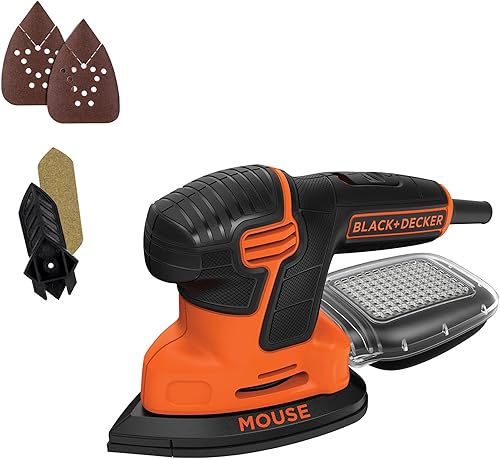
This compact mouse sander is built for corners, cramped spaces and detail work. The 3-position grip, detail finger attachment and dust canister make it a practical general-purpose pick.
Pros
- Compact shape
- Detail finger attachment
- 3-position grip
Cons
- Corded operation
- Fewer included accessories than the SKIL multi-function model
The BLACK+DECKER Detail Sander is the best mouse detail sander for compact corner work. Its 1.2 A motor runs at 16,000 OPM, while the small shape reaches cramped spaces and tight corners.
The detail finger attachment extends the tool's reach into narrow spots. A separate detail sanding pad helps with odd angles, so it suits small furniture parts, trim and intricate wooden projects.
A 3-position comfort grip gives you more than one hand position. You can shift your hold for a corner, an edge or a small flat area without twisting your wrist into an awkward angle.
The dust collection canister helps keep debris down during sanding. Empty it before it fills, since a full canister can reduce airflow and leave more dust on the surface.
The dust-sealed switch protects the switch area from sanding dust. That small detail supports durability, especially when you sand in a workshop without constant vacuum use.
Choose this model if you want a simple corded mouse sander for common detail jobs. For replacement abrasives, compare our guide to the best sandpaper for mouse sanders.
WEN 6301 Electric Detailing Palm Sander: Best for palm-held control
- 0.8 A motor
- 12,000 OPM
- Angled 3.75-by-5.5 in pad
- 2 lb design
- Dust collection port
The angled pad and palm shape suit small woodworking parts, edges and precision finishing. Its 2 lb design is easier to hold for detail work than heavier tools.
Pros
- Lightweight 2 lb design
- Angled tip for precision
- Velcro base pad
Cons
- Lower speed than several picks here
- Basic accessory package
The WEN 6301 Electric Detailing Palm Sander is best for palm-held precision on small wooden parts and edges. Its angled 3.75-by-5.5 in pad gives the pointed end a useful role in detail work.
The angled tip helps you reach into a corner while the body of the pad stays on the surface. That shape is handy for trim, small boxes and furniture edges where a square pad would overrun the line.
The 0.8 A motor runs at 12,000 OPM, and the tool weighs 2 lb. That combination favors controlled movement and can be easier to hold during repeated small-area sanding than a heavier tool.
A lighter tool can make it easier to stop and check progress. It also means you should let the motion do the work, since forcing a light palm sander can make the pad bounce.
A dust collection port helps reduce loose sawdust, while the Velcro base pad supports quick sandpaper changes. The palm shape also gives you a direct grip over the sanding area.
This is a focused option rather than a multi-attachment system. Pick it when a light palm tool and angled pad matter more than maximum speed or a large accessory set.
SKIL Corded Detail Sander: Best for simple dust-conscious sanding
- 1 A motor
- 12,000 OPM
- Micro-filtration
- 1-1/4 in dust port
- 3 sanding papers
This SKIL keeps the core detail-sanding setup simple with a triangular sander, dust box and vacuum-port option. Low vibration and a soft rubber grip support longer small-part sessions.
Pros
- Two dust-control options
- Low-vibration design
- Simple setup
Cons
- Only 3 sanding papers included
- No extra contour attachments
The SKIL Corded Detail Sander is best for simple sanding with two dust-control choices. Its 1 A motor runs at 12,000 OPM, and the micro-filtration system helps collect dust during small finishing jobs.
You can also connect a vacuum through the 1-1/4 in dust port. That flexibility helps if you want a dust box for quick work but already have a workshop vacuum for longer sanding sessions.
For a quick touch-up, the box keeps setup short and cleanup simple. For a longer bench session, a vacuum can keep the pad and the work surface clearer.
The hook-and-loop system makes sanding-sheet changes straightforward. Press the new sheet down evenly so it sits flat, or the edges can catch and leave marks.
A soft rubber grip and counterweight balance are designed to reduce vibration, while the dust-sealed switch keeps the on/off control protected. Those comfort features help on small parts that need steady, repeated passes.
The package includes 3 sanding papers, so you may need more abrasives for a larger project. Choose this model when you want the core features of a detail sander without extra contour attachments.
POWERTEC 21 Profile Sander: Best for hand-sanding complex profiles
- 21 sanding profiles
- 11-piece set
- 30, 45, 60, 75 and 90 degree pads
- Flexible rubber-like material
- For wood
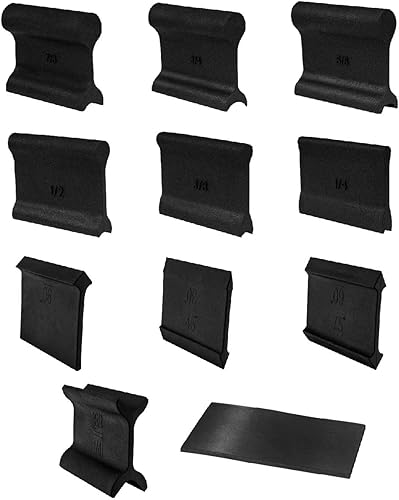
This is a hand-sanding system rather than a powered detail sander. Its 21 profiles help shape wood trim, curved edges, wedges and hard-to-reach angles.
Pros
- Many contour shapes
- Useful for concave and convex edges
- Works with cut sandpaper sheets
Cons
- No motor
- Requires manual sanding pressure and movement
The POWERTEC 21 Profile Sander is best for hand-sanding complex wood profiles. It is not a powered sander.
Instead, the 11-piece set gives you 21 contour and angle profiles for manual work. That makes it a specialist hand tool rather than a motor-driven detail sander.
The profiles include 30, 45, 60, 75 and 90 degree pads, along with shapes for flat surfaces, tight radii, wedges and curved edges. The flexible rubber-like material helps you hold the pad around a wooden contour.
Because the material flexes, it can follow a curve instead of flattening it. That is useful on trim and shaped parts where a flat pad would leave high spots.
You cut your sandpaper to size, wrap it around the selected grip and sand by hand. Cut cleanly and wrap firmly, so loose paper does not fold and scratch the surface.
This setup is useful where a powered triangular pad would remove too much material or fail to follow a curved edge. Manual pressure also gives you fine control on delicate profiles.
Choose POWERTEC for trim, shaped furniture parts and intricate profiles. If you need powered movement, pair your choice with a detail sander rather than treating this set as a replacement for one.
HYCHIKA Detail Sander: Best for mixed-grit starter work
- 1.6 A motor
- 14,000 OPM
- 6-hole dust collection
- Dust bag
- 12 sheets in P80, P120 and P240
HYCHIKA gives you coarse, medium and fine sheets for a range of woodworking steps. Its compact body, soft rubber head and dust bag suit corners and tight spaces.
Pros
- Three included grit levels
- 1.6 A motor
- Dust bag included
Cons
- The maker advises against drywall or cement plaster
- No extra detail attachments
The HYCHIKA Detail Sander is best for starting a project with several grit levels ready. Its 1.6 A motor runs at 14,000 OPM, and the package includes 12 hook-and-loop sheets in P80, P120 and P240.
That grit range supports rougher material removal, medium smoothing and finer finishing. Starting coarser helps remove marks, then moving finer gives a smoother surface for paint or finish.
The compact body and soft rubber head are suited to wooden edges, corners and other tight spaces. The small shape helps you control the tool around a frame or a small part.
A 6-hole dust collection system connects to the included dust bag. The dust bag is easy to remove and install, which helps during cleanup between sanding stages.
Empty the bag before it gets too full, since airflow drops as dust builds up. Quick checks between grits also help you see whether the surface is ready for the next stage.
HYCHIKA says this tool is suitable for sanding, polishing, paint removal and rust removal, but advises against drywall or cement plaster. Choose it for woodworking details when a mixed-grit starter package matters.
WORKPRO Detail Electric Sander with Dust Bag: Best for a broad grit starter set
- 1.6 A motor
- 13,000 OPM
- Dust collector
- Soft rubber top
- 15 sanding sheets from P60 to P240
The 15-sheet set covers P60, P80, P120, P180 and P240, so it supports material removal through finer finishing. The compact body and dust collector fit routine woodworking details.
Pros
- Widest grit range here
- 15 sheets included
- Dust collector included
Cons
- Heavier 3.4 lb design
- No extra attachments
The WORKPRO Detail Electric Sander is best for buyers who want the broadest included grit range. Its 1.6 A motor runs at 13,000 OPM, and the package includes 15 sheets in P60, P80, P120, P180 and P240.
The coarse P60 sheets can help with heavier removal, while the finer P180 and P240 sheets suit later smoothing. Use light pressure and change grit as the surface becomes more even.
Moving through the range in order helps avoid deep scratches from coarse paper. Wipe the surface between stages so you can see what the next grit still needs to remove.
The built-in dust collector helps keep the work area cleaner. Its soft rubber top is designed to improve grip and reduce vibration, which can help on longer small-part sessions.
The 3.4 lb weight makes it heavier than several other picks here. That trade-off is worth it for some buyers because the included sheets cover more stages without an early reorder.
Choose WORKPRO if included abrasives matter more than a light tool. For a lighter mouse sander, compare the best Ryobi mouse sander pads before you plan a replacement-pad setup.
CRAFTSMAN Detail Sander: Best for two-grit mouse sanding
- 14,000 OPM
- Dust-sealed switch
- Rubber grip
- 2 detail attachments
- 120- and 240-grit sheets
CRAFTSMAN pairs a mouse shape with two detail attachments and 2 sanding grits. It suits buyers who want a straightforward corner sander with a rubber grip and dust bag.
Pros
- 2 detail attachments
- Dust bag included
- 120- and 240-grit sheets
Cons
- Only 2 grit levels included
- No stated amperage in the supplied specifications
The CRAFTSMAN Detail Sander is best for two-grit mouse-sander work. It runs at up to 14,000 OPM and includes 120- and 240-grit sheets, a dust bag and 2 detail attachments.
The rubber grip helps with control during small sanding movements. You can keep a steadier hold on edges and corners, where a slip can round over a line.
Its dust-sealed switch is designed for durability around sanding dust, while the one-handed locking dust bag gives you a compact collection option. The locking bag also makes it quicker to empty and refit.
The included grits cover medium and finer work, but they do not give you the same broad range as the WORKPRO or HYCHIKA packages. Plan to buy a coarser abrasive if your project needs heavier material removal.
That limit matters most at the start of a project. If the wood is rough or a joint needs shaping, a coarser sheet will save time before you move to 120 and then 240.
Choose CRAFTSMAN when you want a straightforward corded mouse sander with attachments. If you already own CRAFTSMAN storage equipment, confirm the hook-style Versatrack compatibility before planning your setup.
What type of detail sander is best for corners?
A pointed mouse or triangular detail sander is best for most wooden corners because the narrow tip reaches into inside angles. The BLACK+DECKER, SKIL and CRAFTSMAN models use compact designs, while the SKIL multi-function model adds a thin profile triangular attachment.
That thin profile lets you sand close to a joint without the side of a wider pad digging into the adjoining face. For a butt joint or small box corner, follow the line with short strokes and keep the tip aligned with the angle.
Keep the pad moving and check both faces often, since material comes away faster at the point. Holding the tip in one spot too long can scoop out the corner, so switch to a finer grit and lighter pressure if the surface looks uneven.
The corner shape matters as much as the tool. A tight inside angle suits a pointed tip, while a rounded or curved edge may need a flexible pad or a shaped hand grip.
For curved or concave edges, the POWERTEC set gives you 21 profiles that follow the shape better than a flat powered pad. Manual grips also let you feel the curve change and adjust pressure by hand.
If trim is already fitted, test pressure on a scrap piece first. A detail tool is best for finishing the last part of a surface that a larger sander cannot reach, while broad flat areas may still need a larger sander.
Is a detail sander better than an orbital sander?
A detail sander is better for corners, narrow edges and intricate wooden shapes, while an orbital sander is usually better for larger flat surfaces. The right choice depends on surface area and shape, not only on motor speed.
An orbital sander covers more wood per pass, so it suits tabletops, doors and wide panels. A detail sander covers less area, but its pointed pad reaches a joint or groove that a round orbital pad would miss.
Read our detail sander vs orbital sander comparison if you are choosing between tool types. That comparison helps you match the tool to the shape of the work before you buy.
A detail sander can finish an edge an orbital sander cannot reach, but it takes longer on a wide tabletop. On a large panel, the smaller pad means more passes and more chances for uneven patches.
For a bathroom cabinet or small drawer front, the balance shifts, since flat work still needs a smaller pad for edges and corners. Many woodworkers use both tools on one project, with the orbital sander on broad surfaces and the detail sander on corners and shaped parts.
For a triangle-shaped option, our guide to the best triangle sanders for corners focuses on pointed pads and inside angles. That shape is a useful middle ground when you need corners plus wider coverage than a mouse pad gives.
A detail sander may be slower, but it can move to finer paper on an edge without disturbing the flat area beside it. If most work is small parts and trim, a detail sander may be the main tool, while panels and large furniture usually favour an orbital sander.
Should you choose a corded or cordless detail sander?
Choose a corded detail sander for continuous workshop work and a cordless model when outlet access limits your movement. Every powered pick in this roundup uses corded or electric power, so plan your work area around the cord.
A corded model suits a bench where power is always available. You do not need to manage battery charge, and the tool can run for as long as the work takes.
That steady power helps with repeated passes on trim, furniture parts and small panels. The main limit is the reach and position of the cord.
A cordless detail sander may be more convenient for trim already installed in a room, but battery runtime and charging become part of the setup. You will need a charged battery ready, plus a plan for swapping or recharging it.
Cordless tools help on stairs, fitted cupboards and work away from a bench, though a battery can run down during a finer finishing stage. If you prefer corded power, compare our best corded detail sanders.
For another mouse-style comparison, see the best Black and Decker mouse sanders.
How do you use a detail sander on wood?
Start with the correct grit, secure the workpiece, connect dust collection if available and move the sander with light, even pressure. Let the abrasive do the work instead of forcing the pad into the wood.
Use coarse paper only for material removal, then move through medium and fine grits. Keep the tool flat unless its attachment is designed for an edge or contour, and stop often to check the surface.
When clamping a board for detail work near a saw or bench, follow our guide on how to clamp wood to a miter saw. A stable workpiece makes controlled sanding easier and safer.
If your project includes a larger cutting setup, our guide to the best miter saw for small business covers a separate tool category.
How do you maintain a mouse or palm detail sander?
Unplug the sander before changing paper, attachments or dust-collection parts. Empty the dust box or bag regularly, keep ventilation openings clear and store sanding sheets flat and dry.
Inspect the backing pad when the abrasive stops gripping evenly. A worn pad can make the tool harder to control and may leave an uneven finish.
For replacement parts, compare the best detail sander backing pads and learn how to choose a detail sander interface pad. If you use coarse abrasive, our guide to 40-grit mouse sander pads explains where that grit fits.
Ryobi users can also review the best sanding pads for Ryobi detail sanders, while BLACK+DECKER owners can compare replacement pads for Black and Decker mouse sanders.
More guides on this topic
- Best Ryobi Detail Sanders
Which detail sander should you choose?
Choose the SKIL Corded Multi-Function Detail Sander if you want one tool for corners, edges, broad surfaces and curved contours. Pick the WEN 6307 if narrow belt sanding is your main task, or choose the BLACK+DECKER for compact mouse-sander work.
The WEN 6301 is a good fit for light palm-held control. The HYCHIKA and WORKPRO make sense when included grit variety matters, while POWERTEC is the specialist choice for manual contour sanding.
For speed control, read how to choose a variable speed detail sander. For a focused mouse-sander technique guide, see how to use a Black and Decker mouse sander.
Our top 3 picks at a glance
-
1
Best for versatile woodworking details
SKIL Corded Multi-Function Detail Sander with Micro-Filter
9.7/10 our score
See it on Amazon -
2
Best for narrow contours
WEN 6307 Variable Speed Detailing File Sander
9.7/10 our score
See it on Amazon -
3
Frequently asked questions
What is the best detail sander for woodworking?
The SKIL Corded Multi-Function Detail Sander is the best overall choice here because it combines 14,500 OPM, 3 additional attachments, a dust box, a 1-1/4 in dust port and 12 sanding sheets. Choose the WEN 6307 instead for narrow belt sanding and changing speed.
What is a mouse detail sander used for?
A mouse detail sander is used for corners, edges, narrow surfaces and small woodworking projects. Its pointed pad reaches spaces that larger sanders miss.
Use coarse paper for removal, then move to finer paper for a smoother finish.
Is a palm detail sander good for woodworking?
Yes. A palm detail sander suits small wooden parts, trim edges and intricate projects where controlled movement matters.
The WEN 6301 uses an angled 3.75-by-5.5 in pad and weighs 2 lb, which supports precise palm-held sanding.
What grit should you use with a detail sander?
Start with a coarse grit only when you need to remove material, paint or rough marks. Move through medium grit before finishing with fine grit.
The HYCHIKA includes P80, P120 and P240 sheets, while the WORKPRO includes P60 through P240.


