Sanders: The Complete Buying Guide
The different types of sanders suit different jobs: use a random orbital sander for general surface work, a belt sander for fast stock removal, and a detail or file sander for tight spaces and edges.
On this page (14 sections)
- What are the different types of sanders?
- Which sander is best for general woodworking?
- When should you choose a belt sander?
- What is a detail sander used for?
- What is a file sander used for?
- How do orbital, disc and oscillating sanders differ?
- Which sander is best for furniture refinishing?
- Which sander is best for hardwood floors?
- Which specialty sanders handle curves and large surfaces?
- How do you choose the right sander?
- How should you use a sander safely?
- How do you maintain a sander?
- Explore sanders by topic
- Which sander should you choose?
The different types of sanders suit different jobs. Use a random orbital sander for general flat-surface work, a belt sander for fast stock removal, and a detail or file sander for corners, edges and tight spaces.
That division helps you avoid using one tool for every stage. A machine that removes material quickly may leave scratches that a finishing tool then has to correct.
The right choice depends on material, how much you need to remove, the shape of the workpiece and the finish you want. Soft wood, coated metal and plastic respond differently to pressure and abrasive speed.
Scale matters as much as power. A large floor sander suits a room-sized surface, but it is wrong for a chair leg or narrow trim.
Start by picturing the part you are working on and how it will be used after sanding. A tabletop to be varnished needs a different approach from a rough board that only needs flattening.
Think about the first pass and the last pass separately. The first pass removes what is in the way, while the last pass leaves the surface ready for paint, stain or clear finish.
Random orbital sanders are a sound starting point for many home projects. They handle broad wood surfaces well and are easier to control than faster stock removal tools.
Belt sanders earn their place when speed matters more than a fine finish. They can flatten rough material quickly, but they ask for steady movement and a light touch.
Detail sanders work where their pointed shape can reach. They suit inside corners, small repairs and shaped parts that a round pad would miss.
File sanders take that specialist idea further with a narrow belt. They can follow grooves, thin edges and unusual contours that ordinary pads cannot enter.
Pad size also shapes daily use. A 5 inch pad covers a useful area on furniture and boards, while a smaller pad or narrow belt gives more control on tight work.
Dust control should be part of the decision from the start. A tool with a dust bag, canister or port attachment is easier to use indoors and leaves a cleaner work surface.
Corded models give continuous runtime for longer jobs. That suits workshop use where a cord can be planned, though it still needs care to keep it clear of the workpiece.
The products compared in this guide show those choices in practice. Each has a different balance of coverage, reach, speed and ease of use.
Read the type descriptions first and match them to your own projects. Then use the product notes to see which size and features fit the work you do most often.
A beginner does not need every type at once. One versatile tool for general surfaces plus a specialist for corners will cover most common tasks.
Taking time over this choice saves effort later. The correct sander makes steady progress, while the wrong one can create grooves, rounded edges or extra sanding stages.
What are the different types of sanders?
The different types of sanders fall into a few practical groups: general-purpose surface sanders, fast stock-removal tools, detail sanders and specialty machines. Their pad or belt shape determines where they work best.
| Sander type | Best suited to | Main limitation |
|---|---|---|
| Random orbital | Smoothing broad surfaces and preparing finishes | Round pad cannot reach sharp inside corners |
| Orbital | Light sanding and finish preparation | Can leave a visible pattern if used poorly |
| Belt | Fast removal from large flat areas | Removes material quickly and can gouge wood |
| Detail | Corners, edges and small workpieces | Slower on broad surfaces |
| File | Narrow edges, grooves and unusual contours | Small sanding area |
| Palm | Light work and finish sanding | Less aggressive than a belt sander |
| Disc | Heavy removal and shaping | Fixed abrasive motion needs careful control |
| Spindle | Curved inside edges and cutouts | Stationary benchtop tool |
| Drum | Consistent sanding of boards and panels | Needs setup and dust control |
| Floor | Large floor areas | Bulky and specialized |
Choose the tool by matching its sanding surface to the workpiece. A round 5 inch pad covers a useful area on tabletops, while a narrow belt reaches a groove that a round pad cannot.
Shape should come before motor size in your thinking. A strong motor cannot help a pad that is too wide for the space in front of you.
Random orbital sanders suit broad flat areas because the pad moves in a way that reduces repeating scratch patterns. They are a practical first choice for doors, shelves and cabinet parts.
Belt sanders are built for faster removal on large flat surfaces. Their main trade off is control, since a moving belt can cut deeply if it stays in one place.
Detail sanders use a pointed pad to work into corners and small sections. They are slower on a wide panel, but they save time where a round pad cannot fit.
File sanders use a narrow belt for edges, grooves and shaped contours. They suit metal, plastic and wood parts where access matters more than coverage.
Palm and orbital sanders sit between those options for light work. They suit finish preparation and small flat parts where a simple, controlled motion is enough.
Disc sanders take a more aggressive approach to shaping and removal. They need careful handling because the fixed action can bite into the surface.
Spindle, drum and floor sanders solve scale or shape problems at a fixed station. They make sense for curves, boards and rooms, not for quick small repairs.
For a closer look at the best overall match for wood projects, read our guide to the best type of sander for woodworking.
Which sander is best for general woodworking?
A random orbital sander is the best all-around choice for many woodworking projects because it removes material while leaving a smoother surface than a fixed circular motion. It works well for tabletops, cabinet parts, doors, shelves and broad boards.
Most random orbital sanders use round discs attached with hook-and-loop backing. Move the tool steadily over the surface, keep the pad flat and let the abrasive do the work.
A 5-inch pad is a practical size for home projects. It is small enough to control and large enough to cover a useful area.
Larger pads can cover more surface, but they may be less convenient for small parts.
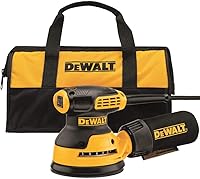
The DEWALT Orbital Sander Kit uses a 5-inch pad, a 3 amp motor and a 12,000 OPM speed. Its shorter height brings your hand closer to the workpiece, while a separate counterweight and rubber over-mold are designed to reduce vibration during use.
The BLACK+DECKER Orbital Sander also uses a 5-inch pad and delivers 12,000 OPM. Its hook-and-loop system allows quick paper changes, and the box includes 1 sanding sheet and a dust bag.
For more product-specific choices, compare our best random orbital sander for woodworking guide. You can also narrow the search by pad size with our best 5 inch random orbital sander guide.
When should you choose a belt sander?
Choose a belt sander when you need to remove a lot of material from a broad, mostly flat surface. For a corded brand-specific option, compare Makita corded belt sanders.
Its continuous abrasive belt moves in one direction, so it can flatten rough boards, remove old coatings and smooth large edges quickly.
Belt sanders require more control than random orbital sanders. Compare the two stock-removal tools in our belt sander vs drum sander guide.
Start with a coarse belt only when the surface needs strong removal, apply light pressure and keep the machine moving with the grain.
A belt sander is not the best first choice for final finishing. After the rough work, switch to a finer abrasive and a random orbital, palm or detail sander to reduce scratches.
A benchtop belt sander keeps the machine in place while you bring smaller workpieces to the belt. For portable use, compare Makita cordless belt sanders.
That setup can help with repeatable edge work, but it does not replace a handheld belt sander for floors, doors or large panels.
See our guide to the best belt sander for woodworking for broad wood surfaces, or compare options in the best bench belt sander guide for a fixed setup.
A belt sander can also work on metal when the abrasive and machine are suitable for the task. Our best belt sander for metal work guide covers that use case.
The belt itself is a consumable part. Check the belt size, grit and tracking requirements before ordering replacement belt sander parts.
For a wider look at abrasive choices, read how to choose sanding belts and discs.
What is a detail sander used for?
A detail sander is used for corners, small surfaces, edges and shaped parts that are difficult to sand with a round pad. Its pointed sanding pad can reach inside corners and narrow sections.
Detail sanders are useful for furniture repairs, window trim, small boxes, craft projects and paint removal around corners. They are slower than random orbital sanders on a large tabletop, so use them where their shape gives you an advantage.
The BLACK+DECKER Detail Sander has a compact design, a 1.2 amp motor and 16,000 OPM. Its 3-position grip, detail sanding pad and detail finger attachment support work in cramped spaces and awkward angles.
A detail sander can be a better fit than a palm sander when the workpiece has inside corners. For a focused comparison, see the best detail sander for woodworking guide.
A palm sander has a more square sanding footprint and suits light work on flat parts. It can be easier to control on trim and small boards, especially when you want a simple finish-sanding tool.
Compare models in our best palm sander for woodworking guide.
What is a file sander used for?
A file sander is used for narrow edges, grooves, contours and tight spaces where a standard sanding pad cannot fit. Its narrow abrasive belt acts like a powered sanding file.
The WEN 6307 Variable Speed Detailing File Sander has a 1/2-by-18-inch belt that pivots up to 55 degrees. Its variable speed dial runs the belt from 1080 to 1800 feet per minute, and its auto-tracking belt system requires no tensioning or adjustments.
This shape suits narrow rails, metal edges, plastic parts and unusual wood contours. The tool-free belt installation makes grit changes simpler during a job, while the included dust port attachment can connect the sander to a dust collection system.
A file sander removes material from a narrow path, so it is not efficient for a wide panel. Use it as a specialist tool when access matters more than coverage.
How do orbital, disc and oscillating sanders differ?
An orbital sander moves its pad in a repeated orbit. A random orbital sander adds free rotation, which helps reduce repeated scratch patterns.
A disc sander uses a circular disc with a more fixed sanding action and is often chosen for aggressive shaping.
An oscillating sander uses a small side-to-side movement and can accept different attachments depending on the tool. Its sanding action differs from the circular motion of a random orbital.
The best choice depends on the finish and shape you need. Use our orbital sander vs disc sander comparison when you are deciding between broad finishing and more aggressive disc sanding.
If you are considering an oscillating tool, read orbital sander vs oscillating sander before choosing. The two tools may look similar in a workshop, but their motions and accessory systems are different.
For a tool that can also polish, see how to choose an orbital sander and polisher. Check the machine's intended attachments before using a sanding tool for polishing work.
Which sander is best for furniture refinishing?
A random orbital sander is usually the best starting point for furniture refinishing, while a detail sander helps around corners, profiles and legs. Use a belt sander only where the furniture has broad surfaces and heavy finish that needs fast removal.
Furniture often combines flat panels, edges, corners, curves and thin trim. One tool may remove finish from a tabletop, but it may be too large for chair rails or delicate molding.
Start with the least aggressive tool that can remove the old coating. Use a suitable coarse abrasive for removal, then move through finer grits before applying paint, stain or clear finish.
Our guide to the best sander for refinishing furniture explains how to match the machine to tabletops, cabinets, chairs and detailed parts.
Protect nearby surfaces from dust and avoid rounding sharp edges. On narrow trim, a detail or palm sander gives you more control than a heavy belt sander.
Which sander is best for hardwood floors?
A floor sander is the right choice for large hardwood floors, because it covers more area and is designed for standing work. A random orbital sander is better for small repairs, edges and spot sanding.
Drum sanders remove material quickly from the main floor area, but they need careful handling because staying in one place can create a low spot. An edging sander reaches the floor near walls and other fixed boundaries.
A floor project may use more than one sander. The main machine handles the open area, an edge tool works around the perimeter and a smaller sander helps with stairs or repairs.
Read our guide to the best sander for hardwood floors before renting or buying equipment. Measure the room and plan dust collection before work begins.
Floor work can also involve molding and trim changes. If you are working around a miter saw, read Can You Use A Miter Saw On The Floor? and learn How To Cut Floor Molding With A Miter Saw? before cutting replacement pieces.
Which specialty sanders handle curves and large surfaces?
Specialty sanders solve shape or scale problems that general-purpose tools cannot handle efficiently.
An oscillating spindle sander is designed for inside curves, cutouts and curved edges. Its sanding sleeve moves around a spindle, helping keep the abrasive in contact with a curved profile.
See the best oscillating spindle sander guide for this setup.
A drum sander is suited to boards, panels and repeated thickness or surface work. It uses a wide sanding drum and requires careful feed control.
Compare options in the best drum sander for woodworking guide.
For drywall, a sander with suitable dust handling and a controlled pad can help smooth joint compound. Choose the abrasive and pressure carefully because drywall compound is softer than most wood.
See the best orbital sander for drywall guide for options and setup advice.
How do you choose the right sander?
Choose a sander by answering 5 questions: what material are you sanding, how large is the surface, how much material must come off, what shape is the workpiece and how will you control dust?
What material will you sand?
Wood, metal, plastic, drywall and painted surfaces need different abrasive choices and pressure. The tool may work across more than one material, but the grit and sanding method still need to match the surface.
Use a coarse grit for faster removal and a finer grit for smoothing. Do not assume a high speed is always better.
Softer materials can cut quickly, while a hard finish may need a slower, controlled pass.
How large is the surface?
Use a broad-pad or belt sander for large flat areas. A 5-inch random orbital works well for many home projects, while a detail or file sander saves time in narrow spaces.
A floor, drum or benchtop machine makes sense when the work is too large or repetitive for a handheld tool. For a small repair, the same machines may add setup without saving time.
How much material must come off?
For light smoothing and finish preparation, choose a random orbital, orbital or palm sander. For thick coatings, uneven boards or fast stock removal, consider a belt or disc sander with careful control.
Start with the least aggressive tool that can complete the job. Removing too much material is harder to correct than making another pass.
What shape is the workpiece?
Round pads work well on broad flat areas. Pointed detail pads suit corners, and narrow file belts reach grooves and thin edges.
Spindle sanders handle inside curves, while floor and drum sanders cover large open surfaces.
Match the abrasive surface to the shape before thinking about motor power. A powerful tool cannot make a round pad fit inside a narrow corner.
How will you manage dust?
Dust collection improves visibility and reduces cleanup, but it does not replace eye, hearing and breathing protection. Connect the tool to a compatible dust bag or vacuum when possible, and keep the work area clear.
The DEWALT model has a locking dust bag and a dust port designed to fit DWV010 or DWV012 dust collectors. Its data also identifies a DWV9000 Universal Quick Connector for other vacuum systems with 1-1/4 in hoses.
The BLACK+DECKER Orbital Sander includes a dust bag, while the BLACK+DECKER Detail Sander has a dust collection canister. The WEN file sander includes a dust port attachment.
For accessories that improve a random orbital setup, see our guide to best orbital sander accessories. If dust is your main concern, compare the best orbital sander with vacuum attachment guide.
How should you use a sander safely?
Use a sander safely by securing the workpiece, wearing eye protection and keeping the abrasive moving. Disconnect corded tools before changing belts, discs, pads or other accessories.
Inspect the abrasive before starting. A torn belt, clogged disc or worn sheet can make the tool cut unevenly and increase the chance of losing control.
Keep both hands available when the tool design calls for two-handed control. Do not force the machine into the surface, and avoid tilting a flat pad because the edge can dig into the workpiece.
Sand with adequate ventilation and use dust collection where possible. Some old coatings may contain hazardous materials, so identify the finish before sanding and follow appropriate local safety guidance.
Corded tools provide continuous runtime, but keep the cord away from the abrasive and the path of the workpiece. Unplug the tool before clearing dust or inspecting a jam.
How do you maintain a sander?
Maintain a sander by cleaning dust from vents, checking the pad or belt and storing abrasives in a dry place. A clean switch, clear dust path and correctly installed abrasive help the tool work as intended.
Small checks before each session prevent most problems. Look at the abrasive first and check that the pad, belt or disc is seated firmly and evenly.
Shake or brush dust from the vents and dust port after use. Built up dust can slow airflow, clog collection and make the surface harder to see while you work.
Replace sanding paper when it stops cutting efficiently. Pressing harder to compensate for a worn abrasive can increase heat and reduce control.
Clogged paper often looks shiny or loaded with dust. Cleaning it or changing it will usually give a cleaner cut than adding more pressure.
Check belt tracking on a belt or file sander before a long pass. The WEN 6307 uses auto-tracking, while other machines may need adjustments according to their instructions.
Even with auto-tracking, a quick look at belt position is worthwhile. A belt that rides to one side can wear its edge and sand unevenly.
Inspect hook and loop pads for damage and make sure discs sit flat. A poorly centered disc can vibrate and leave an uneven pattern.
Keep spare belts and discs organized by grit. Labeling coarse, medium and fine abrasives prevents accidental jumps between sanding stages.
Store abrasives flat and dry so they stay ready for use. Wipe the body and switch area with a dry cloth when dust builds up.
Explore sanders by topic
Explore sanders by topic when you want to narrow the choice. The guides below focus on power source, budget level and disc choice for random orbital work.
- Best Cordless Random Orbital Sanders
- Best High End Orbital Sanders
- Best Orbital Sanding Discs
Use the cordless guide when freedom from a cable matters most. It suits mobile work and smaller jobs where runtime is enough for the task.
Use the high end guide when you want stronger features for frequent use. It helps you weigh comfort, dust control and build quality against the extra cost.
Use the disc guide when your current sander works but the finish does not. The right disc shape and grit can change removal speed and scratch pattern.
Which sander should you choose?
Pick a 5-inch random orbital sander for the broadest mix of home woodworking and finish-preparation jobs. Choose a belt sander for fast removal, a detail sander for corners, a file sander for narrow contours, and a specialty floor, drum or spindle sander when the surface demands it.
The DEWALT Orbital Sander Kit fits buyers who want a 5-inch, 3 amp corded tool with 12,000 OPM and included dust and carrying bags. The BLACK+DECKER Orbital Sander fits buyers who want a compact 5-inch corded tool with 12,000 OPM, a comfort grip and a dust bag.
The BLACK+DECKER Detail Sander suits cramped corners and small shaped parts, with a detail finger attachment and 3-position grip. The WEN 6307 suits narrow edges and unusual contours with its pivoting 1/2-by-18-inch belt and variable speed control.
Start with the shape of your workpiece, then choose the sanding motion and abrasive size. That simple order will lead you to the right type of sander faster than choosing by motor power alone.
Frequently asked questions
What are the different types of sanders?
The different types of sanders include random orbital, belt, detail, palm, disc, spindle, drum and floor sanders. Random orbital sanders handle many flat-surface jobs, belt sanders remove material quickly, and detail or file sanders work better in corners, narrow spaces and irregular shapes.
Which type of sander is best for beginners?
A random orbital sander is usually the most useful starting point for beginners because it can remove old finish, smooth wood and prepare surfaces for paint without leaving the same straight scratch pattern as a fixed sanding motion. Choose a 5-inch model if your work is mostly small or medium projects.
What is the difference between an orbital and random orbital sander?
An orbital sander moves its pad in a small repeating orbit, while a random orbital sander combines orbiting motion with free rotation. That random motion helps reduce visible swirl marks when you use the right grit and keep the tool moving across the workpiece.
Can you use a belt sander on finished wood?
You can use a belt sander on finished wood, but its fast material removal makes it easy to cut too deeply or leave an uneven surface. Start with light pressure, keep the tool moving and use a random orbital or detail sander for the final smoothing stage.
What sander is best for corners?
A detail sander or file sander is best for many corners because its pointed pad or narrow belt reaches spaces that a round sanding disc cannot. A detail sander suits small flat corners, while a file sander can follow narrow edges and unusual contours.