7 Best Miter Saw Blades for a Festool Kapex (November 2026)
The best Festool Kapex saw blades include the Trend CSB/CC21660 Craft Pro Negative Hook Crosscutting for fine trim cuts, the Oshlun SBFT-260080 260mm 80 Tooth FesPro Crosscut for fine crosscuts, and the Oshlun SBFT-260060 260mm 60 Tooth FesPro General for mixed wood cuts.
On this page (6 sections)
The Trend CSB/CC21660 is the best Festool Kapex blade for fine trim, with 60 teeth and a negative 5-degree rake. Choose an 80-tooth crosscut blade for smooth cuts in melamine or veneered sheet goods, or a 60-tooth general-purpose blade for mixed wood work.
Our picks at a glance
-
1
 Best for fine trim cuts
Trend CSB/CC21660 Craft Pro Negative Hook Crosscutting
9.7/10 our score
See it on Amazon -
2
 Best for fine crosscuts
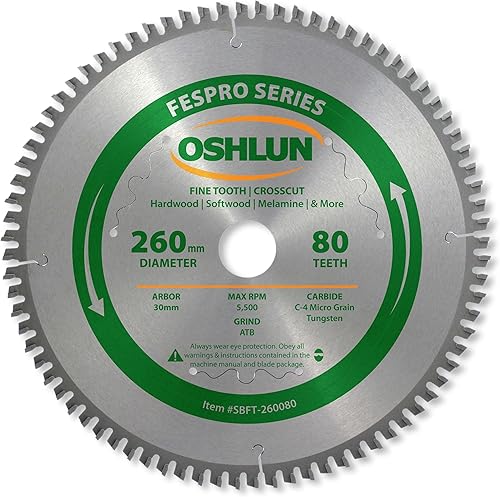
Oshlun SBFT-260080 260mm 80 Tooth FesPro Crosscut
9.5/10 our score
See it on Amazon -
3
 Best for mixed wood cuts
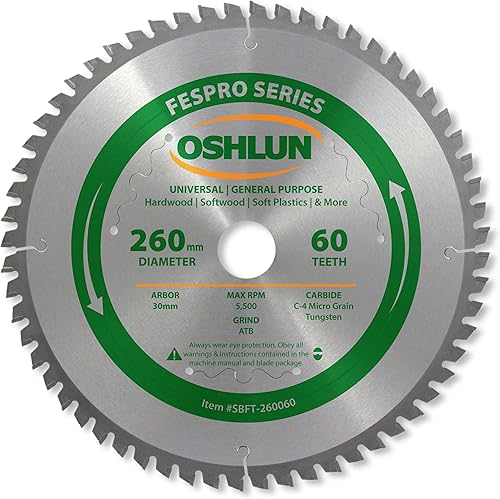
Oshlun SBFT-260060 260mm 60 Tooth FesPro General
9.3/10 our score
See it on Amazon
- 4
 Check it
Festool 495388 Universal General Purpose Blade
Best for wood and soft plastics - 5
 Check it
Festool 494607 Aluminium Saw Blade HW 260x2
Best for aluminum work - 6
 Check it
Oshlun SBFT-260068A 260mm 68 Tooth FesPro Non
Best for non-ferrous metals - 7
 Check it
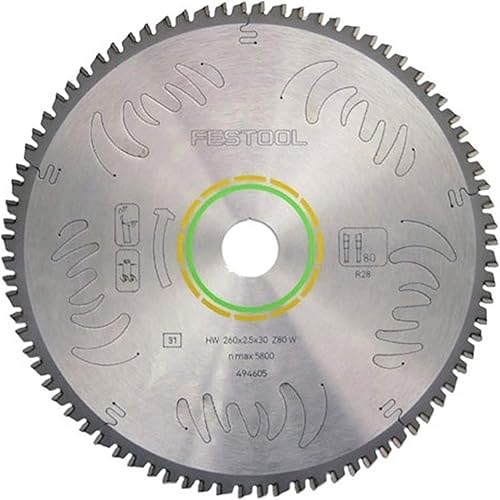
Festool 495387 Fine Tooth Cross-Cut Saw Blade
Best for veneered sheet goods
Which Festool Kapex blades suit different cuts?
The right Festool Kapex blade depends on the material and finish you need: choose a trim or fine crosscut pattern for clean edges, a general-purpose pattern for varied wood cuts, and a dedicated non-ferrous blade for aluminum or brass.
Before comparing tooth counts, confirm the saw model and blade dimensions. This group includes 216 mm and 260 mm blades, and a stated Kapex KS 120 fit should not be assumed to cover every Kapex saw.
For a wider look at blade makers and what their product ranges offer, see What Is the Best Miter Saw Blade Brand?. The Best Miter Saw Blade guide can help if you're comparing options beyond Kapex-compatible models.
| Product | Best for | Diameter | Teeth | Kerf | Our score |
|---|---|---|---|---|---|
| Trend CSB/CC21660 Craft Pro Negative Hook Crosscutting | fine trim cuts | 216 mm | 60 | 2.6 mm | 9.7 |
| Oshlun SBFT-260080 260mm 80 Tooth FesPro Crosscut | fine crosscuts | 80 | 2.5 mm | 9.5 | |
| Oshlun SBFT-260060 260mm 60 Tooth FesPro General | mixed wood cuts | 60 | 2.5 mm | 9.3 | |
| Festool 495388 Universal General Purpose Blade | wood and soft plastics | 60 | 2.5 mm | 9.0 | |
| Festool 494607 Aluminium Saw Blade HW 260x2 | aluminum work | 48 | 8.8 | ||
| Oshlun SBFT-260068A 260mm 68 Tooth FesPro Non | non-ferrous metals | 68 | 2.5 mm | 8.5 | |
| Festool 495387 Fine Tooth Cross-Cut Saw Blade | veneered sheet goods | 80 | 2.5 mm | 8.3 |
How we chose these Kapex blades
We compared the stated fit, diameter, arbor, kerf, tooth count, tooth geometry and intended materials. We scored each blade for how well those details match the needs of Kapex owners, with more weight on fit and a clear use case.
Our score weighs specs, features and buyer feedback against what you're shopping for.
The best Festool Kapex blades by use
These picks cover fine trim, crosscuts, general-purpose work and non-ferrous materials. Start with the blade closest to your most common job, then verify fit for your exact saw.
Trend CSB/CC21660 Craft Pro Negative Hook Crosscutting: Best for fine trim cuts
- 216 mm diameter
- 60 teeth
- Negative 5-degree rake
- 2.6 mm kerf
- 30 mm bore
A 60-tooth negative-rake blade intended for fine trim and mitre work. Trend lists the Festool Kapex among its compatible saws.
Pros
- Designed for trim and mitre cuts
- Negative 5-degree rake
- Compatibility includes Festool Kapex
Cons
- 30 mm bore and 216 mm diameter must match your saw
Trend's CSB/CC21660 is the top pick for trim and mitre work where a crisp edge matters. Its 60 teeth and negative 5-degree rake pair a finer cut pattern with the rake angle Trend specifies for use on pull-over mitre saws.
The blade measures 216 mm across, has a 30 mm bore and uses a 2.6 mm kerf. Trend names Festool Kapex among the compatible saws, alongside selected DeWalt, Makita and Bosch models.
Trend describes it for skirtings, architraves and other finish cuts in MDF, hardwood or softwood mouldings and wrapped vinyl cornice. Those uses make it a focused choice for trim rather than a one-blade answer for every material.
Choose it for fine trim and mitre work when its 216 mm diameter and 30 mm bore match your saw. The negative rake and material guidance are specific to this blade, so check the saw manual before fitting it.
Oshlun SBFT-260080 260mm 80 Tooth FesPro Crosscut: Best for fine crosscuts
- 80 teeth
- Fine-tooth crosscut pattern
- 2.5 mm kerf
- 30 mm arbor
- -5-degree hook angle
This 80-tooth FesPro blade is made for crosscuts in hardwood, softwood and melamine. Oshlun specifies a 2.5 mm kerf and a 30 mm arbor.
Pros
- Fine-tooth crosscut design
- Specifies Kapex KS 120 fit
- C-4 carbide
Cons
- Confirm the 260 mm diameter and arbor against your saw
Oshlun's SBFT-260080 is the strongest fit here for fine crosscuts when your saw is a Kapex KS 120. Its 80-tooth pattern is intended for hardwood, softwood, melamine and other crosscut work.
The FesPro blade has a 2.5 mm kerf, a 30 mm arbor and a -5-degree hook angle. Oshlun describes its FesPro blades as having micro-grain tungsten carbide tips, laser-cut expansion slots and a thin kerf.
The higher tooth count makes this a more specialized choice than the 60-tooth general-purpose FesPro. It makes sense when smooth crosscuts in wood or melamine matter more than covering a broad mix of jobs with one blade.
Choose it for fine crosscuts on a compatible KS 120. Confirm the 260 mm diameter and 30 mm arbor with your saw's requirements before buying.
Oshlun SBFT-260060 260mm 60 Tooth FesPro General: Best for mixed wood cuts
- 60 teeth
- General-purpose ATB pattern
- 2.5 mm kerf
- 30 mm arbor
- -5-degree hook angle
A general-purpose choice for hardwood, softwood and plastics. Its 60 teeth suit mixed cutting jobs when you don't need a dedicated fine crosscut blade.
Pros
- General-purpose material range
- Specifies Kapex KS 120 fit
- C-4 carbide
Cons
- Less specialized for fine crosscuts than an 80-tooth option
The Oshlun SBFT-260060 suits Kapex KS 120 owners who want a blade for a wider mix of wood cuts. Its 60-tooth general-purpose ATB design is intended for hardwood, softwood and plastics.
Oshlun specifies a 2.5 mm kerf, 30 mm arbor and -5-degree hook angle. The 60-tooth count gives it a broader role than the 80-tooth crosscut pick above, though the 80-tooth design has a more focused fine-crosscut use.
The FesPro line uses micro-grain tungsten carbide tips, laser-cut expansion slots and a thin kerf. Those features describe the design, while your cut quality will still depend on the material, setup and blade condition.
Choose this blade for varied work in wood and plastics when the 260 mm diameter fits your KS 120. For repeated fine crosscuts in melamine, compare it with Oshlun's 80-tooth option.
Festool 495388 Universal General Purpose Blade: Best for wood and soft plastics
- 60 teeth
- 2.5 mm kerf
- 30 mm arbor
- -5-degree hook angle
- ATB tooth design
Festool's universal blade is intended for clean cuts in wood and soft plastics. The 60-tooth ATB design also suits fine rip cuts for glue-ready joints.
Pros
- Made for the Kapex miter saw
- ATB tooth design
- Thin 2.5 mm kerf
Cons
- Not the dedicated 80-tooth crosscut option
Festool's 495388 Universal blade is a direct general-purpose option for the Kapex miter saw. Its 60-tooth ATB design is intended for clean cuts in wood and soft plastics, and Festool also describes it for fine rip cuts that leave glue-ready joints.
The blade has a 2.5 mm kerf, 30 mm arbor and -5-degree hook angle. Festool says the oversized arbor enables more secure fastening and can reduce vibration; the thin kerf meets less resistance and produces less material waste.
This pick overlaps with Oshlun's 60-tooth general-purpose blade, but the product details differ. Choose based on the exact saw compatibility, material guidance and brand preference that suit your setup.
Choose it for general wood work and soft plastics when you want a Festool blade with dimensions specified for the Kapex. The 80-tooth blade is a better match for dedicated smooth crosscuts in sheet goods.
Festool 494607 Aluminium Saw Blade HW 260x2: Best for aluminum work
- 48 teeth
- 2.4 mm thickness
- 30 mm bore
- Listed material includes aluminum
A Festool blade identified for aluminum and specified with a 30 mm bore. Check the exact diameter and saw compatibility before fitting it to a Kapex.
Pros
- Intended for aluminum
- 30 mm bore
- 48 teeth
Cons
- Exact Kapex compatibility should be confirmed
Festool's 494607 is the aluminum-focused choice in this group, with a 30 mm bore and 48 teeth. Its name identifies it as an aluminum saw blade, and its material details include aluminum and particle board.
The available compatibility details refer to Festool power tools and other brands with a compatible blade mount. They don't confirm a particular Kapex model, so check the exact diameter, mounting requirements and saw instructions before choosing it.
Its 2.4 mm thickness is another detail to compare with your saw's permitted blade range. Don't rely on the 30 mm bore alone to confirm fit.
Choose this blade for aluminum only after confirming compatibility with your exact Kapex. For a more explicit Kapex KS 120 fit and non-ferrous material range, compare the Oshlun blade below.
Oshlun SBFT-260068A 260mm 68 Tooth FesPro Non: Best for non-ferrous metals
- 68 teeth
- Non-ferrous TCG pattern
- 2.5 mm kerf
- 30 mm arbor
- -5-degree hook angle
This FesPro blade is designed for non-ferrous metals and plastics, with a 68-tooth TCG pattern. Oshlun specifies compatibility with the Kapex KS 120.
Pros
- Designed for aluminum, brass, copper and plastics
- Specifies Kapex KS 120 fit
- C-1 carbide
Cons
- Use it for its non-ferrous material range, not general wood work
Oshlun's SBFT-260068A is made for non-ferrous materials, including aluminum, brass, copper and plastics. It has 68 teeth in a TCG pattern, which sets it apart from the ATB blades intended for wood crosscuts.
The FesPro blade has a 2.5 mm kerf, 30 mm arbor and -5-degree hook angle. Oshlun specifies compatibility with the Kapex KS 120 and describes its C-1 carbide tips for cutting plastics and non-ferrous metals.
This is a focused material pick, not a substitute for a general wood blade. If your work switches between wood and metal, using a blade suited to each material keeps your choice tied to the cut at hand.
Choose it for non-ferrous metal or plastic work when the KS 120 fit and dimensions match your saw. Follow the saw and blade makers' instructions for cutting those materials.
Festool 495387 Fine Tooth Cross-Cut Saw Blade: Best for veneered sheet goods
- 80 teeth
- 2.5 mm kerf
- 30 mm arbor
- -5-degree hook angle
- ATB tooth design
Festool's 80-tooth fine crosscut blade is intended for smooth cuts in veneered plywood, sheet goods, melamine and hardwood or softwood.
Pros
- Fine crosscut design
- Made for the Kapex miter saw
- Thin 2.5 mm kerf
Cons
- More specialized than the 60-tooth universal blade
Festool's 495387 is the dedicated fine crosscut option for Kapex owners who work with veneered plywood, sheet goods or melamine. Its 80-tooth ATB pattern is also intended for smooth crosscuts in hardwood and softwood.
It has a 2.5 mm kerf, 30 mm arbor and -5-degree hook angle. Festool says the thin kerf meets less resistance, while the oversized arbor enables more secure fastening and can reduce vibration.
This blade and the Oshlun 80-tooth crosscut blade share a similar stated use and core dimensions. Compare fit details, the exact saw model and whether you prefer a Festool or FesPro blade.
Choose it for fine crosscuts in wood and sheet goods when you want a Festool blade specified for the Kapex miter saw. For broader mixed work, consider a 60-tooth general-purpose option.
What should you check before fitting a Kapex blade?
Confirm blade diameter, bore, kerf and saw compatibility before fitting any replacement blade. A blade can have a suitable tooth pattern yet still be wrong for your particular Kapex model.
The picks here include 216 mm and 260 mm diameters. The Oshlun FesPro options specify a 260 mm blade with a 30 mm arbor for the KS 120, while Trend lists its 216 mm blade as compatible with the Festool Kapex.
To compare brand-specific options for other saws, see best Makita miter saw blades, best Milwaukee miter saw blades and best Bosch miter saw blades. These comparisons can also help if you use more than one saw brand.
How do tooth count and geometry affect the choice?
Tooth count and tooth geometry help indicate the blade's intended cut, but neither replaces the material and fit checks. In this roundup, 80-tooth blades are designated for fine crosscuts, while the 60-tooth options cover trim or broader wood work.
Which Festool Kapex blade tooth count works for your cuts?
For smoother crosscuts in sheet goods, melamine or veneered plywood, compare the 80-tooth Festool and Oshlun blades. For mixed wood cuts, the 60-tooth general-purpose options are a more flexible starting point.
The Trend 60-tooth blade has a negative 5-degree rake and is aimed at trim. The Oshlun non-ferrous blade uses 68 teeth in a TCG pattern for aluminum, brass, copper and plastics.
Which miter saw blade should you use?
Use the blade designed for your material and cut: a fine crosscut blade for sheet goods, a general-purpose blade for varied wood, or a non-ferrous blade for metals such as aluminum. Our guide to which miter saw blade to use explains how to match blade type to the task.
Which Festool Kapex blade is the best fit for your work?
Choose the Trend CSB/CC21660 for fine trim when its 216 mm diameter and 30 mm bore match your saw. Pick an 80-tooth Festool or Oshlun blade for fine crosscuts, a 60-tooth general-purpose option for varied wood cuts, or Oshlun's non-ferrous blade for a compatible KS 120 cutting aluminum, brass or copper.
Our top 3 picks at a glance
-
1
Best for fine trim cuts
Trend CSB/CC21660 Craft Pro Negative Hook Crosscutting
9.7/10 our score
See it on Amazon -
2
Best for fine crosscuts
Oshlun SBFT-260080 260mm 80 Tooth FesPro Crosscut
9.5/10 our score
See it on Amazon -
3
Best for mixed wood cuts
Oshlun SBFT-260060 260mm 60 Tooth FesPro General
9.3/10 our score
See it on Amazon
Frequently asked questions
What size blade does a Festool Kapex use?
Check the saw manual and blade label for the exact diameter, arbor, kerf and permitted blade type. The picks here include 216 mm and 260 mm blades, so don't assume they fit the same Kapex model.
A blade's stated compatibility with a Kapex KS 120 doesn't confirm fit on every Kapex.
Is a 60-tooth or 80-tooth blade better for a Kapex?
An 80-tooth blade is aimed at fine crosscuts in materials such as melamine, veneered plywood and sheet goods. A 60-tooth blade offers a more general-purpose choice for wood and, in some cases, soft plastics.
Match the tooth pattern to the material and cut you make most often.
Can I cut aluminum with a Kapex blade?
Choose a blade specifically intended for non-ferrous metal, such as aluminum, and confirm that its diameter, bore and other fit details match your Kapex. The Oshlun FesPro non-ferrous blade is specified for aluminum, brass, copper and plastics.
Follow the saw and blade makers' instructions for the material.
Does a higher tooth count always make a better cut?
No. Tooth count is only one part of the match.
An 80-tooth crosscut blade is intended for smooth crosscuts in sheet goods and wood, while a 60-tooth general-purpose blade covers a broader range of work.
Check the blade's intended material, tooth geometry and fit before choosing by tooth count alone.


