Make a Delta Miter Saw Cut the Biggest Board
To make a Delta miter saw cut the biggest board it can handle, identify the exact model, check its manual for maximum width and thickness, then confirm the board clears the fence and blade path. A sliding model may cut wider stock than a non-sliding model.
On this page (8 sections)
- How do you find a Delta miter saw's board capacity?
- Does sliding travel determine how wide a board you can cut?
- How do you measure the board before cutting?
- What changes when you cut a wide board?
- Does blade size tell you how big a board the saw can cut?
- How do you check thick lumber safely?
- What if the board is wider than the Delta's capacity?
- What is the final capacity check?
To make a Delta miter saw cut the biggest board it can handle, match the exact saw model to its capacity chart and measure the board before cutting. The usable limit depends on blade size, sliding travel, fence clearance, cutting angle, and board thickness.
Start with the model number, not the blade diameter. Two Delta saws with similar blade sizes can have different crosscut capacities, especially when one slides and the other does not.
How do you find a Delta miter saw's board capacity?
Find the exact Delta model and read its capacity chart for the planned cut. Check separate limits for straight crosscuts, miter cuts, bevel cuts, and compound cuts because the available space changes as the head pivots.
Look for the model label on the saw body, base, or motor housing. Use the manual that matches that model, then identify the maximum width and thickness for the board position you plan to use.
A capacity chart may show several values instead of one maximum. A straight 90-degree cut can allow more width than a 45-degree miter cut, while a bevel cut can reduce clearance near the fence.
Don't treat the blade diameter as the board limit. A 12 in blade describes the blade size, not the full width that every saw using that blade can crosscut.
Does sliding travel determine how wide a board you can cut?
Sliding travel is one of the main limits on a wide-board cut. A sliding saw lets the blade move through more of the material, while a fixed-head saw depends more on its blade diameter and fence layout.
Pull the unplugged saw head forward and lower it through the intended path. Keep the blade above the board while checking clearance, and don't let the teeth touch the stock during this planning step.
The fence also matters. A board may fit the published width but still sit poorly if its shape, thickness, or position leaves a gap against the fence.
For larger framing stock, compare the saw's stated capacity with the board dimensions before setting up. Our guide to the Best Miter Saw For Framing Lumber can help you compare the type of saw needed for that work.
How do you measure the board before cutting?
Measure both width and thickness at the actual cut location. Lumber can vary along its length, and a warped or cupped board may not sit against the fence the same way as a flat board.
Place the board on the saw base with its intended face against the fence. Confirm that the board is fully supported on both sides of the blade and that clamps or supports won't interfere with the saw head.
Check these points before powering the saw:
- Measure the board's face width.
- Measure its thickness.
- Confirm the planned angle in the capacity chart.
- Check that the board reaches the fence without rocking.
- Lower the unplugged head through the cut path.
- Confirm that the blade can clear the material without forcing the saw.
A board that technically fits may still be unsafe if it extends unsupported far beyond the saw. Use stable supports at the same height as the saw table.
What changes when you cut a wide board?
A wide board needs controlled support and a clear blade path. The wider the material, the more important it becomes to prevent movement as the blade enters and leaves the cut.
Keep your hands outside the saw's marked no-touch areas. Clamp the work when the manual permits it, and support the offcut so it doesn't fall, twist, or pinch the blade.
If your saw cannot crosscut the full width in one pass, don't push the head sideways or force the blade through. A partial cut can leave an uneven kerf and create a binding risk.
The guide to How To Cut Wide Boards With A Miter Saw? covers support, marking, and alternate methods for stock that exceeds the saw's normal path.
Can crown stops help with board positioning?
Crown stops help when the work is crown molding that must rest vertically against the fence. They don't increase the saw's maximum board width or thickness.
The DEWALT Miter Saw Crown Stops (DW7084) are steel stops designed to position crown molding vertically against the saw fence. The set includes 2 crown stops.
Use stops only when they fit your saw and the molding setup. They help repeat positioning, but you still need to check the saw's capacity and keep the molding supported.
Does blade size tell you how big a board the saw can cut?
Blade size gives you a starting point, but it does not prove the saw's usable capacity. The guard, arbor position, fence, bevel range, and sliding rails all affect the cut.
A 12 in blade can suit a saw designed for wider stock, but the saw must still provide enough travel and clearance. A smaller blade may be appropriate for thinner material or a compact saw.
The What Will A 10 Inch Miter Saw Cut? guide explains why blade diameter and actual board capacity are related but not identical.
Would a different blade increase board capacity?
A replacement blade does not turn a saw into a larger-capacity model. It can change the cut quality and material suitability, but the saw's physical travel and clearance remain the same.
The DEWALT 12-Inch Miter Saw Blade is a 2-pack with an 80-tooth blade and a 32-tooth blade. Both are tungsten carbide crosscutting blades intended for miter saws and sliding miter saws.
Choose the tooth count based on the cut and material described for the blade. Install only a blade that matches the saw's required diameter, arbor, rotation, and guard clearance.
How do you check thick lumber safely?
Compare the board thickness with the model's published thickness capacity before cutting. Width is only one limit, and a thick board can contact the guard, fence, or blade housing even when its face width fits.
With the saw unplugged, place the board against the fence and lower the head slowly. Check the full travel from the raised position to the bottom of the cut.
Don't remove guards or alter the saw to gain clearance. If the head stops before the blade passes through, stop and use a method designed for that material.
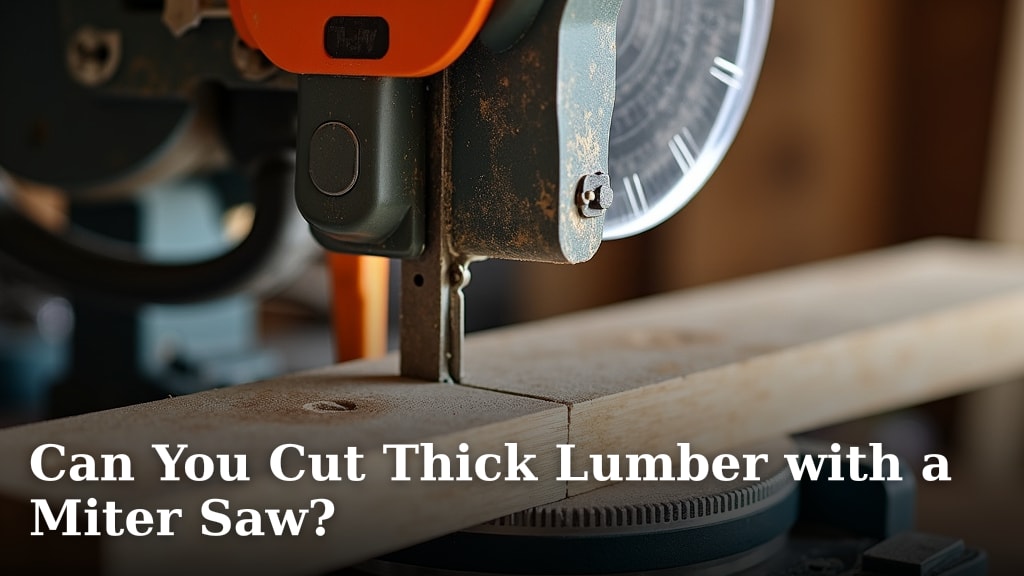
Read Can You Cut Thick Lumber with a Miter Saw? before attempting a thick-stock cut. It explains when the saw's capacity, blade path, and support become limiting factors.
Is a 7-1/4 in blade suitable for a Delta miter saw?
Use a 7-1/4 in blade only when the saw is designed and approved for that blade size. Blade diameter, arbor fit, guard operation, and maximum speed must all match the saw.
The Freud Diablo Finish Saw Blade is a 7-1/4 in, 40-tooth ATB blade with a 5/8 in arbor and an 8,000 maximum RPM rating. It has a carbide body, a thin 0.09 in thickness, and a coating described for reducing gumming and corrosion.
This blade is designed for a 7-1/4 in circular saw, so verify compatibility before considering it for any Delta miter saw. A blade that fits the arbor is not automatically safe for every saw.
What if the board is wider than the Delta's capacity?
Stop at the published limit and choose another approved cutting method. Do not slide the board during the cut, push the saw head sideways, or make an unsupported partial cut just to reach the far edge.
For a wide board, a circular saw with a guide can offer a different setup. A table saw, track saw, or another miter saw may also suit the work, depending on the stock and the equipment instructions.
For curved cuts, see cutting curves with a miter saw.
If you need to make several cuts, mark the line across the full board and support both sides. Verify the blade path before each cut because a changed angle or board position changes the clearance.
For deck stock, see How to Cut Deck Boards with a Miter Saw? for setup ideas that keep long material supported.
What is the final capacity check?
Identify the model, read the angle-specific chart, measure the board, and dry-check the blade path with the saw unplugged. That sequence tells you whether the board fits without relying on blade diameter alone.
Pick the Delta's normal setup when the board stays within its width and thickness limits with full support. Use another method when the material exceeds the chart, cannot sit firmly against the fence, or would require forcing the saw.
If the board fits but the project needs repeated or angled cuts, What Can You Make with a Miter Saw? can help match the saw's capacity to practical projects.
Frequently asked questions
How do I find my Delta miter saw's maximum board capacity?
Find the saw's exact model number on its label or manual, then check the capacity chart for the intended cutting angle, board position, width, and thickness. Do not use the blade diameter alone to estimate capacity, because sliding travel, fence shape, and bevel settings also affect the cut.
Can a Delta miter saw cut a board wider than its blade diameter?
A sliding Delta miter saw may cut a board wider than the blade diameter because the motor and blade travel across the stock. A non-sliding saw usually has a smaller crosscut limit.
Confirm the exact width in the manual instead of assuming that a 10 in or 12 in blade cuts that width.
How do I check if thick lumber will fit a Delta miter saw?
Measure the board's thickness and compare it with the saw's maximum thickness for the planned cut. Place the board against the fence with the correct face down, lower the unplugged blade through its path, and check for clearance without forcing the head.
What should I do if a board is too wide for my Delta miter saw?
Use a different approved cutting method, such as a circular saw with a guide or multiple controlled passes when the material and safety instructions allow it. Support the board fully, mark the cut clearly, and do not stretch the saw beyond its published capacity.