Plunge Router vs Fixed Base Router: Which Should You Choose? (November 2026)
Pick a fixed base for edge work and a plunge base for interior cuts where you start in the middle of the board. In this plunge router vs fixed base comparison, a combo kit often gives you both choices in one motor pack.
On this page (15 sections)
- Plunge router vs fixed base: the quick verdict
- The two side by side
- What a fixed base router does best
- What a plunge router does best
- Edge work: fixed base vs plunge base router
- Power and speed: what the numbers mean
- Depth control and repeat cuts
- Dust collection and visibility
- Kits, collets and base swaps
- Weight, handling and long cuts
- Shop setup: moving tools and adding a plate
- Who should buy which
- Setup, care and safe habits
- More guides on this topic
- Verdict: plunge router vs fixed base router
Pick a fixed base for edge work and a plunge base for interior cuts. In this plunge router vs fixed base comparison, the base you use most should decide your buy, and a combo kit makes that choice less final.
A fixed base holds the bit at one set depth. You set the depth, lock it, then move the router along an edge or a straightedge.
A plunge base lets the bit move up and down on columns. You can start with the bit raised, position the router, then plunge down to the cut.
Our score weighs specs, features and buyer feedback against what you are shopping for. We compared motor power, speed range, included bases and collets for each pick below.

Plunge router vs fixed base: the quick verdict
Choose a combo kit if you do both edge work and interior cuts. Compare router and table combos if you want both setups in one purchase.
Fixed base routers feel simpler for trim work. You set depth once and guide the tool along the work.
Plunge routers feel more controlled for cuts that start inside a board. You raise the bit, line up the template, then lower it in a controlled way.
If forced to pick one, think about your last five projects. Edge rounding and trim favor fixed, while dadoes, inlays and lettering favor plunge.
Our wood routers for woodworking guide puts both styles in a wider buying context. Use it to check motor size and collet options before you narrow the field.
The two side by side
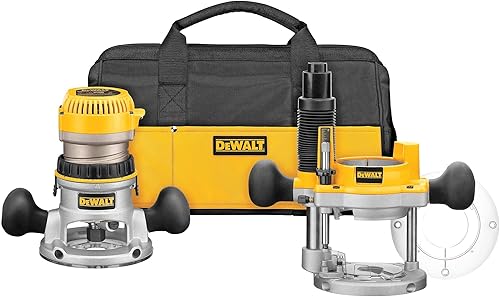
The DEWALT Router and the SKIL 14 Amp Plunge and Fixed Base both ship as fixed and plunge combos. That makes them direct answers to the base style question, since neither forces you to commit on day one.
The DEWALT Router is a 12-amp, 2-1/4 HP kit with variable speed from 8,000 to 24,000 RPM. It includes a fixed base, a plunge base, 1/4 in and 1/2 in collets, a wrench, a large hole sub base, a vacuum adapter and a soft carry bag.
The SKIL 14 Amp Plunge and Fixed Base is a 14-amp, 2.5 HP combo with a maximum speed of 25,000 RPM. SKIL says the LCD speed control lets you select bit type and material for suggested speed settings, and electronic feedback helps hold RPM under load.
| Feature | DEWALT Router | SKIL 14 Amp Plunge and Fixed Base |
|---|---|---|
| Amperage | 12 A | 14 A |
| Horsepower | 2.25 hp | 2.42 hp |
| Base type | Fixed, Plunge | Fixed, Plunge |
| Maximum speed | 24,000 RPM | 25,000 RPM |
| Collets | 1/4 in and 1/2 in | 1/4 in and 1/2 in |
The amp gap is real but small in daily use. Both motors have enough power for hardwood routing, and both offer variable speed and soft start.
The SKIL adds an LCD display and a live tool indicator that lights up when power is connected. The DEWALT adds a detachable cordset, a spindle lock button and a clear LEXAN sub-base.
What a fixed base router does best
A fixed base router is best for edge work, trim cuts and repeat depth cuts. For a size comparison, see fixed base vs trim routers.
You set the depth, lock the motor, and slide the base along the work. That suits rounding a table edge, chamfering a case piece and flush trimming laminate, plus a router table where you set bit height once and feed stock against the fence.
You cannot start in the middle of a board, so you must enter from an edge or use a template with an opening. Our what is a fixed router page explains the mechanism, and our guides on how to use a fixed base router and best fixed base router cover more picks.
What a plunge router does best
A plunge router is best for interior cuts that start inside the board. Place the router with the bit raised, then lower it straight down.
That motion suits dadoes, grooves, mortises, inlays and template work in passes, plunging shallow first, then deeper. The DEWALT plunge base uses precision-machined brass bushings and case-hardened steel guide rods for a smooth stroke, while SKIL lists 2-1/8 in plunge depth versus 1-3/4 in for its fixed base.
Control matters more than depth numbers, and soft start on both kits helps the bit reach speed after placement. For cordless options, see our plunge router cordless guide, and our best plunge router for woodworking roundup compares plunge depth and dust collection.
Edge work: fixed base vs plunge base router
For edge work, a fixed base usually wins on simplicity. You set the depth once, lock it, and guide the router along the edge.
A roundover bit gives a smooth, repeatable edge. A chamfer bit gives a clean 45 degree detail, and a flush trim bit matches a template edge.
A plunge base can do edge work too. You plunge to depth, then move along the edge, and that extra motion adds a step a fixed base avoids.
For sign lettering and inlays, the order flips. A plunge base starts the bit inside the board, which a fixed base cannot do without an entry point.
Combo kits include both bases, plus 1/4 in and 1/2 in collets on the DEWALT and dust extraction adapters on the SKIL.
Power and speed: what the numbers mean
More amps help in hardwood, but speed control matters as much as peak power. Both kits here cover the power range most hardwood work needs.
The DEWALT motor is 12 amps and 2-1/4 HP maximum, with variable speed from 8,000 to 24,000 RPM. Full feedback control helps hold speed under load, according to DEWALT.
The SKIL motor is 14 amps and 2.5 HP, with a maximum speed of 25,000 RPM. SKIL says electronic feedback maintains RPM while routing, and the LCD suggests speed settings by bit type and material.
Lower speeds suit large bits and hardwood, while higher speeds suit smaller bits and lighter stock. Soft start on both reduces the jump at startup, which helps keep the router steady at the start of a cut.
Depth control and repeat cuts
Fixed bases lock depth in place; plunge bases let you change depth during a cut. Both can give repeatable results if set carefully.
The DEWALT fixed base uses a micro-fine depth ring in 1/64 in increments. Its tool-free steel motor cam lock makes depth changes and base swaps quicker.
The SKIL offers three coarse depth settings and micro-depth adjustment. That mix helps you get close fast, then fine-tune.
On a plunge base, set a stop for each pass. Plunge to that stop, cut, raise the bit, then plunge deeper for the next pass.
Two shallow passes often leave a cleaner edge than one deep pass. Marking your stop positions also saves time on repeat work.
Dust collection and visibility
Good dust collection helps you see the bit and keep the cut clean. Both kits here include adapters, but their designs differ.
The DEWALT plunge base has integral through-the-column dust collection. DEWALT says it collects 95% of the dust and provides superior bit visibility.
The SKIL includes fixed base and plunge base dust extraction adapters, plus a clear sub-base in the full kit. The DEWALT includes a clear LEXAN sub-base that accepts standard template guide bushings.
Visibility matters most on template work. When you can see the bit and the line, you can correct your path before the cut drifts.
Connect a shop vacuum and test the setup before you start. Clean the base and columns after each session, since fine dust can make a plunge stroke feel gritty.
Kits, collets and base swaps
A combo kit saves money if you need both bases. Buying a motor, both bases and collets separately often costs more.
The DEWALT kit includes the DW618M motor pack, DW6184 fixed base, DW6182 plunge base, 1/4 in and 1/2 in collets, wrench, large hole sub base, vacuum adapter and soft carry bag. The SKIL kit includes the router, parallel guide, collet wrench, fixed and plunge dust extraction adapters, 1/4 in and 1/2 in collets, edge guide and depth adjustment wrench.
Both collet sizes cover small trim bits and larger panel bits, and base swaps take a few minutes. Our best plunge & fixed base router kit roundup compares more kits, and our best dewalt router combo kit guide covers DEWALT options.
Weight, handling and long cuts
Heavier motors can tire your arms on long cuts, so weight matters. Both kits here are corded, full-size routers, not trim routers.
The DEWALT package weighs 10.1 lb. The SKIL package weighs 14.3 lb, and both figures include the kit contents, so the tool in your hands will feel lighter than the shipping weight.
SKIL says its ergonomic handles limit vibration and reduce fatigue over long use, and it describes a die-cast motor housing. DEWALT describes precision-machined brass bushings and case-hardened steel guide rods for a smooth plunge stroke.
For long edge cuts, plan your stance and your cord path. A cord can pull the router off line if it catches on a bench corner, and breaks help prevent fatigue showing up as a wavy line.
Shop setup: moving tools and adding a plate
A mobile base helps when you need to move heavy shop tools, not when you route. It is a support product in this comparison, not a substitute for either router base.
The WEN Mobile Base fits square base configurations from 11.8 x 11.8 in to 35.4 x 35.4 in. It also fits rectangular bases up to 51.2 x 19.7 in.
It has two fixed casters, two swivel casters and two foot-locking brakes. That mix lets you roll a tool into place, then lock it during use.
Our Best Miter Saw Mobile Base guide covers mobile bases for a different tool. Read it if you plan to move a miter saw station as well as a router table.
A base plate is a different kind of upgrade. It changes the bottom of a compact router, not the base style of a full-size router.
The POWERTEC plate is 5-3/4 in in diameter and 1/4 in thick, made of hardened acrylic. It includes installation screws and predrilled holes for listed models.
Fit is limited to the models named for the plate, including DEWALT DWP611PK, Makita RT0701CX7, Bosch GKF125CEN and PR10E/PR20EVS, Ryobi P601, Porter Cable PCE6435, Milwaukee M18, and Ridgid R2911 and R2401/R24012.
That list does not include the DEWALT DW618PKB or the SKIL RT1322-00 in this comparison. Check your exact router model before you order a plate.
Who should buy which
Buy a fixed base if edges are your main work; buy a plunge base if interior cuts are your main work; buy a combo if you do both. That rule covers most buyers.
Choose the DEWALT Router if you want both bases with a detachable cordset and clear LEXAN sub-base. Its 12-amp motor and 8,000 to 24,000 RPM range cover most hardwood work.
Choose the SKIL 14 Amp Plunge and Fixed Base if you want more power and an LCD speed display. Its 14-amp motor, electronic feedback and soft start suit frequent hardwood routing.
Skip a combo only if you will use one base almost all the time. Our how to choose a miter saw guide shows the same habit: match the tool to the cut you make most.
Setup, care and safe habits
Set depth before you start, check the bit, and keep the base flat on the work. Those habits keep most router work clean.
On a fixed base, set depth, lock the motor, and test on scrap. On a plunge base, set the stop, test the plunge on scrap, and check the bit clears the work at full depth.
Check the bit is seated in the collet and tightened correctly, since a loose bit can shift during a cut. Feed in the designed direction on edge work and do not force the tool.
Wear eye and ear protection and keep hands clear of the bit path. Clean the base, columns and sub-base after use, wipe dust from motor vents, and check the cord for damage.
More guides on this topic
- Best Plunge and Fixed Base Router Kits
- Best Fixed Base Routers
- What Is a Plunge Router Used For?
- Best DeWalt Router Combo Kits
- Best Plunge Routers for Woodworking
Verdict: plunge router vs fixed base router
Pick the DEWALT Router for a balanced combo kit, and the SKIL 14 Amp Plunge and Fixed Base for more power and speed control. Both cover fixed and plunge work, so your choice comes down to features and handling.
The DEWALT suits buyers who value the detachable cordset, clear LEXAN sub-base and micro-fine depth ring. Its 12-amp motor still covers tough hardwood routing.
The SKIL suits buyers who value the LCD speed display, electronic feedback and higher 14-amp motor. Its extra power helps on deep cuts in hardwood.
Pick a fixed base alone only for edge-heavy work, and a plunge base alone only for interior-cut work. For most shops, a combo kit removes the need to choose one style forever, so start with the base that matches your next project.
Frequently asked questions
Is a plunge router or a fixed base router better for beginners?
A fixed base is easier for beginners who mostly round edges and trim, because depth is set before the cut and the bit stays in one place. A plunge base helps when you need to start inside a board, so a combo kit lets you learn both styles with one motor.
Can one router handle both fixed and plunge work?
Yes, a combo kit moves one motor pack between a fixed base and a plunge base. You get a fixed base for edge work and a plunge base for interior cuts, plus the collets and accessories included with that kit.
Which base is better for edge work?
A fixed base is better for most edge work, including rounding over, chamfering and flush trimming with a bearing bit. Depth is locked before you start, and the base stays flat against the work or a straightedge.
Which base is better for interior cuts?
A plunge base is better for interior cuts such as dadoes, mortises and sign lettering that start in the middle of a board. You set the bit above the surface, place the router, then lower it straight down to depth.
Do I need a cordless plunge router instead?
A cordless plunge router suits light interior cuts where a cord gets in the way. A corded combo kit suits heavier hardwood work and long sessions, since power does not depend on a battery charge.