9 Best Belt Sanders for Knife Making (November 2026)
The best belt sanders for knife making include the WEN Benchtop Belt and Disc Sander for compact benches, the BUCKTOOL 2x42" Belt Sander 6" Bench Grinder for blade shaping and grinding, and the VEVOR Belt Grinder Sander for variable speed control.
On this page (9 sections)
- How we compared these belt sanders for knife making
- The best belt sanders for knife making, by use
- Side-by-side: belt size and speed compared
- What belt size should you choose for knife making?
- Belt sander or belt grinder: which do you need?
- Do you need a disc or grinding wheel for handles?
- What grits and speeds work best for blades and handles?
- How should you set up and care for a knife making belt sander?
- Verdict: which belt sander for knife making should you buy?
The **best belt sander for knife making for most people is the BUCKTOOL 2x42 in. Belt Sander 6 in.
Bench Grinder**, because it pairs a wide shaping belt with a grinding wheel for bevel work. A 2 by 42 inch belt removes metal faster than a 1 by 30 inch belt, yet it stays easier to control than a full-size 72 inch grinder.
Knife making uses a belt sander in three stages. You shape the blade profile, grind the bevel, then sand the handle scales flat.
Different belt sizes suit each stage, so the right machine depends on which stage you do most.
Start with different types of sanders if you are unsure how belt sanders compare with disc sanders. Then use our best belt sander for metal work guide if your focus is steel rather than wood handles.
Our picks at a glance
-
1
-
2
 Best for blade shaping and grinding
BUCKTOOL 2x42" Belt Sander 6" Bench Grinder
9.4/10 our score
See it on Amazon -
3

- 4
 Check it
KFMK 2x42 in. Belt Sander & 6"
Best for belt and disc versatility - 5
 Check it
Woodskil 4.3A Belt Disc Sander Combo
Best for wide handle sanding - 6
 Check it
WEN Benchtop Belt and Disc Sander
Best for beginners on a budget - 7
 Check it
VEVOR Belt Grinder Sander with VFD
Best for heavy stock removal - 8
 Check it
SI FANG Mini Electric Belt Sander Knife-Sharpener
Best for small detail work - 9
 Check it
SI FANG Electric Belt-Sander Knife Sharpener Model
Best for polishing and touch-ups
How we compared these belt sanders for knife making
We compared belt size, motor power, belt speed, table size and included grits against blade shaping and handle work. Our score weighs specs, features and buyer feedback against what you're shopping for.
We looked at how each machine handles metal, wood and plastic, how often you need to change belts, and whether a disc or grinding wheel adds useful control. Wide belts shape blades faster, while narrow belts help on small bevels and tight curves.
We also checked tilt range and table support because blade shaping puts pressure on the belt in different positions. A belt that tilts from horizontal to vertical lets you work long blades without lifting the workpiece, and a stable table keeps the blade from dipping into the belt.
Motor type and speed range matter for heat control on steel. Lower belt speeds give you more time to correct a bevel line, while higher speeds cut stock faster but demand lighter pressure and steady movement.
Included accessories shape the real cost of getting started. A miter gauge, extra grits, a grinding wheel or a polishing wheel can cover the first projects before you need to buy belts or discs separately.
What we left out of the scoring
We did not weigh paint color, packaging or features that do not affect sanding. We focused on measurements you can check before you buy, such as belt dimensions, disc diameter, amperage, voltage and stated speed.
We also treated portability as a secondary factor. Most knife making happens at a fixed bench, so a stable base and a workable table matter more than weight alone, except for the mini models where small size is the point.
The best belt sanders for knife making, by use
Each pick below targets a different stage of knife making. Choose by your main job first, then check belt size and speed.
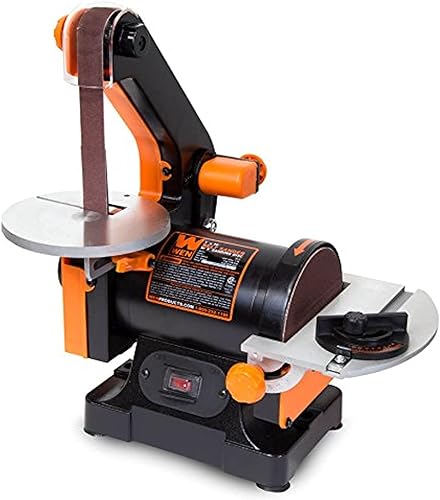
WEN Benchtop Belt and Disc Sander: Best for compact benches
- 1 x 30 in. belt and 5 in. disc
- 2.3 A motor
- 3160 FPM belt speed
- 3450 RPM disc speed
- 80-grit disc and 100-grit belt included
- Miter gauge included
A compact two-in-one bench unit for light blade shaping, bevel work and handle sanding where floor space is tight.
Pros
- Compact 1 x 30 in. belt and 5 in. disc in one unit
- Two dust ports for belt and disc
- Heavy-duty base resists walking
Cons
- Narrow 1 in. belt limits wide bevel work
- 2.3 A motor suits light to moderate stock removal
This WEN suits makers with a small bench who still want belt and disc sanding in one unit. Its 1 x 30 in. belt and 5 in. disc cover light blade shaping, deburring and handle sanding without taking much floor space.
At 11.5 by 11.5 by 15.5 inches and 16 pounds, it is the easiest full bench combo here to move and store.
The 2.3 A motor runs the belt at up to 3160 FPM and the disc at 3450 RPM. That speed is fine for smoothing edges and shaping handle material, but it will remove steel slower than a 2 x 42 in. machine.
Use it for profile cleanup, small blades and handle work rather than heavy stock removal.
WEN includes an 80-grit disc, a 100-grit belt and a miter gauge, so you can start shaping right away. Two dust ports let you connect vacuum to the belt and disc separately, which helps keep metal dust from mixing with wood dust on handles.
The trade-off is the narrow 1 inch belt. It gives control on small blades and tight curves, yet wide bevels will take more passes than on a 2 inch belt.
For a compact bench it remains a practical entry combo.
BUCKTOOL 2x42" Belt Sander 6" Bench Grinder: Best for blade shaping and grinding
- 2 x 42 in. belt
- 6 in. bench grinder
- 3.5 A, 1/3 HP motor
- 4480 FPM belt speed
- 3450 RPM wheel speed
- Belt tilts 0 to 90 degrees
- LED light
A 2 by 42 inch belt plus a 6 inch bench grinder gives one machine for shaping blades, grinding bevels and finishing handles.
Pros
- Wide 2 in. belt for faster blade shaping
- Tilting belt and swiveling housing for long workpieces
- Includes 6 in. 60-grit wheel with LED light
Cons
- Larger footprint than 1 x 30 in. bench combos
- No disc for flat handle sanding
This BUCKTOOL suits makers who want one machine for blade shaping and bevel grinding. Its 2 x 42 in. belt plus a 6 in. bench grinder split the work between fast stock removal and controlled wheel grinding.
That pairing is rare in this group and matches how many makers actually shape a blade.
The 1/3 HP, 3.5 A motor runs the wheel at 3450 RPM and the belt at 4480 FPM. That belt speed removes metal quickly, so use light pressure and keep the blade moving to avoid overheating.
The induction motor is listed as providing power under load, which helps the belt keep cutting when you lean into a pass.
The belt tilts from 0 to 90 degrees and the housing swivels from horizontal to vertical for long workpieces. Two work tables give support for metal and wood, and the cast iron base with rubber feet limits vibration.
Quick release tension and tracking make belt changes faster between grits.
BUCKTOOL includes a 6 inch 60-grit white wheel, an LED light and a tool-free eye shield. The trade-off is bench footprint at 17.99 by 11.3 by 24.53 inches, since this combo is larger than 1 x 30 in. units.
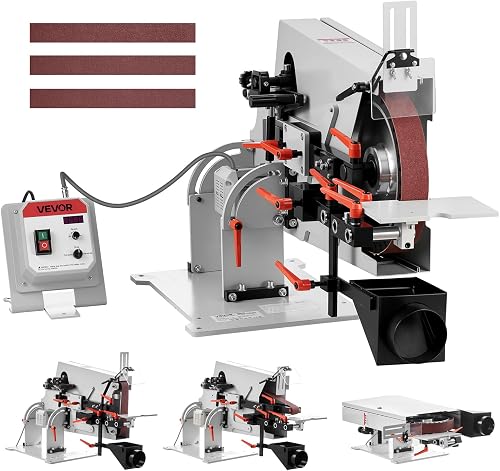
VEVOR Belt Grinder Sander: Best for variable speed control
- 30 x 1 in. belt
- 550W motor
- Variable speed with VFD
- 100, 180 and 240 grit belts included
- Circular and flat grinding modes
- Vertical and horizontal use
A 1 by 30 inch variable-speed belt grinder for makers who want slow, controlled finishing as well as faster shaping.
Pros
- Stepless VFD speed control
- Three grits included for coarse to fine work
- Circular and flat grinding modes
Cons
- Narrow 1 in. belt slows wide blade work
- No disc sander included
This VEVOR suits makers who want speed control on a compact bench grinder. Its 550W motor with VFD variable speed lets you slow the 1 x 30 in. belt for fine work and raise it for faster shaping.
Stepless control means you can match speed to the task instead of living with one fixed belt speed.
The included belts cover 100, 180 and 240 grit, so you can move from coarse shaping to finer finishing without buying belts first. Circular and flat grinding modes give two ways to approach bevels and edges.
Those modes matter when you want a rounded profile on one part and a flat grind on another.
The reinforced steel body runs vertical or horizontal, and the detachable workbench helps you set a comfortable working angle. VEVOR says the pure copper motor runs quietly and tracks steadily, and at 14.76 by 7.09 by 9.25 inches it fits a modest bench.
The trade-off is the narrow 1 inch belt, which removes less metal per pass than a 2 inch belt. No disc is included, so flat handle sanding relies on the belt alone.
KFMK 2x42 in. Belt Sander & 6": Best for belt and disc versatility
- 2 x 42 in. belt
- 6 in. disc sander
- 1/2 HP induction motor
- 3.5 A
- 3580 RPM
- Large 6-3/4 x 9 in. belt table
- Vertical or horizontal belt
A 2 by 42 inch belt and 6 inch disc combo that moves from blade shaping to flat handle work without changing machines.
Pros
- Large work tables for belt and disc
- Belt runs vertical or horizontal
- Disc table adjusts to 45 degrees
Cons
- Heavier bench footprint at 15.54 kg
- No grinding wheel included
This KFMK suits makers who want a wide belt and a disc for handles. Its 2 x 42 in. belt and 6 in. disc let you shape blades on the belt, then flatten handle scales on the disc.
You can finish both jobs without moving to a second machine, which saves time on a full knife build.
The 1/2 HP induction motor with direct drive runs up to 3580 RPM. The large 6-3/4 x 9 in. belt work table supports long blades, and the belt can run vertical or horizontal for different body positions.
A large table is important on steel because it reduces flex as you push a blade across the belt.
The 6 in. disc has a 6-1/8 x 9 in. table that adjusts to 45 degrees for angled handle work. A tool rest, miter gauge, flat wrench and hex keys are included for setup and adjustment, so you can tune both stations for the angles you use most.
The trade-off is size and weight at 15.54 kg, plus no grinding wheel for bevel control. Check our belt sander vs belt grinder guide if you need wheel grinding more than disc sanding.
Woodskil 4.3A Belt Disc Sander Combo: Best for wide handle sanding
- 4 x 36 in. belt
- 6 in. disc
- 4.3 A, 3/4 HP motor
- 3570 RPM
- 1732 FPM
- Belt tilts 0 to 90 degrees
- Two dust ports
- 2-year warranty
A wide 4 by 36 inch belt and 6 inch disc for flat handle scales, tang work and general wood shaping.
Pros
- Wide 4 in. belt covers larger handle areas fast
- Two separate dust exhaust ports
- Transparent PC guard to check belt condition
Cons
- Wide belt is less precise for small bevels
- 1732 FPM is slower for aggressive metal removal
This Woodskil suits handle work and general shop sanding more than fine blade bevels. Its 4 x 36 in. belt and 6 in. disc give a wide surface for flat scales, tangs and wooden parts.
The wide belt covers a full handle scale in fewer passes, which speeds up flattening and shaping.
The 3/4 HP, 4.3 A motor runs at up to 3570 RPM and 1732 FPM. That belt speed is gentler than metal grinders, which helps avoid burning wood but slows aggressive steel removal.
Think of it as a wood-first machine that can still smooth edges and clean up small metal parts.
The belt tilts from 0 to 90 degrees and the table adjusts from 0 to 45 degrees with a miter gauge. Two dust ports keep belt and disc dust separate, and a transparent PC guard lets you check belt condition.
A multi wedge belt drive and tension adjustment are listed to extend belt life.
The trade-off is control on narrow blades, since a 4 inch belt is hard to steer on a small bevel. Woodskil includes a 2-year warranty for extra cover.
WEN Benchtop Belt and Disc Sander: Best for beginners on a budget
- 4 x 36 in. belt
- 6 in. disc
- 4.3 A, 1/2 HP motor
- 3600 RPM
- Belt tilts 0 to 90 degrees
- Cast iron base
- Miter gauge included
A 4 by 36 inch belt and 6 inch disc combo with a tilting belt and cast iron base for entry-level knife making.
Pros
- Tilting 4 x 36 in. belt for flat work
- Cast iron base limits vibration
- Tension release lever for grit changes
Cons
- Wide belt offers less control on narrow blades
- No grinding wheel for bevel work
This WEN suits beginners who learn on wood handles before moving to steel. Its 4 x 36 in. belt and 6 in. disc handle flat sanding, edge smoothing and general shaping on a first bench machine.
The layout is simple to learn because the belt handles large flats and the disc handles smaller edges.
The 4.3 A, 1/2 HP motor runs up to 3600 RPM. WEN says that power helps prevent bogging down under load, which matters when you press a handle scale or tang against the belt.
At 22 by 11 by 12.5 inches, it needs more bench depth than the 1 x 30 in. WEN.
The belt tilts from 0 to 90 degrees for flat work, and the cast iron base limits heavy vibration. A tension release lever makes grit changes simple, and a miter gauge and stop bar are included for angled work and control.
A 2.25 inch dust port connects to a dust extractor.
The trade-off is the wide belt, which is less precise for small blade bevels. This machine makes more sense for handle and wood work than for shaping steel from blank stock.
VEVOR Belt Grinder Sander with VFD: Best for heavy stock removal
- 72 x 2 in. belt
- Compatible with 72 to 82 x 2 in. belts
- 1500W brushless motor
- 600 to 6000 RPM VFD control
- Three grinding modes
- Forward and reverse rotation
- Three belts included
A full-size 72 by 2 inch belt grinder with variable speed for fast blade shaping and controlled finishing.
Pros
- Long 72 in. belt for powerful stock removal
- Wide 600 to 6000 RPM speed range
- Forward and reverse rotation for more control
Cons
- Large 158.7 lb footprint needs dedicated space
- Serious investment for occasional makers
This VEVOR suits serious makers who shape many blades or remove heavy stock. Its 72 x 2 in. belt with a 1500W brushless motor is the only full-size belt grinder in this roundup.
The long belt gives you a large contact area, so you can remove metal with steady passes instead of many small cuts.
The VFD gives 600 to 6000 RPM stepless control, so you can grind fast to remove metal and slow down for precision polishing. Forward and reverse rotation adds control when you change grinding direction.
That range is wider than the fixed speeds on most bench combos.
Three grinding modes, circular, arc and flat, plus vertical and horizontal use, cover different blade shapes. Three 72 x 2 in. belts in 100, 180 and 240 grit are included, and belts from 72 to 82 x 2 in. are compatible, which gives you options when you replace belts.
The trade-off is scale. At 158.7 lb and 40.55 x 18.11 x 27.95 in, it needs dedicated floor space and a heavy-duty steel base.
It is too much machine for occasional handle sanding.
SI FANG Mini Electric Belt Sander Knife-Sharpener: Best for small detail work
- 330 x 30 mm belts
- 20 belts in 120, 320, 600, 800 and 1000 grit
- 4000 to 8000 RPM, 7 speeds
- Grinding wheel and cloth wheel included
- 4 x 4.7 in. body
A palm-size mini belt sander with fine grits for touch-ups, small blades and detail polishing.
Pros
- Five grits included up to 1000 grit
- Seven speed settings for light work
- Grinding wheel and cloth wheel add versatility
Cons
- Tiny belt is too small for shaping full blades
- Mini size limits work table support
This SI FANG mini suits detail work, touch-ups and small blades. Its 330 x 30 mm belts in five grits go from 120 to 1000 grit, so you can refine edges and polish small parts.
The range covers shaping on tiny pieces through to a fine finish without needing a separate polisher.
The copper motor runs from 4000 to 8000 RPM across seven speeds. That range helps on metal, wood and acrylic, and the adjustable worktable angle makes small sanding tasks easier to control.
At 4.3 pounds and about 4 by 4.7 inches, it can sit on a shelf or move between benches.
The package includes 20 belts, a grinding wheel, a cloth wheel, a dustproof cover, wrenches and a power adapter. Swapping the wheel turns the mini sander into a small bench grinder for light grinding.
The stainless steel body is listed to resist rust and wear.
The trade-off is size. At only 4 x 4.7 in., the work area is too small to shape a full blade or support a long handle.
Use it for finishing, not for primary stock removal.
SI FANG Electric Belt-Sander Knife Sharpener Model: Best for polishing and touch-ups
- 330 x 30 mm belts
- 10 belts in 120 to 1000 grit
- 4000 to 8000 RPM, 7 speeds
- Cotton polishing wheel included
- Worktop adjusts to 45 degrees
- Sanding discs included
A mini belt sander and polisher set for fine grits, small handles and final touch-ups on compact blades.
Pros
- Fine grits to 1000 plus polishing discs
- Adjustable worktop to 45 degrees
- Cotton wheel for polishing work
Cons
- Not suited to shaping or major stock removal
- Small footprint offers limited table support
This SI FANG mini suits polishing and fine handle work on small knives. Its 330 x 30 mm belts from 120 to 1000 grit plus sanding discs let you move from light sanding to fine finishing.
The discs add a flat surface for small scales and decorative pieces that a narrow belt struggles to flatten.
The all-copper motor runs from 4000 to 8000 RPM with seven speed settings. The worktop adjusts to a maximum of 45 degrees, which helps when you sand small bevels or curved handle areas.
High precision machining is listed for stable running at speed.
The package includes 10 belts, a cotton polishing wheel, hook and loop backing pads, 80-grit discs and 1000/2000-grit discs, plus a dustproof cover and US power adapter. A cotton wheel turns it into a small polisher for final shine on metal or handles.
The trade-off is scale and power for steel. At 5 x 4.7 x 7.2 in., it fits in one hand and cannot shape blades or remove heavy stock.
Pair it with a larger belt machine for full knife making.
Side-by-side: belt size and speed compared
| Product | Best for | Belt Size | Disc Size | Amperage | Our score |
|---|---|---|---|---|---|
| WEN Benchtop Belt and Disc Sander | compact benches | 1 x 30 in. | 5 in. | 2.3 A | 9.4 |
| BUCKTOOL 2x42" Belt Sander 6" Bench Grinder | blade shaping and grinding | 2 x 42 in. | 3.5 A | 9.4 | |
| VEVOR Belt Grinder Sander | variable speed control | 1 x 30 in. | 9.3 | ||
| KFMK 2x42 in. Belt Sander & 6" | belt and disc versatility | 2 x 42 in. | 6 in. | 9.2 | |
| Woodskil 4.3A Belt Disc Sander Combo | wide handle sanding | 4 x 36 in. | 6 in. | 4.3 A | 8.9 |
| WEN Benchtop Belt and Disc Sander | beginners on a budget | 4 x 36 in. | 6 in. | 4.3 A | 8.7 |
| VEVOR Belt Grinder Sander with VFD | heavy stock removal | 72 x 2 in. | 8.5 | ||
| SI FANG Mini Electric Belt Sander Knife-Sharpener | small detail work | 330 x 30 mm | 8.3 | ||
| SI FANG Electric Belt-Sander Knife Sharpener Model | polishing and touch-ups | 330 x 30 mm | 8.0 |
A wider belt removes more metal per pass, while higher belt speed cuts faster but heats steel sooner. A 2 x 42 in. belt at 4480 FPM suits rapid shaping, and a 1 x 30 in. belt at lower speeds gives finer control.
How to read belt speed and RPM together
Belt speed in FPM tells you how fast abrasive moves past the workpiece. Disc speed in RPM tells you how fast that surface spins, and a larger disc at the same RPM moves faster at its edge.
For knife work, treat high belt speed as a tool for rough shaping and lower speed as a tool for control. If a blade gets hot quickly, slow down, use lighter pressure and let the belt do the cutting.
What belt size should you choose for knife making?
Choose a 2 x 42 in. belt for most knife makers. It removes steel faster than 1 x 30 in. belts and stays more precise than 4 x 36 in. wide belts.
1 x 30 inch belts
These narrow belts suit small benches, small blades and detail work. They track tight curves well and cost less to replace, but they remove less metal per pass.
A 1 inch belt fits into small curves on a blade profile where a wide belt would bridge across the curve. That makes it useful for cleaning up a choil or a short handle, even if it is slow for full bevels.
2 x 42 inch belts
This size is the sweet spot for blade shaping and bevel work. The BUCKTOOL and KFMK here use this size because it balances speed and control for home shops.
The 2 inch width gives enough contact to move metal quickly, while the 42 inch length keeps the machine compact enough for a bench.
4 x 36 inch belts
Wide belts sand flat handle scales quickly. They are poor choices for narrow bevels where you need to steer the belt along a line.
A 4 inch belt spreads the work across a broad face, so a scale flattens fast and evenly. The same width makes it hard to keep a belt on a narrow bevel line.
72 x 2 inch belts
Full-size belts remove the most steel and suit makers who shape many blades. They need floor space, strong power and careful speed control.
The long belt puts more abrasive on the work and spreads heat over a larger area. That helps on thick stock, but a mistake can remove a lot of metal in one pass.
Belt sander or belt grinder: which do you need?
Choose a belt grinder if steel shaping is your main job. Belt grinders run faster and remove metal far quicker than wood sanders.
Our belt sander vs belt grinder guide breaks down belt speed, motor power and table design. A belt sander is better for handles, while a belt grinder is better for blades.
Combo units bridge the gap. The BUCKTOOL adds a grinding wheel to a belt sander, and the KFMK adds a disc for flat handle work.
Match the combo to the stage you spend the most time on.
Do you need a disc or grinding wheel for handles?
Choose a disc if you sand flat handle scales often. A disc gives a broad, flat surface that a narrow belt cannot match.
Disc sanders
The WEN and KFMK combos use discs from 5 to 6 in. for flat tangs, scales and wooden parts. A miter gauge helps keep angled edges square.
A disc also helps you sand the end of a handle square. The work table angle controls how much material you remove, so set it before you start.
Grinding wheels
A wheel helps you control bevel lines and grind small edges. The BUCKTOOL wheel suits this task, while disc-only combos rely on the belt for bevels.
Wheels cut by a narrow line, which makes them easier to steer along a bevel. They also generate heat fast, so keep the steel moving.
Belt-only machines
Variable-speed belt grinders like the VEVOR models handle shaping and finishing on one belt. You trade flat disc area for simpler setup and fewer parts.
A single belt machine is simpler to store and easier to learn. You will spend time changing belts between shaping and finishing.
What grits and speeds work best for blades and handles?
Use coarse grits for shaping and fine grits for finishing. Speed should drop as grit rises, so you keep control near the edge.
For steel, start coarse for profile and bevel, then move to medium grits before a fine belt. Our best sanding belts for knife sharpening guide helps you plan grit progressions.
For handles, a fine belt or disc prevents loading and burning. For edge touch-ups, read our best belt sander for knife sharpening guide for finer grit choices.
Keep wood dust and metal dust apart when you can. A coarse belt loaded with wood dust will scratch steel, and a metal belt loaded with handle dust will burn wood.
How should you set up and care for a knife making belt sander?
Set the table close to the belt and check tracking before you start. A small gap gives support without catching the blade.
Keep the work area clear and use eye protection, especially with a grinding wheel. Let the belt reach full speed before contact, and keep the blade moving to spread heat.
Change belts when they stop cutting cleanly, since a dull belt rubs and heats the steel. Use dust collection on both belt and disc ports where available.
Check belt tracking after each change and after a heavy pass. A belt that drifts to one side will wear unevenly and can fray at the edge.
If your shop also handles cabinet work, see our Best Miter Saw For Cabinet Making picks and What Is a Good Miter Saw for Cabinet Making? guide to plan the wider bench.
Verdict: which belt sander for knife making should you buy?
**Buy the BUCKTOOL 2x42 in. Belt Sander 6 in.
Bench Grinder if you want one machine for shaping and grinding.** Its wide belt, tilting head and grinding wheel cover the core metal work.
Pick the VEVOR 72 x 2 in. grinder for heavy stock removal, the KFMK combo for belt plus disc handle work, or the WEN 1 x 30 in. combo for a compact bench. Add a mini SI FANG later for polishing and detail.
Start with the belt size that fits your bench and your main job. A 2 x 42 in. machine will serve most makers, while a 1 x 30 in. or mini unit works best as a second machine for fine work.
Our top 3 picks at a glance
-
1
-
2
Best for blade shaping and grinding
BUCKTOOL 2x42" Belt Sander 6" Bench Grinder
9.4/10 our score
See it on Amazon -
3
Frequently asked questions
What belt size is best for knife making?
A 2 x 42 in. belt gives the best balance for most makers. It removes metal faster than 1 x 30 in. belts and stays more controllable than 4 x 36 in. wide belts.
Use 1 x 30 in. for small shops and 72 x 2 in. for heavy stock removal.
Can a belt sander shape a knife blade?
Yes, a belt sander can shape the profile, grind bevels and flatten handle scales. A 2 x 42 in. belt makes that work faster than a narrow belt.
A disc helps with flat handle areas, while a grinding wheel helps with bevel control.
Do I need a belt grinder or a belt sander for knives?
Most makers want a belt grinder for metal and a sander for handles, which is why combo units exist. Our belt sander versus belt grinder guide explains the difference in power and belt speed.
Choose the machine that matches the metal work you plan to do most often.
What grits should I start with for knife making?
Start with a coarse grit for shaping, then move through medium grits for bevels and fine grits for finishing. Included belts often cover the first steps.
Keep a fine belt ready for handle scales so you do not load a coarse belt with wood dust.


