9 Best Belt Sanders for Metal Work (November 2026)
The best belt sanders for metal work include the POWERTEC 1/2 x 18 Inch Sanding Belts for file sander belts, the WEN 6307 Variable Speed Detailing File Sander for detail metal work, and the WEN Benchtop Belt and Disc Sander for small bench metal jobs.
On this page (8 sections)
- The best belt sanders for metal work, by job
- How we compared these belt sanders for metal work
- What belt size do you need for metal work?
- Which grits should you buy for metal?
- Bench, handheld or air: which style fits your shop?
- How do you set up and care for a belt sander for metal?
- When should you choose a grinder or disc sander instead?
- Our verdict: the best belt sander for metal work
The best belt sander for metal work for most people is the WEN 6307, because its narrow 1/2-by-18-inch belt reaches corners and contours that wide bench belts cannot.
If your work is mostly flat plates at a bench, a 2x42 or 4x36 machine will cover more surface per pass.
Metal work with a belt sander falls into three jobs.
Deburring removes sharp edges after cutting.
Shaping rounds corners, tapers and contours.
Finishing smooths the surface and blends welds.
The right machine depends on which job you do most.
Our score weighs specs, features and buyer feedback against what you are shopping for.
We compared belt size, speed control, included belts, dust ports and bench or handheld use across the nine picks below.
Our picks at a glance
-
1

-
2
 Best for detail metal work
WEN 6307 Variable Speed Detailing File Sander
9.7/10 our score
See it on Amazon -
3
- 4
 Check it
BUCKTOOL 2x42" Belt Sander 6" Bench Grinder
Best bench combo for metal - 5
 Best variable speed bench grinderCheck it
- 6
 Check it
Woodskil 4.3A Belt Disc Sander Combo
Best for shaping and contour work - 7
 Check it
Jellas 7Amp Handheld Belt Sander
Best handheld for flat metal - 8
 Check it
BUCKTOOL Bench Belt Disc Sander for Woodworking
Best direct-drive bench sander - 9
 Check it
AP Astro Pneumatic 3037 Air Belt Sander
Best air belt sander
The best belt sanders for metal work, by job
Start with belt size.
Narrow belts in 1/2 inch and 1 inch follow curves and inside corners.
Wide belts in 2 inch, 3 inch and 4 inch cover flat metal faster.
Air and electric file sanders share the same 1/2 x 18 belt size, so belts can be shared between them.
If you are still deciding between machine types, start with our different types of sanders guide.
It explains how belt, disc, orbital and detail sanders differ before you spend money.
Speed and power matter as much as width on metal.
A fast belt removes stock quickly but can heat thin parts and round edges you want to keep.
A slower belt gives more control for blending and finishing.
That is why variable speed appears on the file sanders and on the VEVOR bench grinder, while fixed speed bench combos rely on belt choice to set the pace.
Matching belt width to workpiece size
A 1/2 inch belt can enter a bracket or a channel without cutting the sides.
A 1 inch belt is a middle ground for small bench parts.
A 2 inch or wider belt needs a workpiece that presents a flat face at least as wide as the belt, or the edge of the belt will dig in.
Think about your smallest typical part first, then work up.
POWERTEC 1/2 x 18 Inch Sanding Belts: Best for file sander belts
- 50PK, 10 each of 40/80/120/180/240 grits
- 1/2 x 18 inch aluminum oxide
- X-weight cloth backing
- Open-coat design
A 50-pack assortment lets you move from heavy removal to fine finishing on the same file sander without reordering.
Pros
- Five grits in one pack
- Fits WEN 6307 and Astro 3037
- Open coat resists clogging
Cons
- Belts only, no sander included
- Limited to 1/2 x 18 machines
The POWERTEC pack is not a sander, and that is the point.
It supplies 50 belts in five grits, 10 each of 40, 80, 120, 180 and 240, in 1/2 x 18 inch aluminum oxide.
That range covers heavy stock removal through fine finishing on one machine.
The belts fit the WEN 6307, the Astro 3037 and other 1/2 x 18 file sanders.
Powertec lists compatibility with bandfile style tools for woodworking, metal and auto body work.
The open-coat grain and X-weight cloth backing help resist clogging and hold up under pressure.
On metal, that open coat matters because fines can load a tight grain quickly.
Heavy 40 grit suits rust, paint and burr removal.
Eighty grit removes stock faster for shaping.
One hundred twenty and 180 grit smooth scratches before 240 grit blends the surface.
This suits anyone who already owns a file sander and wants a full grit range in one purchase.
The trade-off is clear: you get no machine, and these belts only fit 1/2 x 18 sanders.
Pair them with our guide to the best sanding belts for metal to pick grits for steel, aluminum and non-ferrous metal.
WEN 6307 Variable Speed Detailing File Sander: Best for detail metal work
- 1/2-by-18-inch belt
- 1080 to 1800 feet per minute
- Pivots up to 55 degrees
- Includes three belts and dust port
A handheld file sander with variable speed and a pivoting head for tight corners, weld blends and deburring.
Pros
- Variable speed control
- Auto-tracking belt
- Tool-free belt changes
Cons
- Narrow belt slows wide flat work
- Three belts in the box will run out
The WEN 6307 is a handheld file sander built around a 1/2-by-18-inch belt that pivots up to 55 degrees.
Variable speed runs from 1080 to 1800 feet per minute, so you can slow down for blending and speed up for removal.
The auto-tracking system keeps the belt aligned without tension adjustments.
At 2.4 lb, it squeezes into tight spaces for deburring, smoothing tight corners and shaping metal, plastic and wood.
Tool-free belt changes make grit swaps quick.
WEN includes three belts in 80, 120 and 320 grit, plus a dust port attachment.
The 55 degree pivot is the key detail for metal work.
It lets the narrow belt meet a weld toe, an inside radius or a fender edge at a workable angle instead of forcing the wrist.
Variable speed matters for the same reason.
Fast speed cuts burrs on steel, while slower speed reduces heat on thin aluminum and thin sheet.
This suits detail work, weld blending in corners and small parts where a wide belt would gouge the surface.
The trade-off is speed on flat work: a 1/2-inch belt covers little ground.
For an even smaller profile, see our best detail belt sander picks and best narrow belt sander options.
WEN Benchtop Belt and Disc Sander: Best for small bench metal jobs
- 1 x 30 in belt and 5 in disc
- 2.3A motor, 3160 fpm belt
- Includes miter gauge
- Two dust ports
A compact two-in-one bench machine that pairs a narrow belt with a disc for small parts and edge work.
Pros
- Belt and disc in one unit
- Heavy-duty base resists walking
- Miter gauge included
Cons
- Fixed speed, no variable control
- Narrow belt for large plates
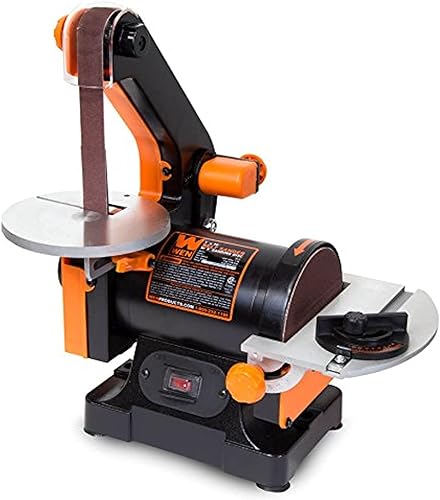
The WEN 6515T pairs a 1-by-30-inch belt with a 5-inch disc on one bench unit.
A 2.3A motor delivers up to 3160 feet per minute on the belt and 3450 rpm on the disc.
The heavy-duty base helps prevent walking and wobbling during use.
It includes a miter gauge, an 80-grit disc, a 100-grit belt and two dust ports.
The beveling work table supports small workpieces on both sides.
That makes it a practical starter bench sander for deburring small brackets, rounding edges and flattening small parts.
The disc side presents a flat face for squaring an end, truing a small plate or easing a corner before you move to the belt.
The belt side in turn reaches curves that a flat disc would bridge.
On metal, the 100 grit belt is a middle grit, good for smoothing after the disc has shaped the part.
Two dust ports help because fine metal dust adds up across both stations.
The trade-off is a fixed belt speed with no variable dial.
The 1-inch belt also limits wide flat work.
If you want variable speed in a similar footprint, compare the 1x30 belt sander variable speed guide.
For knife work, our best belt sander for knife making roundup covers larger bench machines.
BUCKTOOL 2x42" Belt Sander 6" Bench Grinder: Best bench combo for metal
- 2 x 42 in belt, 4480 fpm
- 6 in bench grinder, 3450 rpm
- Tilts 0 to 90 degrees
- Two worktables and LED light
A 2x42 belt and 6-inch grinder combo built for bench metalworking, with tilting belt and two tables.
Pros
- Wide 2-inch belt for metal
- Grinder wheel included
- Horizontal and vertical use
Cons
- Single belt speed
- Bench space required
The BUCKTOOL combo puts a 2-by-42-inch belt next to a 6-inch bench grinder.
The belt runs at 4480 feet per minute from a 1/3HP, 3.5A motor, while the grinder wheel runs at 3450 rpm.
That pairing covers both grinding and belt sanding at one bench.
The belt tilts from 0 to 90 degrees and the housing swivels between horizontal and vertical for long workpieces.
Two worktables, a cast iron base with rubber feet, a 60-grit grinding wheel and an LED light are included.
Quick-release tension and tracking make belt changes fast.
It suits metalworking benches where you grind edges, then finish with the belt.
The 2-inch width is a real step up from 1-inch belts.
It covers flat bar, plate edges and long bevels in fewer passes.
The separate grinder wheel handles tasks where a belt would be slow, such as squaring a tip or re-establishing a bevel before sanding.
Two tables matter here, with a cast iron table for metal work and a larger cast aluminum table suited to wood.
That separation helps keep metal dust away from wood work.
The trade-off is a single belt speed and the bench space a 2x42 machine needs.
If you are unsure which side you need more, read our belt sander vs belt grinder comparison first.
VEVOR Belt Grinder Sander: Best variable speed bench grinder
- 1 x 30 in belt, 550W motor
- VFD variable speed
- 3 belts: 100/180/240 grit
- Circular and flat grinding modes
A variable-speed bench belt grinder with two grinding modes for polishing, deburring and knife work.
Pros
- Stepless VFD speed control
- Two grinding modes
- Vertical and horizontal use
Cons
- Only three belts included
- Narrow 1-inch belt
The VEVOR belt grinder sander is built around a 550W motor with VFD variable speed control on a 1 x 30 inch belt.
Stepless speed regulation lets you move from fast removal to fine sanding without changing belts for every change in pace.
It offers two grinding modes, circular and flat, plus vertical and horizontal use.
Three belts are included in 100, 180 and 240 grit.
A detachable workbench and reinforced steel body help set a stable working position.
It suits polishing, deburring and knife making where speed control matters more than belt width.
On a knife bevel or thin edge, drop speed and use light pressure to keep the line straight.
On heavy burrs, raise speed and let the 100 grit belt do the removal.
Circular grinding suits round work, while flat grinding suits bevels and flat faces.
Vertical and horizontal use lets long pieces rest on the bench instead of being held in the air.
The trade-off is the narrow 1-inch belt and only three belts in the box.
For sharpening-focused work, see our best belt sander for knife sharpening and best sanding belts for knife sharpening picks.
Woodskil 4.3A Belt Disc Sander Combo: Best for shaping and contour work
- 4 x 36 in belt and 6 in disc
- 3/4HP, 1732 fpm, 3570 rpm
- Belt tilts 0-90 degrees
- Two dust ports
A wide-belt combo sander that tilts for contour sanding and shaping, with separate dust ports for belt and disc.
Pros
- Wide 4-inch belt
- Adjustable table 0-45 degrees
- Transparent belt guard
Cons
- 25 lb weight
- Wide belt needs the right grit for metal
The Woodskil combo uses a 4-by-36-inch belt and a 6-inch disc, with a 3/4HP motor providing up to 3570 rpm and 1732 feet per minute.
The wide belt covers flat metal and large edges faster than narrow belts.
The belt tilts from 0 to 90 degrees for horizontal and vertical work.
The work table adjusts from 0 to 45 degrees and can move between the belt and disc sides.
Two separate dust ports serve the belt and disc, and a transparent PC guard lets you check belt condition.
It suits shaping and contour sanding where belt width helps.
A 4-inch belt at 1732 feet per minute removes material steadily without the aggressive bite of a faster narrow belt.
The tilting belt and adjustable table let you set bevel angles for chamfers and edge profiles.
The miter gauge adds repeatable angled work on the disc side before sanding.
The trade-off is weight at 25 lb and the need to choose metal-suitable grits for a wide belt.
Pair it with best sanding belts for steel if most of your stock is steel.
For disc work on metal, compare best sanding discs for metal.
Jellas 7Amp Handheld Belt Sander: Best handheld for flat metal
- 3 x 21 in belt
- 7 Amp, variable speed
- 10 belts included
- Can clamp as bench sander
A powerful handheld 3x21 sander that can be clamped down as a bench sander for flat metal and large parts.
Pros
- Strong 7 Amp motor
- Six-speed variable control
- 10 belts in the box
Cons
- Heavy for overhead work
- Built mainly for flat surfaces
The Jellas is a 7 Amp handheld 3-by-21-inch belt sander with six-dial variable speed control.
It can be clamped to a table with two metal C clamps to act as a bench sander, with a lock-on button for continuous runs.
Ten belts are included: two each of 40, 60, 80, 120 and 180 grit aluminum oxide.
A detachable dust bag and a 2-in-1 vacuum adapter in 35mm and 32mm sizes help with dust collection.
The power cord is 10 feet long.
It suits large flat metal surfaces, stripping and smoothing where a handheld can move across the workpiece.
Seven amps holds speed under load on wide flat work.
Coarse belts for stripping can run faster, while finer belts for smoothing run slower for control.
The clamp-on bench mode is useful for smaller parts that would be awkward to hold against a moving handheld.
The trade-off is heft for overhead or detail work, and a design focused on flat surfaces.
For pipe work, check our best belt sander for pipe guide.
If a disc sander fits the job better, see best orbital sander for metal.
BUCKTOOL Bench Belt Disc Sander for Woodworking: Best direct-drive bench sander
- 4 x 36 in belt, 6 in disc
- 3/4HP direct drive, 2161 fpm
- Tilts 0-90 degrees
- Two cast aluminum tables
A direct-drive bench combo with a 4x36 belt and 6-inch disc for bevel and contour work on small parts.
Pros
- Direct drive, no belt tension setup
- Miter gauge for disc and belt
- Quick belt replacement
Cons
- Marketed for woodworking first
- Single speed belt
The BUCKTOOL bench sander uses a direct-drive 3/4HP motor with a 4-by-36-inch belt and 6-inch disc.
Direct drive removes the need to adjust belt tension, and the maker says it is 25% more efficient than traditional designs.
The belt tilts from 0 to 90 degrees for horizontal and vertical sanding.
Two cast aluminum worktables, a miter gauge that works on both disc and belt, and a quick belt replacement design round out the setup.
Belt speed reaches 2161 feet per minute and the disc runs at 3450 rpm.
It suits bevel and contour work on small parts at a fixed bench.
With no separate belt tension to set, the machine is ready sooner and avoids one source of tracking trouble on a wide belt.
The driven drum supports sanding curved workpieces, where a 4-inch belt can follow a contour instead of only flattening it.
The miter gauge working on both disc and belt helps keep angles consistent when you move a part between them.
The trade-off is that it is marketed for woodworking first, so confirm your belt choice for metal.
Our belt sander angle guide helps you set the table and belt angle for consistent bevels.
AP Astro Pneumatic 3037 Air Belt Sander: Best air belt sander
- 1/2 x 18 in belt
- 0.5HP, 16000 rpm free speed
- Variable speed control
- 3 belts: 36/40/60 grit
A light air file sander for spot weld removal and rust work, with coarse belts included for fast metal removal.
Pros
- Light at 2.2 lb
- Coarse belts for spot welds
- Simple tension lever
Cons
- Needs shop air supply
- Coarse belts only in the box
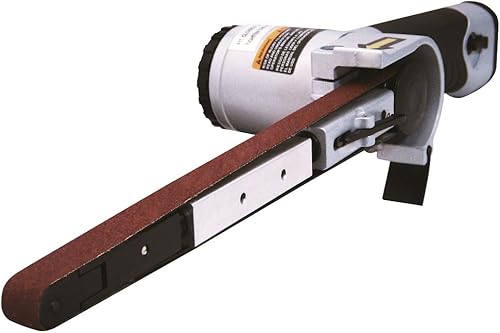
The Astro 3037 is an air-powered 1/2 x 18 file sander with a 0.5HP motor and 16000 rpm free speed.
It weighs 2.2 lb and uses about 4 cfm at 90 psi through a 1/4-inch air inlet.
Three belts are included in 36, 40 and 60 grit, coarse enough for spot weld removal, rust and heavy deburring.
A simple tension lever, protection guard, non-slip grip and variable speed control are built in.
The larger pulley space accepts thicker belts.
It suits auto body and fab shops that already have shop air.
The tool has no cord and no heavy motor housing, so it stays light for overhead weld work.
That matters when blending a spot weld behind a panel or deburring a seam you cannot move to a bench.
Thirty six and 40 grit remove weld nuggets and rust fast, while 60 grit cleans up before a finer belt takes over.
Variable speed helps you avoid gouging thin auto body sheet.
The trade-off is that it needs an air supply, and the included belts are coarse only.
Add finer belts from the POWERTEC pack above for finishing.
For other pneumatic options, see our best air belt sander roundup.
How we compared these belt sanders for metal work
We compared nine picks by belt size, speed control, power source, included belts and bench versus handheld use.
Scores reflect how well each one fits deburring, shaping and finishing on metal, not just raw power.
We did not test these machines.
We checked specs, features and buyer patterns, and we label maker claims as claims.
A wide bench belt will always beat a file sander on flat coverage, while a file sander will always win in corners.
We also looked at what is in the box.
A sander that ships with coarse and fine belts can start work on day one, while a sander with only three belts will need replacements sooner.
Dust ports and adapters counted too, because metal dust is harder to clean than wood dust.
Weight counted for handheld and air tools, since overhead work punishes a heavy motor.
Why these nine made the list
Each pick covers a distinct belt size or power source.
That spread lets you compare file, bench, handheld and air styles on the same metal jobs.
No pick is best at every job, which is why the verdict below splits by use.
What belt size do you need for metal work?
Narrow belts follow curves, wide belts cover flats.
A 1/2 x 18 belt fits file sanders like the WEN 6307 and the Astro 3037.
A 1 x 30 belt fits the WEN bench combo and the VEVOR grinder.
Wider 2 x 42, 3 x 21 and 4 x 36 belts suit bench and handheld flat work.
1/2 x 18 file sanders
Choose this size for deburring inside corners, blending welds behind brackets and shaping small parts.
The POWERTEC belts above fit this size, so one pack can serve both the WEN and the Astro.
1 x 30 bench sanders
Choose this size for a small bench setup that must also handle discs or grinding wheels.
The WEN 6515T and VEVOR models sit in this class.
2 x 42, 3 x 21 and 4 x 36 sanders
Choose these for faster flat work and larger workpieces.
The BUCKTOOL 2x42 combo, Jellas 3x21 handheld and the two 4x36 bench combos cover this group.
Which grits should you buy for metal?
Start coarse for removal and move finer for each pass.
Coarse belts around 36 to 80 grit remove burrs, rust and scale.
Medium belts around 100 to 180 smooth the surface.
Fine belts at 240 or higher finish and blend.
Coarse grits for deburring and rust removal
The Astro includes 36, 40 and 60 grit belts for spot weld and rust work.
The POWERTEC pack starts at 40 grit for the same jobs on file sanders.
Medium grits for smoothing and shaping
Most bench sanders here ship with 80 to 120 grit belts.
That range suits shaping edges and removing scratches before finishing.
Fine grits for finishing and blending
The VEVOR includes 240 grit, and the POWERTEC pack tops out at 240 in this assortment.
Use fine belts with light pressure to avoid rounding edges you want to keep sharp.
Bench, handheld or air: which style fits your shop?
Bench machines give control, handhelds give reach, and air tools give light weight.
A bench sander keeps both hands free and holds a steady angle.
A handheld moves to the workpiece.
An air file sander needs shop air but weighs little.
Bench belt sanders
The BUCKTOOL, VEVOR, WEN and 4x36 combos are bench machines.
They suit repeated passes on small parts and long workpieces you can fixture.
Handheld belt sanders
The WEN 6307 file sander and Jellas 3x21 handheld reach parts that cannot move to a bench.
The Jellas can also clamp down for bench use.
Air belt sanders
The Astro 3037 suits shops with compressed air already in place.
It is the lightest pick here at 2.2 lb.
How do you set up and care for a belt sander for metal?
Check belt tracking, tension and direction before every session.
Run the machine briefly with no workpiece and watch that the belt tracks straight.
Wear eye protection, hearing protection and a respirator rated for metal dust.
Belt direction and tracking
Many belts have an arrow that must match the machine direction.
The Jellas instructions call this out directly.
A drifting belt usually means tracking or tension needs adjustment per the manual.
Dust collection and cleanup
Metal dust is sharp and heavy.
Connect dust ports or a vacuum adapter where the machine provides one, and clean the area after each session.
The WEN bench combo has two dust ports, while the Jellas includes a dust bag and vacuum adapter.
Belt storage
Store spare belts flat and dry.
Heat and humidity can warp belt joints.
Keep coarse and fine belts separate so coarse grit dust does not contaminate finishing belts.
Heat and pressure on thin metal
Thin sheet heats quickly under a fast belt.
Use light pressure and keep the belt moving.
Let the grit do the work instead of forcing the workpiece into the belt, and pause to let the part cool before finishing passes.
When should you choose a grinder or disc sander instead?
Choose a grinder for heavy removal and a disc sander for flat finishing.
A belt sander sits between those tools for most metal work.
If cutting is your problem, check Can You Cut Metal with a Miter Saw? before buying a sander to fix a cutting issue.
Belt sander vs belt grinder
Our belt sander vs belt grinder guide breaks down belt width, backing stiffness and speed.
The BUCKTOOL combo in this roundup gives you both sides of that choice in one unit.
Disc and orbital sanders for metal
A disc sander finishes flat edges quickly, and an orbital sander suits broad flat surfaces.
Compare best sanding discs for metal and best orbital sander for metal when a belt is not the right shape.
Our verdict: the best belt sander for metal work
Pick the WEN 6307 for detail work, the BUCKTOOL 2x42 combo for bench metalworking, and the POWERTEC belts to keep any 1/2 x 18 file sander running.
If you have shop air, the Astro 3037 is the lightest way to remove spot welds and rust.
Buy by the job you do most.
Deburring small parts points to a file sander.
Flat plates point to a wide bench or handheld belt.
Knife and tool work points to the VEVOR or the BUCKTOOL combo.
Then buy belts in a full grit range, because the sander is only half the result.
Start with the best sanding belts for metal guide to match grits to your stock, or revisit different types of sanders if a belt sander is not the right tool for the job.
Our top 3 picks at a glance
-
1
-
2
Best for detail metal work
WEN 6307 Variable Speed Detailing File Sander
9.7/10 our score
See it on Amazon -
3
Frequently asked questions
What is the best belt sander for metal work for beginners?
For most beginners, a 1x30 bench belt sander or a 1/2x18 file sander is the easiest starting point. Both handle deburring and small shaping without the cost of a 2x42 system.
Start with coarse and medium belts, then add finer grits for finishing.
Can a belt sander for metal also work on wood?
Yes, most belt sanders here work on both wood and metal with the right belt. Metal needs a suitable abrasive and grit, while wood clogs belts faster.
Keep separate belts for each material so metal dust does not scratch wood.
What grit should I use for deburring metal?
Start coarse, around 36 to 80 grit, to remove burrs and rust, then move to 120 to 180 for smoothing. Finish with 240 or finer for a clean surface.
The POWERTEC 50-pack covers that full range in 1/2 x 18 belts.
Do I need a belt grinder instead of a belt sander?
A belt grinder usually has a wider belt and a thicker backing for heavy removal, while a belt sander suits finishing and shaping. Our belt sander vs belt grinder guide explains the difference in belt size, speed and work style.
Can I cut metal with a miter saw instead of sanding it?
Cutting and sanding solve different problems. You can check Can You Cut Metal with a Miter Saw? and Can You Use A Metal Blade On A Miter Saw? before deciding, but most deburring and edge work still needs a belt sander.


