9 Best Cyclone Dust Separators for Woodworking (November 2026)
The best cyclone dust separators for woodworking include the Oneida Air Systems Dust Deputy DIY Anti-Static for flexible shop vacuum setups, the Dustopper PRO Dust Collector for compact 5 gallon buckets, and the Mullet Cyclone Dust Collector for one-piece speed and suction.
On this page (8 sections)
- Our top cyclone dust separators for woodworking
- How these cyclone dust separators for woodworking compare
- What vacuum compatibility do you need?
- Which container size fits your shop?
- Do you need a dust collection system for indoor woodworking?
- How do you set up and care for a cyclone separator?
- What trade-offs should you expect from these separators?
- Our verdict on the best cyclone dust separators for woodworking
The best cyclone dust separators for woodworking are the Oneida Air Systems Dust Deputy DIY for flexible shop vacuum setups and the Dustopper PRO for compact 5 gallon bucket use.
This guide compares 9 separators by vacuum compatibility, container construction and workshop capacity.
You will find a DIY retrofit, bucket top units, caster based tanks and a Festool specific flat cyclone.
A cyclone separator sits between your tool and your vacuum or dust collector.
Heavy chips and coarse dust drop into a container.
Fine dust and air pass on to the vacuum, so the filter clogs more slowly and suction holds longer.
Woodworkers who run a table saw, planer, sander or router table generate a mix of large chips and fine dust.
The chips fill a container fast.
The fine dust is what clogs filters.
Our score weighs specs, features and buyer feedback against what you are shopping for.
We compared port sizes, container types, included parts and vacuum fit.
We checked the specs for each model rather than relying on general claims.
Start with the dust collector buying guide if you are not sure whether you need a separator or a full collector.
A separator improves a vacuum you already own.
A dust collector moves more air for larger machines.
Our picks at a glance
-
1
 Best for flexible shop vacuum setups
Oneida Air Systems Dust Deputy DIY Anti-Static
9.7/10 our score
See it on Amazon -
2

-
3

- 4
 Best for double filtration on a 2 inch portCheck it
- 5
 Check it
Festool 204083 CT CYCLONE Dust Separator CT-VA-20
Best for Festool CT extractor owners - 6
 Check it
DEWALT 6 Gallon Dust Separator for Wet/Dry
Best ready to roll 6 gallon system - 7
 Check it
Peachtree Woodworking Supply Cyclone Dust Separator Kit
Best 4 inch kit for your own barrel - 8
 Check it
DEWALT Dust Separator with 10 Gal. Stainless
Best 10 gallon stainless tank option - 9
 Check it
PEMEDOR 2.5'' Dual Cyclone Dust Separator
Best dual cyclone for standard buckets
Our top cyclone dust separators for woodworking
The Oneida Dust Deputy DIY leads this group because it adapts to many vacuum sizes and lets you choose your container.
The Dustopper PRO follows close behind for small shops where height matters.
The Mullet, PEMEDOR and Festool models then solve different port, filtration and extractor problems.
The DEWALT caster systems and the Peachtree 4 inch kit round out the group for larger hoses and larger loads.
Oneida Air Systems Dust Deputy DIY Anti-Static: Best for flexible shop vacuum setups
- Anti-static retrofit cyclone
- Tapered 2.0 inch ports
- Neutral Vane Technology
- Cyclone, gasket and mounting hardware included
A DIY retrofit cyclone you mount on a container you supply. It suits wet or dry shop vacuums of many sizes and keeps fine dust away from the vacuum filter.
Pros
- Fits many wet/dry vacuum sizes
- Tapered ports accept varied hose sizes
- You choose the waste container
Cons
- Container, hose and vacuum not included
- Requires mounting and sealing to your container
The Oneida Air Systems Dust Deputy DIY Anti-Static suits a woodworker who already owns a wet or dry shop vacuum and wants a separator that fits it. Its tapered 2.0 inch ports accept a variety of dust collection hose sizes, so you can move it between a bucket, barrel and cart.
Oneida says it captures up to 99.9% of dust and debris before it reaches the vacuum filter, with Neutral Vane Technology credited for a 20% efficiency gain. The practical result is fine dust dropping into your container instead of clogging the filter.
The box holds the cyclone, gasket and mounting hardware. You supply the container, hose and vacuum, which keeps cost down but means you must cut, mount and seal the lid well.
Made in the USA, it works with wood dust, drywall dust, concrete dust and many other materials. The anti-static build helps in dry shops.
Against complete DEWALT systems, it trades convenience for fit and flexibility, and it is the strongest choice if you like building your own setup.
Dustopper PRO Dust Collector: Best for compact 5 gallon buckets
- Low-profile bucket-top design
- 99.9% efficiency claim
- Seals to a standard 5 gallon bucket
- Two high-flow sweep elbows included
A low-profile separator that sits on a 5 gallon bucket instead of a tall cyclone. The included sweep elbows help preserve airflow around tight shop layouts.
Pros
- Low profile saves vertical space
- Sweep elbows reduce sharp turns
- Made in the USA
Cons
- Requires a standard 5 gallon bucket
- Bucket and vacuum not included
The Dustopper PRO Dust Collector suits a woodworker who wants separation without a tall cyclone on top of a bucket. Its patented low-profile design seals to a standard 5 gallon bucket and keeps total height down under a bench or in a small garage.
Dustopper says the PRO captures 99.9% of dust and debris before it reaches the shop vacuum filter, which helps maintain airflow and reduce filter cleaning during long sessions. The maker also credits it with reducing filter replacement costs over time, though savings depend on how much fine dust you generate.
Two high-flow 90 degree sweep elbows are included. Smooth radius elbows restrict airflow less than sharp fittings, so you can route hoses around tools without sharp bends.
The unit measures 13 x 13 x 7 inches, weighs 1.63 kg and is made of anti-static resin in the USA. Bucket and vacuum are not included, so confirm your rim matches a standard bucket.
Against the Oneida DIY it is more ready to use but less flexible, and against DEWALT caster systems it uses far less floor space.
Mullet Cyclone Dust Collector: Best for one-piece speed and suction
- One-piece parabolic design
- High-speed separator for shop vac
- Rigid cut-to-fit PVC connection
- Two wet/dry vac hose adapters included
A one-piece cyclone built for a faster spin and stronger capture before dust reaches the vacuum. Hose adapters help it connect to many wet/dry vacuums and extractors.
Pros
- One-piece construction avoids loose joints
- Universal hose adapters included
- Works wet or dry
Cons
- Package is large at 29 x 16 x 12 in
- Sound level is 72 dB
The Mullet Cyclone Dust Collector suits a woodworker who values a one-piece design over a kit you assemble. Its parabolic, one-piece construction creates a faster airstream than a straight wall cyclone and bucket assembly, according to Mullet.
A faster spin means more debris drops before air moves on. Mullet says it pre-separates over 99% of debris and keeps suction strong.
The rigid, cut-to-fit PVC connection replaces improvised bolts, bungees and tape, and an airtight connection matters because leaks let dust bypass the cyclone. Two wet/dry vac hose adapters are included for connection to virtually all wet dry shop vacuums and dust extractors.
Mullet says they fit many brands, tall or short, which helps when brands do not match. The unit weighs 7.5 pounds, the package measures 29 x 16 x 12 inches, sound is listed at 72 dB and it works wet or dry.
Made in the USA in Dripping Springs, Texas, it trades compact height for a unified connection and broad hose fit. Against the PEMEDOR 2 inch model it offers a simpler hookup.
PEMEDOR Double Filtration: Best for double filtration on a 2 inch port
- Double filtration cyclone
- 2 inch / 50 mm turbocharged filter
- Adapters and connectors included
- 99.99% efficiency claim
A double filtration separator with a 2 inch port for shop vac and woodworking use. Extra connectors help when your vacuum hose is not 50 mm.
Pros
- Double filtration design
- Multiple size connectors included
- Suits saws, sanders and routers
Cons
- 2 inch port is smaller than 4 inch systems
- May need extra connectors for some hoses
The PEMEDOR Double Filtration suits a woodworker who wants a two-stage style separator on a 2 inch port. Its double filtration system captures dust and debris before it enters the vacuum cleaner.
PEMEDOR says this improves vacuum lifespan and reduces breakdown risk from clogged filters. The port is 50 mm or 2 inches, common on shop vacuums but smaller than 4 inch dust collector ports.
If your hose is not 50 mm, PEMEDOR includes 2 connectors of multiple sizes, though unusual hoses may still need an extra connector. Measure your hose outside diameter before ordering.
PEMEDOR claims 99.99% efficiency and says it suits saws, sanders and routers. It measures 12 x 10 x 9 inches, is made of plastic, attaches with an included flange and is reusable.
For daily use, less fine dust reaches the filter during woodworking and DIY work. The trade-off is air volume.
A 2 inch port moves less air than a 4 inch port, which matters for large machines. Against the Oneida DIY it is a more complete kit but less flexible, and against Peachtree it favors shop vacuum use.
Festool 204083 CT CYCLONE Dust Separator CT-VA-20: Best for Festool CT extractor owners
- Flat cyclone design
- Fits Festool Systainer system
- For CT 26, 36 and 48 extractors
- Anti-static three-stage separation
A flat pre-separator made for Festool CT 26, 36 and 48 extractors. It catches larger debris before the filter bag and fits the Systainer storage system.
Pros
- Made for Festool CT extractors
- Compact flat design for storage
- Reduces filter bag changes
Cons
- Limited to Festool CT extractor use
- Extractor not included
The Festool 204083 CT CYCLONE Dust Separator CT-VA-20 suits a woodworker who already owns a Festool CT 26, 36 or 48 dust extractor. Its flat cyclone design fits securely within the Festool Systainer modular storage system for storage and transport.
It removes larger dust and debris before it fills the filter bag, which Festool says reduces bag and filter changes and helps keep suction consistent. Those benefits grow with high dust applications such as sanding and cutting.
Festool says it is OSHA Table 1 compliant when used with a HEPA-certified CT dust extractor, and that depends on extractor and application, so confirm details for your work. The unit measures 15.55 x 11.61 x 20.28 inches, weighs 7 kg, is made of aluminum and carries a 1 year warranty.
It works with all CT 26, 36 and 48 extractors, with or without Autoclean. Against universal separators it is narrower in compatibility but stronger in integration.
It does not help a non-Festool vacuum, so skip it unless you own a CT extractor and Systainer stack.
DEWALT 6 Gallon Dust Separator for Wet/Dry: Best ready to roll 6 gallon system
- 6 gallon poly bucket included
- Four-caster base
- 1-7/8 inch or 2-1/2 inch ports
- 1-7/8 inch hose included
A complete 6 gallon separator on casters with a lid, latches, handles and hose. It moves around the shop and empties without lifting a bucket off a lid.
Pros
- Bucket and caster base included
- Easy to move and empty
- Fits most vacuum hoses
Cons
- Vacuum not included
- Taller than bucket-top separators
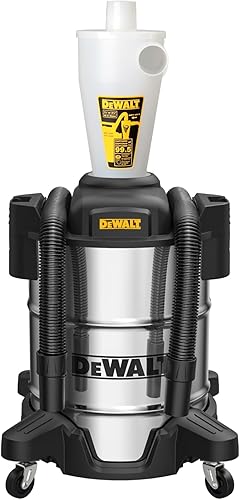
The DEWALT 6 Gallon Dust Separator for Wet/Dry Shop Vacuums suits a woodworker who wants a complete, mobile separator rather than a kit. Its four-caster base makes the system stable and easy to move around the workshop.
You can roll it from a table saw to a sander without lifting a filled bucket. The package includes the separator, 6 gallon poly bucket, lid, sealing strips, latches, handles, hose holders, wheel bracket, casters, screws and a 1-7/8 inch hose.
The vacuum is not included. Ports accept 1-7/8 inch or 2-1/2 inch hoses, which covers most shop vacuums.
For a portable vacuum option, read the Milwaukee M18 compact vacuum review.
DEWALT says it captures wood chips and other debris before they enter the vacuum, reducing suction loss, and separates up to 99.5% of debris. Parts are durable and heat resistant with an anti-clogging design.
It measures 15.9 x 15.9 x 31.4 inches, weighs 12 pounds and includes a 3 year limited warranty. The 6 gallon bucket empties more often than the 10 gallon DEWALT model, which is the trade-off for a smaller footprint.
Against bucket-top units it is taller but easier to empty and move.
Peachtree Woodworking Supply Cyclone Dust Separator Kit: Best 4 inch kit for your own barrel
- 4 inch cyclone dust separator kit
- Two top-side 4 inch ports
- Two bottom-side 4 inch elbow ports
- Two hose clamps and hardware included
A 4 inch kit you install on a bucket, barrel or box you supply. The larger ports suit dust collector hoses and larger chips from planers and jointers.
Pros
- 4 inch ports for larger hoses
- Fits buckets, barrels and boxes
- Protects dust collector impellers
Cons
- Hose and container not included
- You cut and seal the container lid
The Peachtree Woodworking Supply Cyclone Dust Separator Kit suits a woodworker who runs a dust collector with 4 inch hoses. Its 4 inch ports move more air than 2 inch and 2.5 inch shop vac ports.
That helps with planers, jointers and router tables that produce large chips. The kit includes two top-side 4 inch ports, two bottom-side 4 inch elbow ports, two hose clamps and a hardware pack.
Hose and container are not included. You install it on a bucket, barrel or box and cut the lid to fit, with rigid containers and secure lids working best.
Peachtree says it captures heavy debris before it reaches the dust collector or shop vacuum. That protects the impeller from large chips and keeps the bottom bag from filling as fast, so you empty less often.
The kit weighs 1.5 pounds, is made of plastic and lists a 30 gallon capacity for the container type it can suit. Against shop vacuum separators it favors larger hoses and machines.
Against DEWALT caster systems it is cheaper to start but needs more setup work. Our cyclone dust separator 4 inch guide explains sizing and sealing.
Skip it if your vacuum uses 2.5 inch hose.
DEWALT Dust Separator with 10 Gal. Stainless: Best 10 gallon stainless tank option
- 10 gallon stainless steel tank
- Fits 1-7/8 inch to 2-1/2 inch hoses
- Four swiveling casters
- 2.1 meter hose length
A larger 10 gallon separator on casters for shops that fill a bucket fast. The stainless tank and swiveling casters suit garage and jobsite moves.
Pros
- Largest capacity in this group
- Stainless steel tank
- Casters for moving around the shop
Cons
- Vacuum not included
- Tall 34.6 inch height needs floor space
The DEWALT Dust Separator with 10 Gal. Stainless Steel Tank suits a woodworker who fills small buckets too fast.
Its 10 gallon stainless steel tank holds more chips between emptying trips. That helps during long planer, jointer or table saw sessions.
It fits 1-7/8 inch to 2-1/2 inch hoses. DEWALT says it separates and captures up to 99.5% of debris and helps prevent suction loss and clogged filters.
Four swiveling casters let you move it around a garage or worksite. It measures 18 x 17 x 34.6 inches, weighs 7.39 kg, has two handles and a 2.1 meter hose length.
DEWALT includes a 3 year warranty. The vacuum is not included.
For daily use, the larger tank means fewer interruptions. The trade-off is size.
At 34.6 inches tall it needs more floor space and storage height than bucket-top models, and stainless costs more than a plastic bucket. Against the 6 gallon DEWALT it trades footprint for capacity.
Against the Peachtree kit it arrives as a complete mobile system. Choose it when chip volume matters more than compact storage.
PEMEDOR 2.5'' Dual Cyclone Dust Separator: Best dual cyclone for standard buckets
- Dual cyclone pre-separation
- Fits US standard buckets
- 2.5 inch shop vac ports
- 1 meter flexible hose included
A dual cyclone that snaps onto US standard buckets for 2.5 inch shop vac systems. The included 1 meter hose connects the separator to your vacuum.
Pros
- Dual cyclone structure
- Snaps onto standard US buckets
- Hose included
Cons
- Bucket not included
- 2.5 inch ports limit hose size
The PEMEDOR 2.5'' Dual Cyclone Dust Separator suits a woodworker who uses a shop vacuum with 2.5 inch hoses. Its dual cyclone pre-separation design separates sawdust, fine dust and debris before they reach the vacuum.
PEMEDOR says this reduces filter clogging and maintains stronger suction. It snaps onto standard US buckets, creating a simple system without cutting a lid.
Most debris collects in the bucket, so you clean the filter less often. Ports are 2.5 inches, matching most shop vacuums.
A 1 meter flexible hose is included, with 50 mm inner and 58 mm outer diameter, for connection to the vacuum. It weighs 5.24 pounds and is described for workshops, garages, job sites and DIY use.
It is hand powered with no motor, so it relies on the vacuum to move air. Against the PEMEDOR double filtration model it is similar in port size but uses a dual cyclone shape.
Against the Dustopper PRO it includes a hose but depends on a US standard bucket, which is not included. Choose it for a snap-on bucket setup, and skip it if you need 4 inch ports.
How these cyclone dust separators for woodworking compare
The comparison below sorts the group by fit and capacity rather than by score alone.
Use it to match port size and container type to your vacuum or dust collector before you compare features.
| Product | Best for | Ports | Dimensions | Weight | Our score |
|---|---|---|---|---|---|
| Oneida Air Systems Dust Deputy DIY Anti-Static | flexible shop vacuum setups | 2.0 in tapered | 15.5 x 9.3 x 7.4 in | 0.8 oz | 9.7 |
| Dustopper PRO Dust Collector | compact 5 gallon buckets | 13 x 13 x 7 in | 9.5 | ||
| Mullet Cyclone Dust Collector | one-piece speed and suction | 7.5 lb | 9.4 | ||
| PEMEDOR Double Filtration | double filtration on a 2 inch port | 12 x 10 x 9 in | 9.2 | ||
| Festool 204083 CT CYCLONE Dust Separator CT-VA-20 | Festool CT extractor owners | 15.55 x 11.61 x 20.28 in | 7 kg | 9.0 | |
| DEWALT 6 Gallon Dust Separator for Wet/Dry | ready to roll 6 gallon system | 1-7/8 or 2-1/2 in | 15.9 x 15.9 x 31.4 in | 8.7 | |
| Peachtree Woodworking Supply Cyclone Dust Separator Kit | 4 inch kit for your own barrel | 4 in | 1.5 lb | 8.5 | |
| DEWALT Dust Separator with 10 Gal. Stainless | 10 gallon stainless tank option | 18 x 17 x 34.6 in | 8.3 | ||
| PEMEDOR 2.5'' Dual Cyclone Dust Separator | dual cyclone for standard buckets | 2.5 in | 5.24 lb | 8.1 |
We compared each separator by vacuum compatibility, container construction and workshop capacity.
A DIY kit scores well on fit but needs more setup.
A caster system scores well on capacity and mobility but takes more floor space.
A bucket-top unit scores well on compact height but depends on the bucket you supply.
Port size is the first filter.
Shop vacuums usually use 1-7/8 inch, 2 inch or 2.5 inch hoses.
Dust collectors often use 4 inch hoses.
A mismatch does not make a separator unusable, but adapters add joints and can restrict airflow.
Measure your hose before you choose.
Container type is the second filter.
A 5 gallon bucket suits a small shop.
A 6 gallon or 10 gallon tank suits longer sessions with a planer or table saw.
A barrel you supply lets you choose capacity but puts sealing and mounting on you.
Our best cyclone dust separator for 5 gallon bucket guide covers bucket rim fit and lid sealing.
Our best cyclone dust separator attachment guide covers attachments that fit shop vacuums.
Our dust collector vs cyclone guide explains when a separator alone is enough and when a full collector makes more sense.
What vacuum compatibility do you need?
Match the separator ports to your vacuum or dust collector hose.
Shop vacuums need 1-7/8 inch, 2 inch or 2.5 inch ports.
Dust collectors need 4 inch ports for larger machines.
The Oneida Dust Deputy DIY uses tapered 2.0 inch ports for a variety of hose sizes.
The DEWALT models use 1-7/8 inch or 2-1/2 inch ports.
The PEMEDOR models use 2 inch and 2.5 inch ports.
The Peachtree kit uses 4 inch ports.
The Festool model is limited to Festool CT extractors.
Shop vacuum separators
Shop vacuum separators suit table saws, miter saws, sanders and routers in a small or medium shop.
They keep fine dust from clogging the vacuum filter.
The Dustopper PRO, Mullet, Oneida and PEMEDOR models fall in this group.
Our best shop vacuum dust separator guide compares more options for this use.
If you plan to connect a planer or jointer with a wide port, check the hose size first.
Dust collector separators
Dust collector separators suit planers, jointers and large sanders that need wide hoses.
The Peachtree 4 inch kit is the main 4 inch option here.
It protects the impeller from large chips.
Our best dust extractor with cyclone guide covers extractors that include a cyclone stage.
Those systems cost more but arrive as a matched set.
Which container size fits your shop?
Choose container size by how fast you generate chips, not by floor space alone.
A 5 gallon bucket suits a small shop.
A 6 gallon or 10 gallon tank suits longer cutting sessions.
The Dustopper PRO seals to a standard 5 gallon bucket.
The PEMEDOR dual cyclone snaps onto US standard buckets.
The Peachtree kit fits buckets, barrels and boxes.
The DEWALT 6 gallon system includes its own poly bucket on casters.
The DEWALT 10 gallon system includes a stainless tank on casters.
Both empty more easily than a bucket you lift off a lid.
Both also take more floor space.
Bucket top separators
Bucket top separators save floor space and suit small garages.
They need a bucket with a rim that seals well.
A loose rim will leak air and reduce separation.
Our best dust collector lid guide covers lid options for bucket setups.
Caster based tanks
Caster based tanks suit shops where you move the separator between tools.
Casters let you roll the unit to the tool instead of running a long hose.
That also reduces hose bends that slow airflow.
Compare their heights with your bench clearance before you buy.
Do you need a dust collection system for indoor woodworking?
Yes, if you run power tools indoors or in a garage that connects to living space.
Fine dust stays airborne long after a cut ends.
Our Do You Need a Dust Collection System for Indoor Woodworking? guide covers health, cleanup and tool wear in more detail.
A separator does not replace ventilation or a respirator.
It reduces the amount of dust that reaches your vacuum filter and the air in the room.
Wood dust from sawing and sanding can irritate airways.
Use a separator along with good ventilation and appropriate respiratory protection.
Our Can You Cut Metal with a Miter Saw? guide covers the dust and chip issues that come with that use.
Metal shavings and wood dust both benefit from separation before they reach a filter.
How do you set up and care for a cyclone separator?
Seal the container, connect the hoses in the right order and empty the container before it fills.
A good setup takes an hour.
A poor seal costs suction every time you use it.
Start by mounting the cyclone to the container lid.
Use the included gasket or sealing strips.
Check that the lid sits flat and the latches hold.
Connect the tool hose to the cyclone inlet.
Connect the cyclone outlet to the vacuum or dust collector.
That order sends dirty air through the cyclone first.
Sealing and hose checks
Check seals each time you empty the container.
Dust on the rim can break the seal.
Wipe the rim clean before you close the lid.
Check hose clamps and inspect hoses for cracks.
Our best Oneida Dust Deputy guide covers the Oneida DIY model in more detail.
Emptying and filter care
Empty the container when chips reach about two thirds full.
A full container reduces the space for the cyclone to work.
Clean or replace the vacuum filter as the maker directs.
A separator reduces filter load but does not remove the need for filter care.
What trade-offs should you expect from these separators?
Every separator trades fit, capacity or setup effort for the others.
A complete system costs more in parts but works on day one.
A kit costs less but needs a container and mounting work.
The Oneida DIY offers the best fit for many vacuums but needs your container and hose.
The Dustopper PRO offers low height but needs a standard bucket.
The Mullet offers a one-piece build but takes more storage space.
The PEMEDOR models offer compact double filtration but use smaller ports.
The Festool model offers clean integration but only for CT extractors.
The DEWALT models offer mobility and capacity but take more floor space.
The Peachtree kit offers 4 inch ports but needs cutting and sealing.
Choose the trade-off that matches your shop layout and your tools.
Our verdict on the best cyclone dust separators for woodworking
Pick the Oneida Dust Deputy DIY if you want the most flexible fit for a shop vacuum and do not mind mounting it to your own container.
Pick the Dustopper PRO if you need low height on a 5 gallon bucket.
Pick a DEWALT caster system if you want a complete, mobile setup.
Pick the Peachtree 4 inch kit if your dust collector uses 4 inch hoses.
Pick the Festool model only if you own a CT 26, 36 or 48 extractor.
Pick the Mullet or PEMEDOR models when you want a one-piece or double filtration design for a shop vacuum.
Measure your hose, measure your floor space and check your container rim before you order.
Those three checks will tell you more than any single efficiency claim.
Our top 3 picks at a glance
-
1
Best for flexible shop vacuum setups
Oneida Air Systems Dust Deputy DIY Anti-Static
9.7/10 our score
See it on Amazon -
2
-
3