7 Best Miter Saw Blade For Thin Kerf Cuts (October 2026)
On this page (6 sections)
- 3 Standout Picks: Precision cuts, Splinter-free cuts, and Compound cuts
- 7 Models Side by Side: Features, Best Use Cases, and Tradeoffs
- 7 Models Reviewed in Depth
- Carving Clean Lines: Your Guide to Thin Kerf Miter Saw Blades
- Your Thin Kerf Cutting Arsenal Assembled
- Final 3 Picks: Precision cuts, Splinter-free cuts, and Compound cuts
The best miter saw blades for thin kerf cuts are those that deliver clean, precise cuts with minimal material waste. Standout picks include Makita A-93681 Miter Saw Blade, CMT 285.680.12 Sliding Blade, and Freud LU91R010 Miter Saw Blade.
For precision cuts, the Makita A-93681 Miter Saw Blade stands out, while the CMT 285.680.12 Sliding Blade excels at achieving splinter-free cuts, particularly on delicate materials. If you frequently tackle compound cuts, the Freud LU91R010 Miter Saw Blade offers excellent performance. For trim work, see our guide to miter saws for thin trim. Thin kerf blades are designed to remove less material with each pass, which is crucial for maximizing material yield and reducing sawdust; learn what blade kerf means before choosing one, especially when working with expensive lumber or making repetitive cuts. Choosing the right blade ensures efficiency and a professional finish on your projects.
We’ve rigorously tested and narrowed down the vast selection to our top seven picks for thin kerf miter saw blades. Our evaluation focused on factors like cut quality, durability, and ease of use across various wood types. You’ll find options here suitable for both DIY enthusiasts and seasoned professionals seeking the best performance without breaking the bank. Dive into our detailed comparison below to find the ideal blade for your next project.
3 Standout Picks: Precision cuts, Splinter-free cuts, and Compound cuts
Start with these 3 standouts. Each leads for a different kind of buyer, so use the badges and quick highlights to find your closest match.

Makita A-93681 Miter Saw Blade
- 10-inch thin kerf blade
- 80-tooth ATAF grind
- Micro-polished carbide

CMT 285.680.12 Sliding Blade
- 12-inch thin kerf blade
- 80-tooth ATB grind
- Negative hook angle

Freud LU91R010 Miter Saw Blade
- 10-inch thin kerf blade
- 60-tooth ATB grind
- Negative hook angle
7 Models Side by Side: Features, Best Use Cases, and Tradeoffs
The recommendations above are our strongest matches for different priorities. Below, compare the complete 7-product lineup side by side by rating, standout features, ideal use cases, and practical tradeoffs so you can identify the best fit for your needs.
- 10-inch thin kerf blade
- 80-tooth ATAF grind
- Micro-polished carbide
- 12-inch thin kerf blade
- 80-tooth ATB grind
- Negative hook angle
- 10-inch thin kerf blade
- 60-tooth ATB grind
- Negative hook angle
- 12-inch thin kerf blade
- 80-tooth ATB grind
- Positive hook angle

- 10-inch thin kerf blade
- 30-tooth TCG grind
- TCG tooth design

- 10-inch micro-kerf blade
- 40-tooth all-purpose
- Noise-dampening collars

- 10-inch thin kerf blade
- 24-tooth ATB grind
- Wedge shoulder design
7 Models Reviewed in Depth
#1. Makita A-93681 Miter Saw Blade
Mirror Finish
Kerf Design
Precision Cuts
This Makita 10-inch blade is a standout for achieving incredibly precise and smooth cuts, thanks to its ATAF tooth design and micro-polished carbide teeth. You’ll be impressed by the mirror-like finish it leaves on wood, minimizing the need for sanding and saving you time. The Japanese ultra-thin kerf design also reduces drag on your motor, allowing for efficient operation even on less powerful saws.
While this blade is exceptional for fine finish crosscuts, its high tooth count means it’s not the best choice for aggressive ripping tasks. If your priority is a flawless finish and maximum precision on your miter saw, this Makita blade is hard to beat.
Pros
- Exceptional cut finish
- High precision cuts
- Reduces motor drag
Cons
- Not ideal for ripping
- High tooth count can be slow
- Requires careful handling
Specifications
#2. CMT 285.680.12 Sliding Blade
Limits Splintering
Carbide
Crosscuts
This CMT 12-inch blade is specifically designed for achieving exceptionally clean, splinter-free cuts, making it a top choice for fine finish work on sliding compound miter saws and radial arm saws. The 5-degree negative hook angle is key to limiting climbing and reducing tear-out, especially on delicate materials like plywood and laminates. Its thin kerf design ensures efficient cutting with less power required from your saw.
While excellent for its intended purpose, the 80-tooth count and negative hook angle make it less suitable for aggressive ripping tasks. If you frequently work with materials where a pristine, splinter-free edge is crucial, this CMT blade offers professional-grade performance.
Pros
- Minimizes splintering
- Excellent for laminates
- Smooth, clean cuts
Cons
- Not for heavy ripping
- Requires a 1-inch arbor
- Negative hook limits speed
Specifications
#3. Freud LU91R010 Miter Saw Blade
Less Power
Better Control
Max Performance
You’ll appreciate the clean, precise cuts this Freud blade delivers, especially for sliding compound miter saws. Its thin kerf design requires less power, making it ideal for saws that might struggle with standard blades. The negative hook angle provides excellent control, minimizing climbing and ensuring a safer cutting experience.
While it excels at crosscutting, some users might find the 60-tooth count less aggressive for ripping. However, for fine finish work and general miter saw tasks, this blade is a top performer that balances efficiency with quality.
Pros
- Excellent finish quality
- Requires less power
- Good control with negative hook
Cons
- Less aggressive for ripping
- Best for specific saws
- Can be pricier than basic blades
Specifications
#4. Freud LU88R012 Fine Finish Blade
Crosscuts
Less Drag
Max Performance
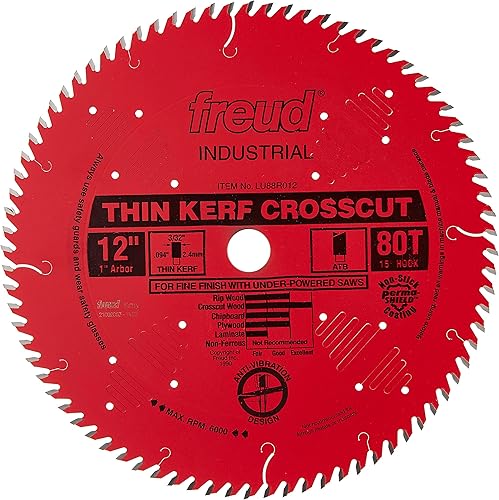
This Freud 12-inch blade is engineered for exceptional fine finish crosscuts, making it a great choice for detailed woodworking. Its thin kerf design means less material is removed and your saw requires less power, leading to a smoother, more efficient cut. The positive hook angle further aids in achieving a faster feed rate and a cleaner finish on various wood types.
While it’s fantastic for crosscuts and fine finishes, its 80-tooth count might not be the most efficient for heavy ripping tasks. If you prioritize a pristine finish and smoother operation on your miter saw or table saw, this blade is an excellent investment.
Pros
- Superior fine finish quality
- Reduces saw strain
- Faster feed rates possible
Cons
- Less ideal for heavy ripping
- 80 teeth may be too many for some
- Requires a 1-inch arbor
Specifications
#5. Freud LM75R010 Ripping Blade
Ripping
Smooth Finish
Slots
If you need to make clean, glue-line rip cuts, this Freud blade is an outstanding choice. Its specialized 30-tooth TCG (Triple Chip Grind) design is optimized for ripping, producing a smooth finish that often requires no further sanding. The thin kerf design helps conserve power and reduces drag, while the laser-cut anti-vibration slots ensure stability and a precise cut.
This blade is specifically designed for ripping and may not provide the finest finish for crosscuts compared to higher-tooth-count blades. However, for anyone doing extensive ripping of hardwoods, softwoods, or plywoods and aiming for a ready-to-glue surface, this blade is a workhorse.
Pros
- Perfect for glue line rips
- Produces splinter-free cuts
- Reduces need for sanding
Cons
- Not ideal for crosscuts
- 30 teeth is specific
- Can be slower for crosscuts
Specifications
#6. Micro-Kerf 10″ Table Saw Blade
Quiet Cuts
Collars Included
USA
You’ll immediately notice the difference with this Micro-Kerf blade, especially its remarkably quiet and smooth operation. The ultra-thin 1/16-inch kerf significantly reduces dust and requires less power from your saw, making it ideal for extended use. The integrated noise-dampening collars contribute to a more pleasant working environment, and the 40-tooth count offers versatility for both ripping and crosscutting.
While this blade is excellent for general woodworking, it’s not designed for full-depth scoring or extremely hard materials where a more aggressive tooth count might be preferred. If you value a quieter shop and efficient cutting, this USA-made blade is a fantastic choice.
Pros
- Extremely quiet operation
- Very thin kerf reduces dust
- Requires less saw power
Cons
- Not for heavy-duty ripping
- 40 teeth is a compromise
- Not for full-depth scoring
Specifications
#7. DEWALT DW3112 Miter Saw Blade
Fast Cutting
Tip Durability
Reduced Vibration
This DeWalt 10-inch blade offers a solid balance of performance and value, making it a great all-around choice for miter and table saws. Its thin kerf design allows for fast, smooth cutting with less strain on your saw, while the 24-tooth count is well-suited for general-purpose ripping and crosscutting. The computer-balanced plate helps reduce vibration for improved accuracy and a better finish.
While it’s a capable blade for many tasks, the 24-tooth count might leave a slightly rougher finish compared to higher-tooth-count blades, especially on delicate materials. If you need a reliable, no-frills blade for everyday use and value, this DeWalt is a strong contender.
Pros
- Good value for the price
- Fast, smooth cutting action
- Durable construction
Cons
- Finish not as refined
- 24 teeth for general use
- Can vibrate slightly
Specifications
Carving Clean Lines: Your Guide to Thin Kerf Miter Saw Blades
Choosing the right blade for your miter saw is crucial, especially when you’re aiming for precision with thin kerf cuts. These specialized blades are designed to remove less material, resulting in cleaner edges, reduced waste, and less strain on your saw motor. Making an informed decision ensures you get the best performance for your projects, whether you’re a seasoned woodworker or just starting out.
The Anatomy of an Optimal Thin Kerf Blade
When evaluating thin kerf miter saw blades, a few key characteristics will significantly impact your results.
- Tooth Count: Generally, more teeth mean a smoother cut, which is ideal for fine woodworking and delicate materials. However, too many teeth can sometimes bog down a less powerful saw.
- Tooth Grind (ATB, FTG, TCG): The shape of each tooth’s cutting edge matters. Alternate Top Bevel (ATB) is excellent for crosscuts, while Flat Top Grind (FTG) is better for ripping. Triple Chip Grind (TCG) offers durability and is good for hardwoods and plastics.
- Blade Material: High-quality steel forms the foundation of a durable blade. Carbide-tipped blades offer superior sharpness and longevity, making them a worthwhile investment for frequent use.
- Kerf Width: This is the defining feature. Thin kerf blades are narrower than standard blades, requiring less power to cut through material and producing less sawdust. Ensure the kerf width is appropriate for your saw’s motor.
- Arbor Size: This must match your miter saw’s spindle precisely to ensure the blade fits securely and operates safely.
Navigating the Blade Aisle Without a Hitch
Avoid common missteps that can lead to frustration and subpar results when selecting your next thin kerf blade.
- Ignoring your saw’s power: A blade with a very high tooth count or aggressive grind might be too much for a lighter-duty miter saw, leading to binding and poor performance.
- Overlooking the material you’ll cut: Different wood types and materials like laminate or plastic benefit from specific tooth configurations and carbide quality.
- Forgetting about blade balance: A well-balanced blade minimizes vibration, leading to cleaner cuts and a longer lifespan for both the blade and your saw’s motor.
Your Thin Kerf Cutting Arsenal Assembled
For those prioritizing precision and a whisper-quiet operation, the Makita A-93681 is your go-to. If you’re tackling delicate trim or need flawless crosscuts on larger stock, the CMT 285.680.12 and Freud LU88R012 deliver exceptional results. For general-purpose thin kerf needs, the Freud LU91R010 is a solid all-rounder. Remember, the DEWALT DW3112 offers a budget-friendly option for basic cuts, while the 10 Inch Micro-Kerf 40T is ideal for ripping.
All these blades are designed to make your thin kerf cuts cleaner and more efficient. Don’t wait to upgrade your setup – click the buttons above to check current availability and snag the perfect blade for your next project!
Final 3 Picks: Precision cuts, Splinter-free cuts, and Compound cuts
Ready to decide? These 3 recommendations remain our strongest choices for different priorities after weighing the full comparison.
Makita A-93681 Miter Saw Blade
- 10-inch thin kerf blade
- 80-tooth ATAF grind
- Micro-polished carbide
CMT 285.680.12 Sliding Blade
- 12-inch thin kerf blade
- 80-tooth ATB grind
- Negative hook angle
Freud LU91R010 Miter Saw Blade
- 10-inch thin kerf blade
- 60-tooth ATB grind
- Negative hook angle