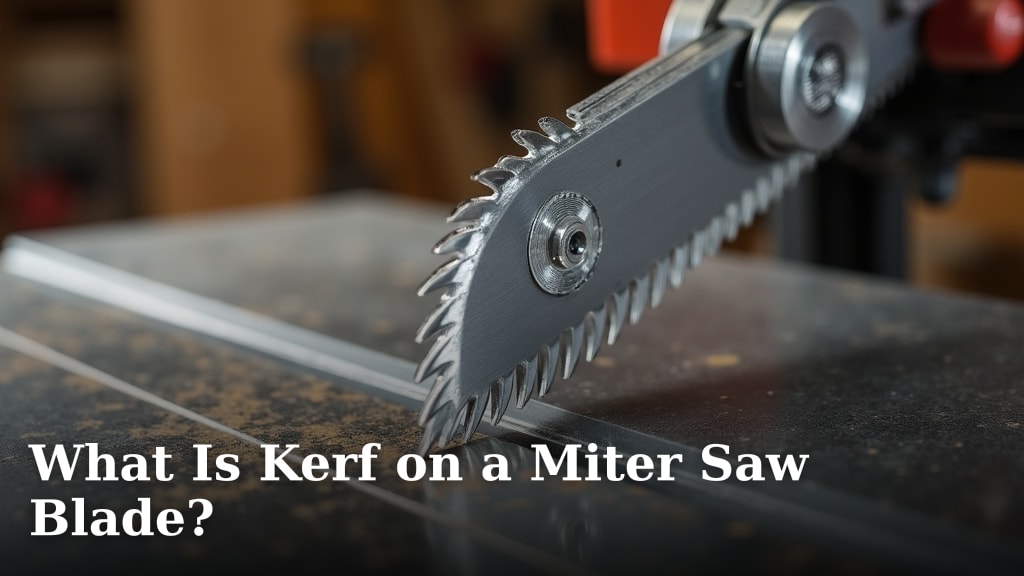
9 Best Thin Kerf Table Saw Blades (November 2026)
The best thin kerf table saw blades include the FOXBC 10 Inch Thin Kerf Fine Finish for smooth mixed-shop crosscuts, the FOXBC 10-Inch Flat Tooth Ripping Table Saw for fast ripping, and the Freud LU83R010 Industrial 10-in 50T Thin Kerf for one-blade versatility.
On this page (3 sections)
The best thin kerf table saw blade for most woodworkers is the FOXBC 10 Inch Thin Kerf Fine Finish, because its 60-tooth ATB pattern and 0.087-inch kerf favor clean cuts with less material removed. That helps when you want a finish ready for sanding or assembly.
Choose the FOXBC 24-tooth blade for ripping, Freud's 80-tooth blade for plywood and melamine, or a combination blade for mixed work. Each balances speed, edge quality and material coverage differently.
Thin kerf means the blade removes a narrower strip of wood. That can reduce waste and cutting resistance, but tooth pattern still depends on ripping with the grain, crosscutting across it, or working with coated sheet goods.
A thin kerf can also ease work on thick stock or a modest motor. It does not replace a sharp blade, stable fence and steady feed, and those still shape the final edge.
More teeth usually give a smoother crosscut in solid wood. Fewer teeth and larger gullets usually clear waste faster on long rips, keeping the blade working more freely.
If you also use a miter saw, compare our guide to the Best Miter Saw Blade For Thin Kerf Cuts before choosing one blade for both tools. A blade suited to table saw ripping may not suit short miter cuts.
Match blade to saw as well as material. Check diameter, arbor size, guard clearance and maker guidance before fitting.
With limited stock, kerf affects how many usable parts you get from a board. A narrower cut leaves more material for the next part, which adds up over repeated cuts.
The goal is not the thinnest blade available. Choose a tooth layout and kerf that fit the cut, material and saw you own.
Our picks at a glance
-
1
 Best for smooth mixed-shop crosscuts
FOXBC 10 Inch Thin Kerf Fine Finish
9.7/10 our score
See it on Amazon -
2

-
3
 Best for one-blade versatility
Freud LU83R010 Industrial 10-in 50T Thin Kerf
9.4/10 our score
See it on Amazon
- 4
 Check it
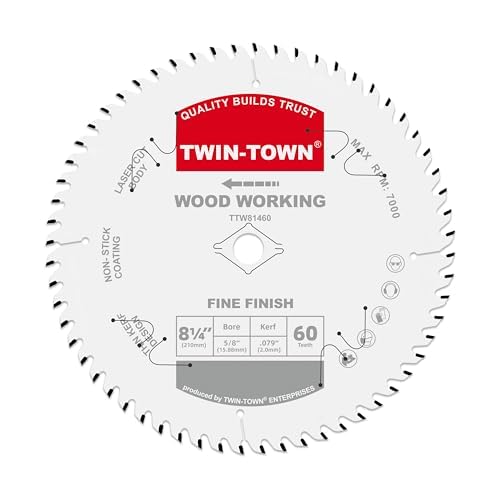
TWIN-TOWN 8-1/4-Inch 60 Teeth ATB Fine Finish
Best for compact 8-1/4-inch saws - 5
 Check it
HARDWIN 10-Inch 50-Tooth Combination Table Saw Blade
Best for table saw combination work - 6
 Best for a simple fine-finish replacementCheck it
- 7
 Check it
Freud Thin Kerf Ultimate Plywood & Melamine
Best for plywood and melamine - 8
 Check it
DEWALT 10-Inch Miter / Table Saw Blade
Best for coarse general ripping - 9
 Best for softwood and plywood combinationsCheck it
The best thin kerf table saw blades for different cuts
The best blade depends on the cut you make most often. Fine-finish blades use more teeth for smoother edges, while ripping blades use fewer teeth and larger spaces to clear waste quickly.
That split explains most of this guide. A 24-tooth blade moves through long grain with speed, while a 60- or 80-tooth blade leaves a cleaner edge on crosscuts and sheet goods.
Combination blades sit in the middle. They trade some specialized speed or finish for one blade across rips, crosscuts and general work.
Our score weighs stated specs, tooth design, materials and features against thin kerf table saw needs. It also reflects how closely each option matches a clear job such as ripping, finishing or plywood work.
Kerf matters because it affects material removal. A narrower kerf can reduce waste and load, while tooth shape and plate still affect stability and finish.
Arbor fit and diameter come first, since a mismatched blade cannot be used safely. Speed ratings and compatible devices also matter when moving a blade between saw types.
Material coverage narrows the field too. Some blades list solid wood only, while others include plywood, melamine, chipboard or laminates.
Care and setup shape daily results as well. A clean, sharp blade at the right height usually cuts better than a dull, dirty or poorly aligned one.
Use the picks below as a starting point, then check the saw manual for final fit. Start with your most common cut, and let finer specs support that goal.
| Product | Best for | Diameter | Teeth | Kerf | Our score |
|---|---|---|---|---|---|
| FOXBC 10 Inch Thin Kerf Fine Finish | smooth mixed-shop crosscuts | 10 inches | 60 ATB | 0.087 inches | 9.7 |
| FOXBC 10-Inch Flat Tooth Ripping Table Saw | fast ripping | 10 inches | 24 flat teeth | 0.094 inches | 9.6 |
| Freud LU83R010 Industrial 10-in 50T Thin Kerf | one-blade versatility | 10 inches | 50 | 9.4 | |
| TWIN-TOWN 8-1/4-Inch 60 Teeth ATB Fine Finish | compact 8-1/4-inch saws | 8-1/4 inches | 60 | 9.3 | |
| HARDWIN 10-Inch 50-Tooth Combination Table Saw Blade | table saw combination work | 10 inches | 50 ATB | 9.1 | |
| DEWALT Table Saw Blade | a simple fine-finish replacement | 10 inches | 40 | 8.8 | |
| Freud Thin Kerf Ultimate Plywood & Melamine | plywood and melamine | 10 inches | 80 | 8.6 | |
| DEWALT 10-Inch Miter / Table Saw Blade | coarse general ripping | 10 inches | 24 ATB | 8.4 | |
| CMT Orange Tools 256.050.10 | softwood and plywood combinations | 10 inches | 50 | 0.102 inches | 8.1 |
FOXBC 10 Inch Thin Kerf Fine Finish: Best for smooth mixed-shop crosscuts
FOXBC 10 Inch Thin Kerf Fine Finish: Best for smooth mixed-shop crosscuts
- 10-inch diameter
- 60-tooth ATB design
- 0.087-inch kerf
- 5/8-inch arbor
The 60-tooth ATB layout and 0.087-inch kerf suit clean crosscuts in wood, plywood, melamine and moulding. Its 5/8-inch arbor fits many 10-inch saws.
Pros
- Fine-finish 60-tooth layout
- Thin 0.087-inch kerf
- Tungsten carbide teeth
Cons
- Better suited to finishing than fast ripping
- Confirm arbor and saw compatibility
The FOXBC 10 Inch Thin Kerf Fine Finish is the strongest all-around pick when clean crosscuts matter most. Its 60-tooth ATB pattern presents more cutting points than the 24-tooth ripping blades here.
The blade has a 10-inch diameter, a 5/8-inch arbor and a stated 0.087-inch kerf. That narrow cut reduces material removed per pass, which matters when sizing repeated parts from limited stock.
FOXBC describes it for oak, pine, melamine, plywood and moulding. Tungsten carbide teeth suit wood cutting, while the fine-finish layout suits crosscuts more than high-volume ripping.
In daily use, it suits trim work, furniture parts and jobs where the cut end stays visible. A steady feed and good support help the ATB teeth leave an even edge.
Set height so only the teeth clear the workpiece, and keep the fence square. Excess height increases exposure without improving the result.
Clean resin from teeth and plate when cuts feel rough or slow. A dirty blade can create heat and friction even when teeth remain serviceable.
Check arbor and guard clearance before fitting. For tooth patterns, see what is a crosscut saw blade.
The trade-off is pace, since it will not clear long rips as fast as a 24-tooth option. Use it where edge quality matters, and keep a ripping blade for heavier removal.
FOXBC 10-Inch Flat Tooth Ripping Table Saw: Best for fast ripping
FOXBC 10-Inch Flat Tooth Ripping Table Saw: Best for fast ripping
- 10-inch diameter
- 24 flat teeth
- 0.094-inch kerf
- 5/8-inch arbor
The 24-tooth flat-tooth layout is aimed at ripping hard and softwood. It can also handle crosscuts, plywood, chipboard and laminates.
Pros
- Ripping-focused tooth layout
- Thin kerf for less material removal
- Works with wood materials
Cons
- Coarser finish than 60- or 80-tooth blades
- Confirm the 5/8-inch arbor
Choose the FOXBC 10-Inch Flat Tooth Ripping Table Saw Blade when your main task is cutting boards lengthwise. Its 24 flat teeth, 20-degree hook angle and 0.094-inch kerf give it a more aggressive ripping focus than the fine-finish picks.
The blade is 10 inches with a 5/8-inch arbor. FOXBC describes it for hard- and softwood, plywood, chipboard and laminates.
Fewer teeth leave larger spaces between cutting points. In daily use, that pattern is better suited to moving through long grain quickly, while the flat-tooth layout can leave a different edge than a 60- or 80-tooth finishing blade.
It suits shop work where you need to break down boards, size panels or prepare stock before a finer cut. A steady feed matters more than speed alone, since forcing the wood can spoil both the edge and the cut line.
Keep the blade clean and set at a sensible height for the stock thickness. Pitch buildup in the gullets can reduce chip clearance and make long cuts harder than they should be.
Pick it when speed and ripping are more important than the smoothest crosscut edge. A separate fine-finish blade may still make sense if your projects include visible crosscut ends.
Confirm the 5/8-inch arbor and guard clearance before installation. That check takes a minute and prevents a blade that cannot be fitted safely.
Freud LU83R010 Industrial 10-in 50T Thin Kerf: Best for one-blade versatility
Freud LU83R010 Industrial 10-in 50T Thin Kerf: Best for one-blade versatility
- 10-inch diameter
- 50-tooth combination design
- TiCo carbide blend
- Perma-Shield coating
This combination blade balances ripping and crosscutting with a 50-tooth layout. Anti-vibration design and a non-stick coating support smoother general work.
Pros
- Ripping and crosscutting layout
- TiCo high-density carbide blend
- Anti-vibration design
Cons
- Not as specialized as a dedicated rip or finish blade
- Check the arbor before fitting
The Freud LU83R010 is the best fit when you want one thin kerf blade for both ripping and crosscutting. Its 50-tooth combination layout sits between the coarse 24-tooth choices and the 80-tooth plywood blade.
Freud gives it a 0.07-inch blade thickness, TiCo high-density carbide and a Perma-Shield non-stick coating. The design also includes anti-vibration features and does not need stabilizers.
The combination pattern includes one flat-top tooth followed by 4 ATB teeth. That arrangement supports aggressive ripping while retaining a crosscut side for general woodworking.
It works with wood, chipboard, plywood and laminate. Choose it for a mixed project schedule where changing blades after every operation would slow you down.
In daily use, it suits a shop that moves between framing stock, cabinet parts and sheet goods. One blade cannot match a dedicated rip or finish blade in every case, but it covers a wide range of routine work.
Keep the coating clean by removing pitch and dust after heavy cutting sessions. A cleaner surface helps the blade enter and leave the material with less drag.
Check the arbor and guard clearance before fitting, and set the height for the stock you are cutting. Correct setup helps the combination pattern work as intended.
The trade-off is specialization. If most of your work is long rips or polished plywood edges, a dedicated blade will serve those jobs more directly.
TWIN-TOWN 8-1/4-Inch 60 Teeth ATB Fine Finish: Best for compact 8-1/4-inch saws
TWIN-TOWN 8-1/4-Inch 60 Teeth ATB Fine Finish: Best for compact 8-1/4-inch saws
- 8-1/4-inch diameter
- 60 ATB teeth
- 5/8-inch DMK arbor
- Thin kerf design
The smaller diameter fits compatible circular, miter and table saws with a 5/8-inch arbor hole. Its 60-tooth ATB pattern targets fine cuts in softwood, hardwood and engineered wood.
Pros
- Compact 8-1/4-inch size
- 60-tooth fine-finish layout
- C4 grade carbide teeth
Cons
- Not a replacement for a 10-inch blade
- Confirm the saw accepts this diameter
The TWIN-TOWN 8-1/4-Inch 60 Teeth ATB Fine Finish is the right size-focused choice for a compatible compact saw. Its 8-1/4-inch diameter is smaller than the 10-inch blades in most of this roundup, so it should not be treated as a direct replacement without checking the saw manual.
The blade has 60 precision-sharpened ATB teeth and a 5/8-inch DMK arbor. It is described for softwood, hardwood, plywood and engineered wood.
Its thin kerf design removes less material than a wider cut, while the C4 grade tungsten carbide teeth and electrophoretic coating are aimed at longer cutting service. Expansion slots and stabilizer vents address heat, noise and vibration.
Pick it when your saw accepts an 8-1/4-inch blade with a 5/8-inch arbor hole. For a 10-inch saw, choose one of the 10-inch options instead.
The smaller diameter also limits cutting depth, so confirm that it clears the stock you plan to cut. A blade that is too small for the workpiece can force unsafe workarounds.
In daily use, it suits compact saws and lighter shop work where a fine edge matters. The 60-tooth ATB layout helps with crosscuts in solid wood and engineered material.
Clean the blade after cutting resinous stock and store it flat in a dry place. That simple care helps protect the coating and keeps the teeth cutting cleanly.
The key limit is fit, not tooth count. Once diameter and arbor match your saw, the fine-finish layout becomes a practical choice for smaller equipment.
HARDWIN 10-Inch 50-Tooth Combination Table Saw Blade: Best for table saw combination work
HARDWIN 10-Inch 50-Tooth Combination Table Saw Blade: Best for table saw combination work
- 10-inch diameter
- 50 ATB carbide teeth
- 0.098-inch kerf
- 5/8-inch arbor
This table-saw combination blade uses 50 ATB teeth for hardwood, softwood and plywood. Its 0.098-inch kerf and 5/8-inch arbor fit the common dimensions stated for this blade.
Pros
- Combination tooth layout
- ATB carbide teeth
- Rated up to 6,000 RPM
Cons
- Thicker kerf than several picks here
- Table-saw use only
The HARDWIN 10-Inch 50-Tooth Combination Table Saw Blade suits owners who want one blade for hardwood, softwood and plywood. Its 50 ATB carbide teeth pair a moderate tooth count with a stated maximum speed of 6,000 RPM.
The blade uses a 5/8-inch arbor and a 0.098-inch kerf. That remains narrow versus many full-kerf blades, though it removes more than the FOXBC fine-finish pick.
HARDWIN describes a non-stick coating and large gullets for chip removal. Those help when dust builds up, but steady feed and support remain essential for safe operation.
Choose it for table-saw-only mixed cuts. For miter saw use, pick a model listing both saw types as compatible.
In daily use, the layout suits general work moving between rips, crosscuts and plywood. It is a middle ground, not a dedicated finish blade.
Set height for material thickness and keep work flat on the table. Good support prevents movement and gives teeth a stable path.
Clean pitch when performance drops or the cut sounds strained. Check saw speed against the 6,000 RPM maximum before fitting.
If minimal material removal or a polished sheet-good edge is the priority, another pick may fit better.
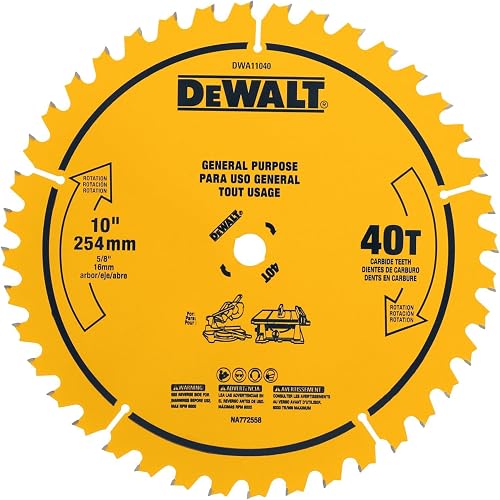
DEWALT Table Saw Blade: Best for a simple fine-finish replacement
DEWALT Table Saw Blade: Best for a simple fine-finish replacement
- 10-inch diameter
- 40 teeth
- Ultra-sharp carbide
- Optimized tooth geometry
The 40-tooth layout offers a middle point between coarse ripping and high-tooth-count finishing. DEWALT gives it optimized tooth geometry and ultra-sharp carbide for wood cutting.
Pros
- 40-tooth middle-ground layout
- Ultra-sharp carbide
- 10-inch replacement size
Cons
- Kerf is not stated here
- Less specialized than the rip and plywood picks
The DEWALT Table Saw Blade is a straightforward 10-inch option for a middle tooth count. Its 40 teeth sit between fast 24-tooth blades and smoother 60- or 80-tooth choices.
The DWA11040 uses ultra-sharp carbide and optimized tooth geometry for clean cutting. DEWALT also claims up to 3X life, a brand claim rather than a guarantee for every situation.
No kerf measurement is stated, so confirm that detail if minimizing material removal drives your purchase. The 10-inch diameter and wood use still make it a practical replacement for a compatible saw.
Choose it for general cutting in a 40-tooth layout. Choose a published narrow kerf when exact material savings matter.
Daily, 40 teeth suit mixed crosscuts and moderate rips. It will not clear long grain as fast as 24 teeth, nor finish as finely as 80 teeth.
That middle position appeals to mixed shops. You avoid frequent changes while keeping a reasonable balance of speed and edge quality.
Clean teeth and plate after resinous cuts and inspect for damage before storage. Confirm diameter, arbor and guard clearance before fitting.
The limit is missing detail, not tooth count. Compare kerf, coating and speed specs across other options if those matter.
Freud Thin Kerf Ultimate Plywood & Melamine: Best for plywood and melamine
Freud Thin Kerf Ultimate Plywood & Melamine: Best for plywood and melamine
- 10-inch diameter
- 80 teeth
- Hi-ATB geometry
- Perma-Shield coating
The 80-tooth Hi-ATB design targets smooth, chip-free edges in veneered plywood, melamine, laminates, mouldings and crosscuts in solid wood.
Pros
- Highest tooth count here
- Hi-ATB design for fine edges
- Anti-vibration slots
Cons
- Slower choice for routine ripping
- Confirm the 5/8-inch arbor
The Freud Thin Kerf Ultimate Plywood & Melamine blade is the strongest choice for clean edges in veneered plywood, melamine and laminates. Its 80-tooth Hi-ATB design gives it the highest tooth count in this group.
The 10-inch LU79R010 uses a premium TiCo crosscutting carbide blend, laser-cut anti-vibration slots and a Perma-Shield coating. Freud describes those features for reducing tear-out, vibration, heat and pitch buildup during finish work.
It also suits fine mouldings and crosscuts in solid wood. The trade-off is speed: an 80-tooth blade is a more specialized finish choice than a 24-tooth rip blade.
Pick it when the cut edge will remain visible or when coated sheet goods are part of your regular work. Check the arbor before installation and support the sheet to reduce movement during the cut.
In daily use, extra support helps large sheets stay stable and keeps the cut line true. A scorer can help in some cases, but Freud describes this blade as not needing a stabilizer or scoring blade.
Feed the material at a steady pace and avoid forcing it through the cut. A calm feed helps the Hi-ATB teeth shear the surface instead of tearing it.
Clean pitch from the blade after cutting coated or resinous material. Buildup can undo the coating benefits and make edges rougher.
The main limit is pace for routine ripping. Keep this blade for finish work, and use a coarser blade when stock removal matters more.
DEWALT 10-Inch Miter / Table Saw Blade: Best for coarse general ripping
DEWALT 10-Inch Miter / Table Saw Blade: Best for coarse general ripping
- 10-inch diameter
- 24 ATB teeth
- Thin kerf
- 5/8-inch arbor
The 24-tooth ATB pattern and thin kerf suit fast, smooth cutting in compatible miter and table saws. It is a practical choice when speed matters more than a polished edge.
Pros
- Fast 24-tooth layout
- Thin kerf
- Computer-balanced plate
Cons
- Coarser finish than high-tooth-count blades
- High-speed steel construction
The DEWALT 10-Inch Miter / Table Saw Blade fits buyers wanting a thin kerf blade for quick general cuts. Its 24-tooth ATB pattern favors ripping and fast removal over a polished edge.
The DW3112 has a 10-inch diameter and 5/8-inch arbor. DEWALT describes a computer-balanced plate for less vibration and a wedge shoulder placing more steel behind each tip.
Product information lists engineered wood use. The blade is high-speed steel, so compare it with carbide options for frequent plywood or hardwood work.
Choose it when speed matters and you have a compatible miter or table saw. For finer crosscuts, move to a 50-, 60- or 80-tooth blade.
Daily, it suits rough sizing and construction cuts where finish is secondary. Thin kerf reduces removal while low tooth count clears waste quickly.
Set height carefully and support stock on both sides. On a miter saw, hold short offcuts firmly so they cannot shift.
Clean resin when cuts slow and inspect teeth before use. A dull blade can burn the edge and make coarse work harder.
Carbide options may suit frequent hardwood or plywood better. Confirm arbor and guard clearance, with the saw manual as final guide.
CMT Orange Tools 256.050.10: Best for softwood and plywood combinations
CMT Orange Tools 256.050.10: Best for softwood and plywood combinations
- 10-inch diameter
- 50 teeth
- 4 ATB plus 1 flat tooth pattern
- 0.102-inch kerf
The 50-tooth combination pattern works with softwood, hardwood and plywood on compatible table or radial arm miter saws. Its 4 ATB plus 1 flat tooth layout supports mixed cuts.
Pros
- Combination tooth pattern
- Carbide construction
- Anti-vibration design
Cons
- Widest kerf in this roundup
- Less focused on ultra-fine finish work
The CMT Orange Tools 256.050.10 is a combination blade for softwood, hardwood and plywood. Its 4 ATB plus 1 flat tooth pattern gives the 50-tooth blade a mixed-cut layout rather than a dedicated rip or finish profile.
It has a 10-inch diameter, a 5/8-inch bore and a stated 0.102-inch kerf. That is the widest kerf in this roundup, so it is less focused on maximum material savings than the FOXBC and Freud thin kerf options.
CMT describes a hardened laser-cut plate, expansion slots, anti-vibration design and micrograin carbide teeth. The blade works with table saws and radial arm or miter saws.
Choose it when broad material coverage matters more than the narrowest cut. If you are comparing kerf measurements across saw types, read What Is Kerf on a Miter Saw Blade? for the basic measurement.
How do you choose a thin kerf table saw blade?
Choose the blade by tooth count, tooth pattern, kerf, arbor and the material you cut most often. A 24-tooth blade is aimed at faster ripping, while 60- and 80-tooth blades are better suited to visible crosscuts and sheet goods.
What tooth count is best for table saw work?
A 40- to 50-tooth blade is a useful middle ground for mixed work. The DEWALT 40-tooth blade and the Freud and HARDWIN 50-tooth combination blades suit buyers who do not want to switch blades often.
Choose 24 teeth for long rips through wood. Choose 60 or 80 teeth when a cleaner crosscut or sheet-good edge matters more than fast stock removal.
Is a thinner kerf always better?
A thinner kerf can reduce material waste and cutting resistance, but it does not automatically produce the best cut. Tooth shape, blade stiffness, feed rate, material support and the saw's setup also affect the result.
Compare the stated measurements carefully. The FOXBC fine-finish blade has a 0.087-inch kerf, HARDWIN has a 0.098-inch kerf, and CMT has a 0.102-inch kerf.
What arbor size should you check?
Check that the blade arbor matches the saw before buying. Many products here use a 5/8-inch arbor, including the FOXBC 10-inch blades, the Freud LU83R010 and the DEWALT DW3112.
Also confirm the blade diameter, maximum rated speed and the saw guard's clearance. The TWIN-TOWN model is 8-1/4 inches, so it needs a compatible saw rather than a standard 10-inch setup.
How should you set up and care for a thin kerf blade?
Turn off and unplug the saw before changing a blade. Seat it in the correct direction, secure the arbor hardware, and set height so teeth clear the work without unnecessary exposure.
Check diameter, arbor and guard fit. A thin kerf blade still needs full guard coverage and firm mounting.
Keep table, fence and supports aligned. Feed steadily without forcing, use push tools, and remove pitch with a cleaner made for saw blades.
Clean table and fence before starting, since dust and offcuts can shift work. A clear area also helps you watch the cut line.
Support long boards and large sheets so they do not tip or bind. Use a helper, outfeed support or extra hands to keep stock stable.
Use push sticks or blocks near the blade. Plan cuts so you do not reach over it, and keep the feed path clear.
A dull or dirty blade raises resistance and heat. Stop if it vibrates, binds or leaves a strange edge, then check blade, alignment and support.
Watch for sound and feel changes. They can signal buildup, a dull tooth or a setup problem.
Clean the blade after resinous or coated material and store it dry. Wipe the plate and check teeth before next use.
Inspect arbor hole, teeth and plate for damage. Replace a bent, cracked or missing-tooth blade.
Keep the manual close for speed limits, guard rules and direction. Good setup and steady habits do more than force for a clean cut.
Which thin kerf table saw blade should you buy?
The FOXBC 10 Inch Thin Kerf Fine Finish is best for most readers wanting smooth crosscuts and a narrow 0.087-inch kerf. Pick the FOXBC 24-tooth flat-tooth blade for ripping, the Freud LU79R010 for plywood and melamine, and the Freud LU83R010 for one-blade mixed work.
That short list covers main jobs. A ripping blade handles long grain, a high tooth count handles coated sheet goods, and a combination blade covers the middle.
For a compact saw, choose TWIN-TOWN only when its 8-1/4-inch size and 5/8-inch arbor match your equipment. Diameter is a hard limit.
Check arbor, diameter, guard clearance and speed rating before buying. Those checks matter more than badge or score.
If miter saw work matters too, compare the Best Miter Saw Blade and plan setup with a Best Miter Saw Table. A table saw blade may not suit short miter cuts the same way.
Think about material you cut most often, not once a year. That points to the right tooth count and pattern for daily use.
Consider blade change frequency too. One combination blade saves time, while dedicated blades give clearer ripping or finish advantages.
Clean and store your chosen blade carefully. Pitch, rust and damage can reduce edge quality faster than normal wear.
Keep the saw manual as the final check for fit and safe use. When checks point to one blade, buy it and learn its habits on your most common work.
Our top 3 picks at a glance
-
1
Best for smooth mixed-shop crosscuts
FOXBC 10 Inch Thin Kerf Fine Finish
9.7/10 our score
See it on Amazon -
2
-
3
Best for one-blade versatility
Freud LU83R010 Industrial 10-in 50T Thin Kerf
9.4/10 our score
See it on Amazon