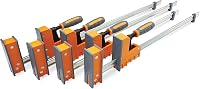
9 Best Parallel Clamps for Woodworking (November 2026)
The best parallel clamps for woodworking include the VEVOR 31" and 24" Parallel Bar Clamp for mixed-size glue-ups, the Bora Parallel Clamps 4 Pack for broad padded jaws, and the JORGENSEN 36-Inch Parallel Bar Clamps Set for high-pressure 36 in work.
On this page (7 sections)
- The best parallel clamps for woodworking by use
- What should you check before buying parallel clamps?
- How do you set up parallel clamps for a square glue-up?
- Do you need parallel clamp blocks?
- Are long parallel clamps worth storing?
- Can you use parallel clamps for miter-saw work?
- Which parallel clamp should you choose?
The best parallel clamps for woodworking are the VEVOR 31-inch and 24-inch 4-pack for most shops. It combines two useful lengths, 1,100 lb load capacity, soft rubber pads and reversible jaws for clamping or spreading.
You get two 24-inch clamps for compact work and two 31-inch clamps for wider panels. That mix suits builders who move between small boxes and wider cabinet parts.
The 1,100 lb load limit covers everyday glue-ups, furniture assembly and cabinet work. Parallel faces spread pressure across the edge to keep joints closed and parts square.
Soft rubber pads reduce dents or cracks on softer woods and finished faces. Reversible jaws also add spreading use for internal support and correction.
For large cabinets, the 50-inch JORGENSEN gives the longest reach and 2,200 lb of clamping force. For smaller case work, the 18-inch BESSEY is lighter and simpler to store.
Parallel clamps are one part of a complete woodworking clamps buying guide. They do the heavy work on panel glue-ups, carcass assembly and frame work.
If you need narrower or more general-purpose tools, compare these picks with the best bar clamps for woodworking. Measure your widest panel before you choose a length, and think about clamp count as well as size.
Our picks at a glance
-
1

-
2

-
3
 Best for high-pressure 36 in work
JORGENSEN 36-Inch Parallel Bar Clamps Set
9.4/10 our score
See it on Amazon
- 4
 Check it
JORGENSEN 50-Inch Parallel Bar Clamps
Best for long cabinet panels - 5
 Check it
VEVOR 24" Parallel Bar Clamp Set
Best for standard 24 in panels - 6
 Best for a single premium clampCheck it
- 7
 Check it
SpeTool 24 inch Panel Clamps 2Pack
Best for flush panel joints - 8
 Check it
WEN 24-Inch 2000-Pound Parallel Jaw Clamp
Best for repeatable 24 in setups - 9
 Best for smaller case workCheck it
The best parallel clamps for woodworking by use
The best choice depends on panel size, clamp count and the pressure you need. The VEVOR and Bora sets cover common 24-inch and 31-inch work, while JORGENSEN and BESSEY solve longer or more specialized jobs.
Our score weighs specs, features and buyer feedback against what you're shopping for. We compared the stated sizes, pressure, jaw design, pack size and useful setup features.
| Product | Best for | Sizes | Pack | Load limit | Our score |
|---|---|---|---|---|---|
| VEVOR 31" and 24" Parallel Bar Clamp | mixed-size glue-ups | 24 in and 31 in | 4 clamps | 1,100 lb | 9.6 |
| Bora Parallel Clamps 4 Pack | broad padded jaws | 24 in and 31 in | 4 clamps | 9.5 | |
| JORGENSEN 36-Inch Parallel Bar Clamps Set | high-pressure 36 in work | 2 clamps | 2,200 lb | 9.4 | |
| JORGENSEN 50-Inch Parallel Bar Clamps | long cabinet panels | 2 clamps | 9.2 | ||
| VEVOR 24" Parallel Bar Clamp Set | standard 24 in panels | 2 clamps | 1,500 lb | 8.9 | |
| BESSEY KRE3540 | a single premium clamp | 1 clamp | 8.7 | ||
| SpeTool 24 inch Panel Clamps 2Pack | flush panel joints | 2 clamps | 8.4 | ||
| WEN 24-Inch 2000-Pound Parallel Jaw Clamp | repeatable 24 in setups | 2 clamps | 8.2 | ||
| BESSEY KRJR-18 K Body REVO JR | smaller case work | 1 clamp | 7.9 |
VEVOR 31" and 24" Parallel Bar Clamp: Best for mixed-size glue-ups
- 2 x 24 in and 2 x 31 in clamps
- 1,100 lb load limit
- 4-pack
- Clamp and spreader modes
Two clamp sizes cover small and larger panels, while the reversible jaws add spreading use.
Pros
- Mixed 24 in and 31 in sizes
- 4-pack
- Soft rubber pads
Cons
- Heavier 27.3 lb set
- Lower load limit than the 2,200 lb picks
The VEVOR set is the strongest all-around choice when you want several clamps in two common lengths. It includes 2 x 24-inch and 2 x 31-inch clamps, so you can match the tool to smaller panels or broader cabinet parts.
Each clamp has a stated 1,100 lb load limit. That level suits daily woodworking and assembly tasks involving wood, furniture, cabinets and steel for cutting, joining and installation work.
The parallel faces provide even pressure and accurate alignment during gluing or assembly. They help keep the workpiece firmly in place while the joint sets and the glue cures.
Soft rubber clamping pads help avoid dents or cracks on the workpiece surface. They also give better grip than standard hard pads, which can make setup feel more secure.
The PA6 handles use 30% glass fiber, and the bars use 45# carbon steel. That steel provides strong bend and wear resistance for smooth long-term use in a busy shop.
The ergonomic handle is built for heavy tightening without feeling harsh in the hand. Quick release operation helps you slide the jaw into position and remove the clamp when the work is done.
The jaws reverse for spreading use. That gives the 4-pack more flexibility for internal support or correction, although the 27.3 lb set needs a firm storage location.
Bora Parallel Clamps 4 Pack: Best for broad padded jaws
- 2 x 24 in and 2 x 31 in clamps
- 3.5 in padded jaws
- 1,100 lb clamping pressure
- Passive lock jaw
The mixed-size set combines wide padded jaws with a passive lock jaw for cabinet and furniture glue-ups.
Pros
- 3.5 in padded jaws
- Passive lock jaw
- 4-piece set
Cons
- No 36 in or 50 in clamp in this set
- 1-year warranty
The Bora 4-pack is a close match to the VEVOR set, with 2 x 24-inch and 2 x 31-inch clamps for mixed-size woodworking. Its key difference is the 3.5-inch wide padded jaw, which gives a broad contact area across the workpiece.
The set provides 1,100 lb of clamping pressure. That fits cabinet glue-ups, furniture builds, boxes and case assemblies where you want firm pressure across a larger face.
The padded jaw grips gently but firmly, even when winding tight. That helps protect the surface while still holding the parts in alignment during a glue-up.
A passive lock jaw holds the lower jaw in position while you tighten. It prevents slippage and helps ensure accurate, consistent clamping pressure every time you set the clamp.
The large, easy-grip handle allows quick sliding and adjustment. It supports one-handed use when you are positioning the jaw with the other hand on the workpiece.
The reversible jaw also allows quick cabinetry work and spreading tasks. That adds versatility when a project needs internal support rather than outside pressure.
Choose Bora if wide padded jaws and secure jaw positioning matter most. Choose VEVOR if soft rubber pads, a stated 2-in-1 design and the lower score-leading price tier are more important to your buying decision.
JORGENSEN 36-Inch Parallel Bar Clamps Set: Best for high-pressure 36 in work
- 36 in clamps
- 2,200 lb load limit
- 2-pack
- Clamp and spreader modes
This 2-pack suits wider glue-ups where a rigid steel bar and high clamping force matter.
Pros
- 2,200 lb load limit
- 36 in length
- Clamp stand included
Cons
- Only 2 clamps
- Longer bar needs more storage space
The 36-inch JORGENSEN is the right step up when 24-inch and 31-inch clamps do not give enough reach. Its 2,200 lb load limit suits larger glue-ups, furniture repairs, cutting board assembly and cabinet work.
The rigid steel bar is designed to resist flexing under pressure. That rigidity helps keep even pressure across wide workpieces where a thinner bar might bow.
The upgraded steel screw thread delivers consistent clamping force. It helps prevent warping during precise glue-ups and keeps cabinet assembly parts secure while they set.
A quick-release trigger enables safe repositioning without losing alignment. That is useful during glue-ups on drawers or frames when you need to adjust the jaw position quickly.
The sliding jaw reverses for spreading without tools. Quick clamp-to-spreader conversion makes the set versatile for separating tasks as well as clamping.
This is a 2-pack, so it gives you two long clamps rather than the four shorter tools in the VEVOR and Bora sets. The included 2-in-1 glue separator and clamp stand raises the bar from the surface during use.
The Soft Landing System prevents the sliding jaw from falling when carried vertically. Replacement jaw pads help protect the workpiece and improve glue resistance over time.
Pick this set for wider work where high pressure and 36-inch length matter. Add more clamps if your panel needs pressure at several points along the joint.
JORGENSEN 50-Inch Parallel Bar Clamps: Best for long cabinet panels
- 50 in clamps
- 2,200 lb clamping force
- 2-pack
- Replacement jaw pads and clamp stands
The 50-inch reach gives large panels and long cabinet assemblies more room between the jaws.
Pros
- Longest clamps here
- 2,200 lb force
- Replacement pads included
Cons
- Too long for small projects
- Only 2 clamps
The 50-inch JORGENSEN is the best fit for long cabinet panels and broad assemblies that need more jaw reach. It keeps the 2,200 lb clamping force of the 36-inch model while extending the stated size to 50 inches.
The alloy steel bar, quick-release trigger and reversible sliding jaw support the same clamp-to-spreader workflow. The Soft Landing System helps keep the sliding jaw from falling when the clamp is carried vertically.
This 2-pack includes replacement jaw pads and 2-in-1 glue separator and clamp stands. Those included parts add practical value for repeated glue-ups and help keep the bar raised from the work surface.
Its length is also the main trade-off. Measure your storage space and workbench before choosing 50-inch clamps for smaller projects.
A woodworking clamp rack can help keep long clamps organized between glue-ups.
VEVOR 24" Parallel Bar Clamp Set: Best for standard 24 in panels
- 24 in clamps
- 1,500 lb load limit
- 2-pack
- High carbon steel bar
A straightforward 24-inch pair for standard panel work, furniture assembly and projects needing two clamps.
Pros
- 1,500 lb load limit
- 24 in jaw opening
- Extended rod
Cons
- Only 2 clamps
- No mixed sizes
The VEVOR 24-inch set is a practical choice when your projects usually fit within a standard 24-inch opening. The pair provides a 1,500 lb load limit and an extended rod for workpieces with different thicknesses.
That stated load limit sits above the 1,100 lb VEVOR and Bora sets. It suits cutting, joining and installation work with wood, wood furniture and steel materials.
The PA6 handle uses 30% glass fiber, while the slide bar uses 45# carbon structural steel. The reinforced plastic is harder and more durable than commonly used ABS.
The parallel clamp jaw ensures a complete and tight fit on the workpiece. Even contact helps hold parts square during assembly and reduces the risk of shifting under pressure.
The 24-inch jaw opening provides adjustment space for precise positioning. It accommodates various standard-sized woods without forcing you to use an oversized clamp.
The 2-pack is easier to store than a mixed 4-pack or 50-inch pair. It also gives you two matching clamps for a small panel glue-up, although you may need more tools for a long joint.
Simple operation helps save time during processing. A clear user manual walks through locking, sliding and release steps for new users.
Choose it when 24 inches is enough and you want more stated load capacity than the 1,100 lb sets. It does not give you the second length that makes the larger VEVOR set more flexible.
BESSEY KRE3540: Best for a single premium clamp
- 40 in clamp
- 1,700 lb nominal force
- 90-degree clamping
- Removable glue-resistant pressure caps
This single 40-inch K Body REVO clamp offers large contact surfaces and controlled pressure for case work.
Pros
- 40 in reach
- 1,700 lb force
- Oversized clamping surfaces
Cons
- Single clamp
- Higher cost per clamp than a multi-pack
The BESSEY KRE3540 is the strongest single-clamp pick for buyers who want a 40-inch K Body REVO. It provides 1,700 lb of nominal clamping force and large contact surfaces that distribute pressure across the workpiece.
The oversized faces suit cabinetmakers, carpenters, joiners and kitchen fitters. They allow strong, precise and gentle clamping of large areas without damaging the material.
The operating jaw stays where you position it during setup. That helps you place the clamp, hold the workpiece and then apply force without the jaw drifting.
Non-marring pads and rail protection pieces help protect the workpiece, while three removable pressure caps resist glue, paint and grease solvents. Cleanup is easier because dried glue can be removed from the caps.
The cold drawn steel rail bar supports nominal 90-degree clamping. The ergonomically formed 2-component handle includes a steel socket for a hex key or driver when hand pressure alone is not enough.
This is one clamp, not a multi-pack. It suits adding a longer clamp to an existing collection, but a new shop will need several clamps for even pressure across a broad panel.
Choose the KRE3540 when its 40-inch reach, 90-degree clamping and oversized faces fit your work. Choose a pack if you need several matching tools at once.
SpeTool 24 inch Panel Clamps 2Pack: Best for flush panel joints
- 4-way pressure
- Panels up to 24 in wide
- 1/4 in to 3 in thickness
- 2-pack
Parallelogram couplers apply pressure in two directions, helping with flat panels and flush joints.
Pros
- 4-way pressure
- Steel construction
- Works across 1/4 in to 3 in thickness
Cons
- Panel clamp design differs from standard bar clamps
- Limited to panels up to 24 in wide
The SpeTool 24-inch panel clamp differs from a standard parallel bar clamp because it applies pressure in two directions. Its parallelogram couplers help press panels flat while fixed pins apply vertical pressure for flush joints.
That 4-way action helps bring boards into the same plane while the joint closes. It does more than only squeeze the edges together.
The 2-pack handles panels up to 24 inches wide and thicknesses from 1/4 inch to 3 inches. That range fits cutting boards, tabletops, wide door panels, cabinet tops and thick bench tops.
Tightening the screw device applies horizontal force for flat panels. Inserting a fixed pin applies vertical force for flush joints, so each force has a clear job.
The steel pipe body has a durable powder-coat finish and copper thread bushing. The bushing helps keep the retaining pins strong through repeated use.
Glue residue can be removed from the treated surface by hand or with a knife. Cleaning after each use still matters, because buildup can affect how the couplers move.
Follow the instructions or video guide and learn pin placement before a glue-up. Correct placement creates the second direction of pressure.
Choose SpeTool when flat panels and flush joints are the main problem. If you need a general clamp for cabinet assembly or spreading, a standard parallel bar design may fit better.
WEN 24-Inch 2000-Pound Parallel Jaw Clamp: Best for repeatable 24 in setups
- 24 in capacity
- 2,000 lb force
- 4-1/8 in throat
- Removable non-marring jaw pads
The WEN pair combines a 24-inch capacity with a rail scale, workpiece supports and a spreader function.
Pros
- 2,000 lb force
- 4-1/8 in throat
- Rail scale
Cons
- Composite resin construction
- Only 2 clamps
The WEN 24-inch pair suits repeatable setups where a rail scale and workpiece supports matter. Each clamp provides up to 2,000 lb of evenly distributed force, with a 24-inch capacity and 4-1/8-inch throat.
That force level fits tabletops, cabinet faces, cabinet carcasses, panels and fine furniture. The heavy-duty design is aimed at work where even pressure and square alignment both matter.
The 1-13/16-inch wide jaws grip workpieces at exactly 90 degrees. Removable non-marring covers help prevent workpiece damage and accidental glue adhesion.
The rail scale offers a quick preset stop for repeated operations. It helps you return the movable jaw to a familiar position without measuring each time.
The ergonomic handle lifts to slide the movable jaw back into position. A through-hole lets you use a screwdriver for additional leverage when tighter pressure is needed.
Workpiece supports keep the assembly off the rail during setup. A movable rail stand and end stop also help support the clamp while you work.
The sliding jaw flips around to convert the clamp into a spreader in seconds. That conversion adds useful flexibility for internal support and correction.
Pick WEN for 24-inch cabinet faces, tabletops and panels where high stated force and repeatable positioning are useful. It is a 2-pack, so long glue-ups may need additional clamps.
BESSEY KRJR-18 K Body REVO JR: Best for smaller case work
- 18 in capacity
- 900 lb nominal force
- 3-1/4 in throat
- Wooden handle
The compact K Body REVO JR fits smaller panels and frames while keeping the same parallel-clamp approach.
Pros
- Compact 18 in size
- 900 lb force
- Spreader conversion
Cons
- Shortest capacity here
- Single clamp
The BESSEY KRJR-18 is the compact choice for smaller frames, panels and case parts. Its 18-inch capacity, 3-1/4-inch throat and 900 lb nominal force suit work that does not need a long bar.
The K Body REVO JR uses a wooden handle and large clamping surfaces. The oversized faces distribute force evenly for furniture making, restoration and cabinet construction on a smaller scale.
Non-marring pads and rail protection pieces help limit marks on the workpiece. The rail protectors isolate the clamp from the steel rail, which helps avoid discoloration or staining with some woods and glues.
The removable end stop lets you reverse the operating head for spreading. That conversion gives the single clamp a second role during assembly and correction work.
Slide-on plastic jaw protector pads can be removed for cleaning and replacement when worn. The operating jaw stays where you put it, so you can position the clamp, set the workpiece and then apply force without constant adjustment.
This is a single clamp, so one clamp cannot maintain even pressure across a large panel by itself. Choose it when storage space and smaller workpieces matter more than maximum reach.
For long cabinet panels, step up to the 36-inch or 50-inch JORGENSEN instead.
What should you check before buying parallel clamps?
The most important checks are jaw length, clamp count, pressure and jaw protection. Match the clamp opening to the widest workpiece you expect to assemble, then decide how many pressure points your glue-up needs.
A 24-inch clamp is a useful size for many standard panels. The 31-inch VEVOR and Bora options add room for larger work, while the 36-inch and 50-inch JORGENSEN clamps suit long cabinet parts.
Clamping force is not the only deciding factor. More pressure can help hold an assembly, but correct alignment and even spacing still matter.
Look at jaw surfaces as well. Bora has 3.5-inch padded jaws, WEN has 1-13/16-inch wide jaws and a 4-1/8-inch throat, and BESSEY emphasizes oversized contact surfaces.
How do you set up parallel clamps for a square glue-up?
Set the clamps on a stable surface, place the workpieces between parallel jaws and tighten gradually while checking the assembly for square. Use the lowest pressure that holds the parts securely and keeps the joint closed.
Keep the jaws aligned with the workpiece edges. If one clamp sits at an angle, it can push the assembly sideways instead of keeping the panel faces aligned.
Use protective pads where the design includes them. Glue-resistant or removable pads also make cleanup easier after the joint cures.
For a deeper explanation, start with what a parallel clamp is. If your workpiece needs a broader contact setup, review how to choose parallel clamp blocks.
Do you need parallel clamp blocks?
Parallel clamp blocks can help keep the clamp bar and workpiece in a controlled position during a glue-up. They are most useful when the workpiece needs extra clearance or when you want a repeatable setup.
Blocks work best as a support aid, not as a replacement for clamping force. They help steady the assembly while the real pressure comes from the parallel jaws.
Choose blocks that match your clamp design and the thickness of your workpiece. A poor fit can block jaw movement or push the assembly out of alignment.
The goal is to support the assembly without blocking the jaws or changing the pressure direction. Keep the contact faces flat and parallel so the force stays even across the joint.
Blocks are especially helpful on wide panels where a small shift can throw the whole glue-up out of square. They give a stable reference point while you tighten the clamps in sequence.
They also help when you repeat the same setup for matching parts. Once blocks are placed in a known position, you can return to that setup with less measuring and checking.
Use blocks with gradual tightening and visual checks from both sides of the panel. Tighten a little, check for square, then tighten a little more.
Keep blocks clean and free of dried glue. A clean, flat support surface gives predictable results and makes cleanup after the cure much simpler.
Are long parallel clamps worth storing?
Long parallel clamps are worth storing when you regularly assemble wide cabinets, long frames or broad panels. The JORGENSEN 50-inch pair gives the most reach here, while the 36-inch pair is easier to match to medium-size work.
Reach matters only when the workpiece needs it. A long bar lets the jaws sit fully on the workpiece instead of forcing a cramped setup at the edge of the panel.
Long clamps take more wall or bench space. Plan a vertical rack or a clear wall section before you buy, because leaning long bars in a corner rarely keeps them safe or easy to reach.
If most of your projects are smaller than 24 inches, a 24-inch pair or the 18-inch BESSEY may be easier to handle. Shorter bars are lighter to lift, quicker to position and simpler to store.
Weight also grows with length. A 50-inch clamp can be tiring to hold steady while you open the jaw and place the workpiece, so a stable bench helps during setup.
Long clamps earn their space when they prevent removing parts or adding extensions to a glue-up. For occasional oversized work, one long pair may be enough for the whole shop.
Compare the best long clamps for woodworking if your projects regularly exceed the reach of standard clamps. Measure both the workpiece and your storage area before choosing.
Can you use parallel clamps for miter-saw work?
Parallel clamps are mainly for holding parts during assembly and glue-ups, not for replacing a dedicated saw clamp. A miter-saw setup needs a clamp that fits the saw, fence and workpiece without entering the blade path.
A parallel clamp jaw is wide and flat, which suits panel pressure. On a saw, that same width can interfere with the fence or the blade travel, so the fit needs careful checking.
Use a parallel clamp to hold a workpiece for assembly after cutting, rather than to hold it during the cut. That keeps the clamp doing the job it was designed for.
For that task, compare the Best Miter Saw Clamp and read How To Use Miter Saw Clamp? before cutting. Keep every clamp outside the blade's travel area.
A dedicated saw clamp is shaped for the saw table and fence. It keeps the workpiece steady without pushing the operator's hands toward the blade.
If a parallel clamp must be used nearby, test the full setup with the saw unplugged first. Confirm there is no contact with the blade path at any angle.
Which parallel clamp should you choose?
Choose the VEVOR 31-inch and 24-inch 4-pack if you want the broadest mix of sizes for common woodworking glue-ups. Choose Bora if wide padded jaws and a passive lock jaw are your priority.
Pick the 36-inch JORGENSEN for high-pressure medium-large work, or the 50-inch version for long cabinet panels. Both give you 2,200 lb of clamping force for wider assemblies.
Choose BESSEY when you want a single 40-inch or compact 18-inch clamp with large contact surfaces. The K Body design suits buyers who want one premium tool rather than a multi-pack.
For a 24-inch panel, VEVOR, WEN and SpeTool each solve a different problem. Pick VEVOR for a standard bar clamp, WEN for repeatable setup and higher stated force, or SpeTool for two-direction panel pressure.
Match the final choice to your most common workpiece size. The best clamp is the one that fits your panels, your storage space and the pressure points your glue-ups need.
Our top 3 picks at a glance
-
1
-
2
-
3
Best for high-pressure 36 in work
JORGENSEN 36-Inch Parallel Bar Clamps Set
9.4/10 our score
See it on Amazon
Frequently asked questions
What are parallel clamps used for in woodworking?
Parallel clamps hold panels, cabinet parts, frames and other workpieces with opposing jaws that stay parallel. That shape spreads pressure across the edge instead of concentrating it at one small point.
They are useful for glue-ups where square alignment and even pressure matter.
How many parallel clamps do you need for a panel glue-up?
Most panel glue-ups need several clamps spaced along the joint, but the exact number depends on panel length, thickness and the glue-up method. A 4-pack gives you more starting coverage than a 2-pack.
Use enough clamps to maintain even contact without over-tightening.
Are longer parallel clamps better?
Longer parallel clamps are better only when the workpiece needs more jaw reach. A 50-inch clamp suits long cabinet panels, while an 18-inch or 24-inch clamp is easier to store and better matched to smaller assemblies.
Measure the panel before choosing clamp length.
Can parallel clamps be used as spreaders?
Yes, several clamps in this roundup convert to spreaders by reversing or flipping the jaw. That helps with internal support and correction during assembly.
Check the specific design before buying because the conversion method differs between models.