What Is the Difference Between a Sliding and Non-sliding Miter Saw?
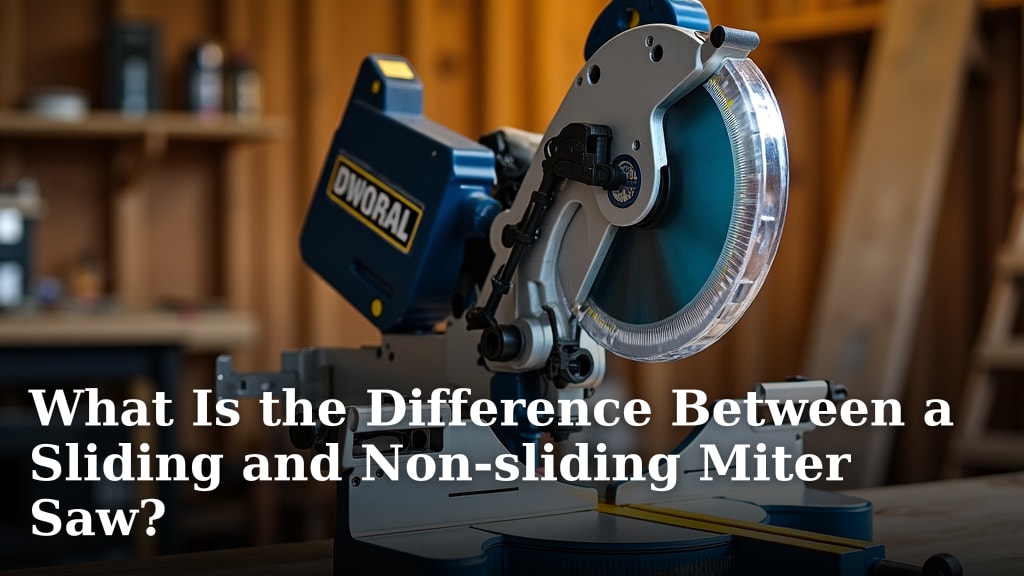
The main difference between a sliding and non-sliding miter saw is how far the blade can cut across your material. A sliding miter saw moves the blade along rails, letting you cut much wider boards. A non-sliding miter saw (or standard miter saw) has a fixed pivot point, limiting its cut capacity.
Choosing the right saw really depends on your projects and what kind of materials you work with often. Do you need to cut wide planks for flooring or trim? Or are you mostly making smaller cross-cuts on narrower pieces? We found that each saw offers distinct advantages for different tasks.
- Sliding miter saws handle wider materials.
- Non-sliding miter saws are more compact.
- Sliding saws often cost more and take up more space.
- Non-sliding saws are lighter and more portable.
- Both saws excel at precise angle cuts.
Let’s dive into the specifics of each saw. We’ll help you figure out which one is the perfect fit for your workshop.
Comparing Sliding vs. Non-Sliding Miter Saws
Understanding the core differences between these two miter saw types will help you pick the right tool for your projects. It’s all about how the blade moves and the kind of cuts it can make.
What is a Sliding Miter Saw?
A sliding miter saw has a unique design. The saw head is mounted on horizontal rails or bars. This design lets the blade slide forward and backward across the material.
How it Works
When you operate a sliding miter saw, you pull the saw head towards you. Then, you push it through the workpiece. This sliding action significantly increases the cross-cutting capacity. It’s like having a miniature table saw and a miter saw in one.
- The blade moves along rails.
- Allows for wider cuts.
- Great for larger lumber.
Key Advantages of Sliding Miter Saws
The biggest perk of a sliding miter saw is its ability to cut wide boards. We found that you can easily cut a 2×12 or even wider lumber with many models. This is especially useful for tasks like cutting shelving, decking, or larger trim pieces.
- Increased Cross-Cut Capacity: You can cut boards much wider than the blade’s diameter.
- Versatility: Handles a wider range of projects and material sizes.
- Compound Cuts: Many models offer double bevels, making complex cuts easier.
Research shows that woodworking professionals often choose sliding miter saws for their flexibility and power. They save time and allow for more precise cuts on larger materials.
Considerations for Sliding Miter Saws
While powerful, sliding miter saws have a few drawbacks. They generally cost more than non-sliding models. They also take up more space in your workshop due to the rails extending backward.
- Higher Cost: Expect to pay more for a sliding model.
- Larger Footprint: Requires more bench space or floor space.
- Weight: Can be heavier and less portable.
You’ll need to think about your budget and available workspace. Is the extra cutting capacity worth the investment and space requirement for your typical projects?
What is a Non-Sliding Miter Saw?
A non-sliding miter saw, often called a standard miter saw or chop saw, is simpler. The saw head is fixed at a pivot point. It doesn’t move forward or backward.
How it Works
With a non-sliding miter saw, you simply pull the saw head down. The blade cuts through the material in a straight, chopping motion. The cutting capacity is limited by the blade’s diameter.
- The blade pivots downwards.
- Cuts narrow materials.
- Often used for trim work.
Key Advantages of Non-Sliding Miter Saws
Don’t count out the non-sliding miter saw just yet! It has its own set of strong points. For many common projects, it’s actually the better choice.
- Compact Size: Takes up less space on your workbench.
- Portability: Lighter and easier to move around job sites.
- Lower Cost: Generally more affordable than sliding saws.
- Simplicity: Fewer moving parts can mean less maintenance.
Many DIY enthusiasts and even professional trim carpenters find these saws perfect. They are quick to set up and ideal for repetitive cuts on standard lumber sizes.
Considerations for Non-Sliding Miter Saws
The main limitation of a non-sliding miter saw is its cutting capacity. If you need to cut anything wider than a 2×6 or 2×8 (depending on blade size), you might struggle.
- Limited Cross-Cut Capacity: Cannot cut very wide boards.
- Less Versatile for Wide Stock: Not ideal for large pieces of plywood or decking.
You might find yourself needing to flip boards to complete a cut on wider materials. This can reduce accuracy and take more time. We’ve certainly had to do that on occasion!
Deciding Which Miter Saw is Right for You
Now that you know the ins and outs of each type, how do you choose? It really comes down to your specific needs. Think about the types of projects you typically do and the materials you frequently use.
Project Type Matters Most
Consider your most common tasks. Are you often working on smaller home improvement projects, or are you building large structures?
When a Sliding Miter Saw Excels
If your projects involve cutting wide boards, like laminate flooring, engineered wood, or large deck planks, a sliding miter saw is a game-changer. It makes these tasks much easier and more accurate.
- Installing wide plank flooring.
- Cutting large baseboards or crown molding.
- Building outdoor structures like decks or pergolas.
- Any project requiring cuts on 2x10s, 2x12s, or wider.
We found that many serious DIYers and contractors choose a sliding model for its sheer versatility. It can handle almost anything you throw at it, within its blade size.
When a Non-Sliding Miter Saw is Sufficient
For more common household tasks or precision trim work on narrower materials, a non-sliding miter saw is often all you need. It’s fantastic for standard framing lumber and typical trim sizes.
- Cutting 2x4s for framing.
- Installing door and window casings.
- Making picture frames or small craft items.
- Cutting small molding and trim.
If you’re just getting started with woodworking, a non-sliding saw can be a more approachable and affordable entry point. It’s a great tool for learning the basics of miter cuts.
Space and Portability Considerations
Your workshop size and how often you move your tools are also important factors. Do you have a dedicated workspace or do you move your tools frequently?
- Sliding Saws: Need more back clearance due to rails. Heavier.
- Non-Sliding Saws: Compact. Lighter. Easier to transport.
If you’re setting up a permanent workshop and have ample room, a sliding saw might fit perfectly. But if you’re a mobile contractor or have a small garage, a non-sliding saw might be a better choice for its portability.
Budgeting for Your Miter Saw
Cost is always a factor, right? Generally, sliding miter saws are more expensive than their non-sliding counterparts. The extra moving parts and engineering contribute to the higher price tag.
We’ve observed that a good quality non-sliding miter saw can often be found for half the price of a comparable sliding model. If your budget is tight, a non-sliding saw still offers incredible value and precision for many tasks.
| Feature | Sliding Miter Saw | Non-Sliding Miter Saw |
|---|---|---|
| Cross-Cut Capacity | Very Wide (e.g., 2×12+) | Limited (e.g., up to 2×8) |
| Footprint / Space | Larger (rails extend) | Compact |
| Portability | Less portable (heavier) | More portable (lighter) |
| Cost | Higher | Lower |
| Typical Projects | Decking, flooring, large trim | Framing, door casings, small trim |
Checklist for Choosing Your Miter Saw
To help you make a decision, here’s a quick checklist. Consider each point based on your unique situation.
- Do you frequently cut boards wider than 8 inches?
- Is your workshop space limited?
- How often do you need to move your saw?
- What is your budget for this tool?
- Are you typically making large, structural cuts or fine trim work?
- Do you anticipate needing double bevel capabilities for complex angles?
Your answers to these questions will quickly point you in the right direction. There’s no single “best” saw; there’s only the best saw for your needs.