How to Store Bar Clamps
Store bar clamps vertically or horizontally on a wall rack, with jaws supported and handles easy to reach. Group long clamps by size, keep smaller clamps in a drawer or bin, and leave enough room to remove each clamp safely.
On this page (8 sections)
- What is the best way to store bar clamps?
- How should you store long bar clamps on a wall?
- Can bar clamps be stored vertically?
- How do you organize small bar clamps?
- Should clamps be stored with the jaws open or closed?
- Can spreader clamps share the same storage rack?
- How much space should bar clamp storage have?
- Which bar clamp storage idea should you use?
Store bar clamps vertically or horizontally on a sturdy rack, with the bars supported and the jaws easy to remove. Long clamps need full-length support, while mini bar clamps fit better in a drawer, shallow bin, or compact wall organizer.
Good bar clamp storage ideas keep the tools visible without wasting wall space. They also prevent long bars from leaning into walkways, protect padded jaws from damage, and make it easy to choose the right clamp during a glue-up.
What is the best way to store bar clamps?
Use a wall rack for long bar clamps and a drawer or bin for smaller clamps. The best layout depends on clamp length, available wall height, and how often you need each size.
A horizontal rack works well when you have a clear wall beneath cabinets or above a workbench. It lets you group clamps by length and keeps the bars from resting on the floor.
Vertical storage uses less wall width, but it needs enough height for the longest clamp. Add a lower support or stop so the clamps do not slide sideways when you remove one.
Keep the jaws and handles facing the same direction. This makes the storage area easier to scan and reduces the chance that one clamp will catch another.
If you are still choosing clamp types, our guide to woodworking clamps explains how bar clamps fit with other workshop clamps.
How should you store long bar clamps on a wall?
Support long clamps at 2 points instead of leaning them against a wall. Two supports help keep the bars straight and reduce the chance of a clamp sliding into a walkway.
A simple rack can use two horizontal supports spaced along the wall. The lower support carries part of the weight, while the upper support keeps the clamp from rotating or falling forward.
Measure your longest clamp before fixing the rack. Leave enough clearance above and below the supports to lift a clamp free without striking a shelf, light, or nearby tool.
Group clamps by length, such as short, medium, and long. Put the most-used group between shoulder and waist height if that location lets you remove each clamp with control.
Keep the clamp jaws closed or lightly positioned while stored. This reduces the open span and prevents the jaws from catching nearby clamps.
Which long clamps suit this storage plan?
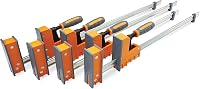
The BORA set includes 2 24 in parallel clamps and 2 31 in parallel clamps, so it suits a rack with separate spaces for medium and longer clamps. Its 3.5 in padded jaws and passive lock jaw make it useful for organized cabinet and furniture glue-ups.
The set has an alloy steel and aluminum construction, an ergonomic handle, and 1,100 lb of clamping pressure. For higher-pressure projects, compare heavy-duty bar clamps.
Those dimensions make a strong rack and clear removal path especially useful.
Place the 24 in clamps in one section and the 31 in clamps in another. That arrangement helps you select a pair without pulling every clamp from the wall.
For selection help before you build the rack, compare best bar clamps for woodworking.
Can bar clamps be stored vertically?
Yes, vertical storage works when the rack supports the bar and prevents tipping. It is a good choice for a narrow workshop wall where a horizontal row would use too much width.
Use a lower ledge, pocket, or stop to support the bottom of each clamp. Add an upper guide that keeps the bars together without pinching the handles or release levers.
Leave space between groups rather than packing every clamp tightly. A small gap gives your fingers room to separate one clamp from the next.
Do not store a long clamp where its end extends into a doorway or work area. A clamp that is secure on the wall can still become a hazard if its bar projects into a path.
Vertical storage also works well beside a lumber rack or at the end of a workbench. Keep the clamps away from areas where boards are lifted or carried.
How do you organize small bar clamps?
Keep small bar clamps in a shallow drawer, open bin, or compact rack at the front of the storage area. Small clamps are easy to lose behind long tools, so visibility matters more than maximum capacity.
Separate clamps by reach and style. Put 6 in clamps together, keep 12 in clamps in another group, and place spring clamps or hand clamps in their own container when they are part of the same storage area.
For metal options, see metal spring clamps.
Use dividers if the drawer is deep enough for clamps to overlap. A shallow tray is often easier because you can see the handles and release triggers without digging.
Small clamps should stay close to the bench if you use them for quick positioning, edge work, or small repairs. Long clamps can occupy a less convenient wall section because they are usually brought out for larger projects.
Which compact set works for mixed small-clamp storage?
The IRWIN set includes 8 pieces: 2 12 in mini one-handed bar clamps, 2 6 in mini one-handed bar clamps, 2 2 in Handi-Clamps, and 2 2 in resin spring clamps. It suits a divided drawer or open bin where several small clamp types need to stay together.
The clamps use reinforced resin, and the mini bar clamps exert up to 150 psi of clamping pressure. Quick-release triggers make it easier to identify and reposition them when the drawer is full.
Keep the 6 in and 12 in mini bar clamps in separate sections. Store the 2 in clamps at the front so they do not disappear beneath longer tools.
If you want more detail on compact choices, see best mini bar clamps.
Should clamps be stored with the jaws open or closed?
Store clamps with the jaws closed or lightly positioned, not fully tightened. A closed position reduces the space each clamp takes and lowers the chance of catching a nearby tool.
Do not clamp a storage rack tightly unless the rack is specifically designed for it. Storage should support the clamp, not keep pressure on the bar or handle for long periods.
Arrange the handles so they face outward. This gives you a clear grip and helps you remove a clamp without pulling against another clamp.
For one-handed clamps, keep the trigger clear of the support. A blocked trigger makes the tool harder to adjust and encourages rough handling during removal.
When putting a clamp away after glue-up, wipe off glue before it hardens. Keep the bar, jaw faces, and handle clear of residue that could interfere with the next use.
For safe use after storage, follow our guide to how to use bar clamps.
Can spreader clamps share the same storage rack?
Spreader clamps can share a rack with bar clamps if the rack supports their bars and leaves room around the jaws. Store them where the spreader position will not catch neighboring tools.
If a clamp converts between clamping and spreading, leave enough open space to change its position without striking a shelf. Keep the release or advancing handle accessible.
Which compact clamps need flexible storage space?
The JORGENSEN set includes 4 6 in light-duty bar clamps with a 2-3/8 in throat depth and a 6 in maximum opening capacity. Each clamp has a plated, round-edge, high-carbon steel bar and a glass-filled nylon advancing handle.
The clamps have a 200 lb normal load limit, soft plastic pads, and an E-Z Hold design that allows clamp or spreader use. Their sliding heads and one-handed handles make a front-access bin useful.
Keep these clamps separate from fixed long clamps if you often use the spreading function. A labeled section prevents you from pulling out a longer clamp when a compact spreader is the better fit.
See best bar clamp spreader for more options built around spreading tasks.
How much space should bar clamp storage have?
Measure the longest clamp, handle clearance, and jaw opening before building storage. The rack needs room for the tool itself and for your hand to remove it.
For horizontal storage, measure the full bar length and add clearance at both ends. For vertical storage, measure from the bottom support to the highest point of the clamp.
Keep storage away from saw blade paths, dust collection hoses, and areas where boards are carried. A rack that blocks another tool will make the shop feel more crowded even if it saves wall space.
Leave room for future clamps if you expect your collection to grow. A rack filled edge to edge is harder to use than one with a few open positions.
You can also review How To Store Miter Saw? and Where To Store Miter Saw? when planning a complete workshop storage wall.
Which bar clamp storage idea should you use?
For long bar clamp storage, choose a two-point wall rack with sections sorted by length. For small clamps, use a shallow drawer or bin with dividers that keep each reach visible.
Choose the BORA set if your storage plan needs 24 in and 31 in parallel clamps for larger assemblies. Choose IRWIN if you need a mixed 8-piece group of compact clamps.
Choose JORGENSEN if 6 in clamps with clamp and spreader use fit your smaller projects.
The best bar clamp storage ideas follow one rule: every clamp should be supported, visible, and removable without moving a pile of tools. Measure first, label by length, and keep the most-used clamps closest to the workbench.
Frequently asked questions
What is the best way to store long bar clamps?
The best way to store long bar clamps is on a wall rack or vertical support that holds the bars straight and keeps the jaws from sliding. Place longer clamps where their full length fits without blocking doors, outlets, or walkways.
Leave enough clearance to lift each clamp free.
Can bar clamps be stored vertically?
Yes, bar clamps can be stored vertically when the rack supports the bar and keeps the clamp from tipping. Group clamps by length, place heavier clamps lower when possible, and make sure the handles and jaws do not project into a walking path.
How do you organize small bar clamps?
Organize small bar clamps in a shallow drawer, open bin, or small wall rack where the handles and release triggers remain visible. Keep 6 in and 12 in clamps in separate groups so you can grab the right reach without moving longer clamps first.
Should bar clamps hang by the handle?
Avoid hanging a bar clamp from a handle unless the rack is designed to support its weight that way. A support under the bar or frame spreads the load and reduces slipping.
Store the clamp with the jaws closed or lightly positioned so loose parts do not catch nearby tools.