9 Best Chamfer Router Bits (November 2026)
The best best chamfer router bits include the Hiltex Router Bit Set for beginners building a first set, the Whiteside Router Bits 2292 Chamfer Bit for trim routers and small edges, and the BOSCH RBS015MBS 15-Piece Carbide-Tipped Wood Router Bits for a branded all-purpose set.
On this page (10 sections)
- Best chamfer router bits for every edge shaping task
- Chamfer router bit comparison: angle, shank and size at a glance
- How we compared these chamfer bits
- What angle chamfer router bit should you buy?
- What shank size chamfer bit fits your router?
- How large a chamfer router bit do you need?
- How do you use a chamfer router bit safely?
- How do you cut a roundover edge after chamfering?
- What other angles pair with chamfer bits for miter work?
- Verdict: which is the best chamfer router bit for you?
The best chamfer router bit for most buyers is the Hiltex Router Bit Set, because it pairs a 45° 1-1/4 inch chamfer bit with 14 other profiles on universal 1/4 inch shanks. If you already own a full set, a dedicated Whiteside or Freud chamfer bit gives you more control over bevel size.
A chamfer router bit cuts a flat angled bevel on an edge. It eases sharp corners, adds a decorative line, and helps two pieces meet in a miter joint.
Our score weighs specs, features and buyer feedback against what you are shopping for. We compared diameter, angle, shank size, cutting length and set contents across all nine picks.
If you are new to routers, start with wood routers for woodworking to match the bit to your router and collet. Shank size matters more than brand for a first purchase.
Our picks at a glance
-
1

-
2
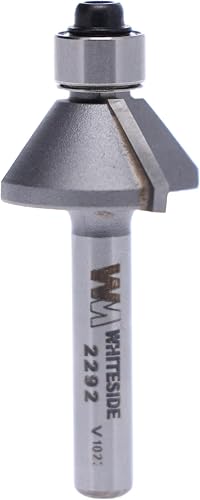 Best for trim routers and small edges
Whiteside Router Bits 2292 Chamfer Bit
9.6/10 our score
See it on Amazon -
3
 Best for a branded all-purpose set
BOSCH RBS015MBS 15-Piece Carbide-Tipped Wood Router Bits
9.5/10 our score
See it on Amazon
- 4
 Check it
Freud 1-5/8" Chamfer Router Bit with Tico
Best for large 45 degree bevels - 5
 Check it
Whiteside Router Bits 2306 Chamfer Bit
Best for extra wide chamfer cuts - 6
 Check it
KOWOOD Plus 45 Degree Chamfer Router Bit
Best for 45 degree size variety on a budget - 7
 Check it
YONICO Chamfer Router Bits Edge Forming
Best for 45 degree edge forming and miters - 8
 Check it
WSOOX 5PCS Chamfer Router Bits with 1/4"
Best for multiple bevel angles - 9
 Check it
Akylin 4Pcs 45° Chamfer Router Bit Set
Best for stepped 45 degree bevels
Best chamfer router bits for every edge shaping task
These nine picks cover small trim router bevels, large 45° bevels, multi angle sets and all purpose starter sets. For profiles aimed at cabinet doors, compare router bit sets for cabinet doors.
Grouping them by job helps you choose faster than sorting by price.
Hiltex Router Bit Set: Best for beginners building a first set
- 15-piece set with 1/4 inch shank
- 45° 1-1/4 inch chamfer bit
- YG8 tungsten carbide tips
- Hardened alloy steel bodies
- Labeled storage case
A complete 15-piece starter set with one 45° chamfer bit and the straight, flush trim and roundover profiles most projects use first.
Pros
- Includes chamfer plus 14 other profiles
- Fits any router with a 1/4 inch collet
- Labeled case keeps bits organized
Cons
- Only one chamfer size in the set
- Packaging may vary between two styles
The Hiltex set suits a beginner who needs one case to cover edge shaping, trimming and simple joinery. Its 15 bits include four straight bits, core box bits, a cove bit, a 90° V-groove, a mortising bit, a roundover, a dovetail, a Roman ogee, a 45° 1-1/4 inch chamfer bit, a panel pilot and a flush trim bit.
Each bit has a universal 1/4 inch shank, so it fits trim routers as well as full size plunge and fixed base routers. The YG8 tungsten carbide tips and hardened alloy steel bodies handle common woods with resistance to heat.
The labeled hard case keeps each bit in its own slot. That matters when you switch profiles mid project and want the right bit without hunting through a drawer.
The trade off against the dedicated chamfer sets is chamfer choice. You get only one chamfer size here, a 45° at 1-1/4 inch, and no stepped range for small easing or large bevels.
If your main job is chamfers, a dedicated set below will serve you better.
Whiteside Router Bits 2292 Chamfer Bit: Best for trim routers and small edges
- 45° angle
- 7/16 inch cutting length
- 1 inch large diameter
- 1/4 inch shank
- Bearing guide on the end
A compact 45° chamfer bit with a 1 inch diameter that fits through a small trim router base plate for light eased edges.
Pros
- Compact size for trim routers
- Bearing guide for aligned cuts
- Carbide tipped for clean edges
Cons
- Small cutting length limits bevel size
- Single profile only
The Whiteside 2292 suits owners of small trim routers who want a clean 45° bevel without stepping up to a full size router. Its cutting length is 7/16 inch, its cutting height is 5/16 inch, and its diameter is 1 inch.
That 1 inch diameter is the key detail. Whiteside states it passes through the base plate on small trim routers.
You can ease a sharp wedge or add visual detail where a larger bit would not fit.
A bearing guide sits on the end of the bit. It helps keep the cut aligned along the edge for a consistent bevel.
The trade off against larger single bits is bevel size. A 7/16 inch cutting length limits how wide the bevel can go, and the 5/16 inch height keeps the cut shallow.
Choose this for light eased edges, not for bold decorative chamfers.
BOSCH RBS015MBS 15-Piece Carbide-Tipped Wood Router Bits: Best for a branded all-purpose set
- 15-piece carbide-tipped set
- Includes 1-3/8 inch x 45° chamfer bit
- Also includes 1 inch x 25° chamfer bit
- Micrograin carbide tips
- Plastic storage case
A 15-piece Bosch set with two chamfer profiles, a 45° and a 25°, plus dovetail, V-groove, rabbeting and trim bits.
Pros
- Two chamfer angles in one set
- Micrograin carbide tips
- Anti-friction coating
Cons
- Chamfer bits are only a small part of the set
- No chamfer size range for fine stepped bevels
The Bosch RBS015MBS set suits a buyer who wants a branded set with more than one chamfer angle. It includes 15 carbide tipped bits in a plastic storage case.
The chamfer bits are a 1-3/8 inch by 45° bit and a 1 inch by 25° bit. That gives you a standard 45° bevel and a shallower 25° bevel for wider, lower profiles.
The rest of the set covers a dovetail, V-groove, slotting, rabbeting, flush trim, Roman ogee, cove, roundover and straight bits. Bosch uses micrograin carbide tips and an anti-friction coating to limit residue build-up.
The set works on soft and hard wood plus wood composites.
The trade off against dedicated chamfer sets is depth of chamfer options. Two chamfer bits help, but there is no stepped range of 45° sizes, so fine control over bevel width still relies on bit height and fence position.
Freud 1-5/8" Chamfer Router Bit with Tico: Best for large 45 degree bevels
- 1-5/8 inch diameter
- 1/2 inch shank
- 5/8 inch height
- 45° angle
- TiCo Hi-Density Carbide
- Maximum RPM 16,000
A large 1-5/8 inch diameter 45° chamfer bit with a 1/2 inch shank for bold, uniform bevels on furniture and cabinetry edges.
Pros
- Large diameter for wide bevels
- Adjustable chamfer size by bit height or fence
- TiCo carbide for hardwoods and composites
Cons
- Requires a 1/2 inch collet
- Too large for small trim router work
The Freud 40-114 suits furniture, cabinetry and millwork projects where a bold uniform chamfer matters. It has a 1-5/8 inch diameter, a 1/2 inch shank, a 5/8 inch height and a 45° angle with two cutters.
You can adjust chamfer size by changing bit height or moving the fence. That flexibility covers fine joinery through larger woodworking tasks without buying several bits.
Freud uses TiCo Hi-Density Carbide for long lasting sharpness. It rates the bit for a maximum RPM of 16,000 and lists solid wood, plywood and composites as suitable materials.
The trade off against the 1/4 inch shank picks is router size. This bit needs a 1/2 inch collet, so it will not fit a 1/4 inch trim router.
It is a full size router choice, not a compact one.
Whiteside Router Bits 2306 Chamfer Bit: Best for extra wide chamfer cuts
- 45° angle
- 1-1/16 inch cutting length
- 3/4 inch cutting height
- 1/2 inch shank
- 2 inch large diameter
- Bearing guide on the end
The widest single chamfer bit here, with a 2 inch diameter and 1-1/16 inch cutting length for large decorative bevels.
Pros
- Widest bevel capacity in this group
- Bearing guide for precise cuts
- Carbide tipped construction
Cons
- Requires a 1/2 inch collet
- Large diameter is awkward for small pieces
The Whiteside 2306 suits a project that needs a very wide 45° bevel on a modern or contemporary edge. It has a 1-1/16 inch cutting length, a 3/4 inch cutting height, a 1/2 inch shank and a 2 inch diameter.
That 2 inch diameter is the largest in this group. It removes a sharp wedge or adds a strong visual detail in fewer passes than a smaller bit.
A bearing guide on the end helps keep cuts precise along the edge. The carbide tipped design balances quality and cost for a range of applications.
The trade off against the Freud 40-114 and smaller bits is control on small work. A 2 inch bit is awkward on narrow pieces and needs a 1/2 inch collet.
Save it for large panels and wide edges.
KOWOOD Plus 45 Degree Chamfer Router Bit: Best for 45 degree size variety on a budget
- 45° chamfer set
- 1/4 inch shank
- Cutting diameters 1/4, 5/16, 3/8 and 1/2 inch
- KOWOOD C3 Carbide
- Heat-treated process
Four 45° chamfer sizes on 1/4 inch shanks, from 1/4 inch to 1/2 inch, for stepping up bevel size without changing angle.
Pros
- Four sizes for gradual bevels
- 1/4 inch shank fits most routers
- C3 carbide with heat treatment
Cons
- Small diameters only, no large bevel option
- Single 45° angle
The KOWOOD Plus set suits a buyer who wants several 45° sizes on one shank size. It includes cutting diameters of 1/4, 5/16, 3/8 and 1/2 inch, all on 1/4 inch shanks.
Those four sizes let you step up bevel width gradually. You can start with a small easing cut, check the look, then move to a larger bit for a bolder bevel.
KOWOOD uses C3 carbide with a heat treated process for durability. The 1/4 inch shank fits handheld routers, table routers and CNC machines listed for this series.
The trade off against the Akylin set and large singles is ceiling. The largest diameter here is 1/2 inch, so wide decorative bevels are out of reach.
Choose this for small to medium 45° chamfers.
YONICO Chamfer Router Bits Edge Forming: Best for 45 degree edge forming and miters
- 45° angle
- 1/2 inch cutting depth
- 1/4 inch shank
- C3 micro-grain tungsten carbide
- Silver induction brazing
A single 45° chamfer bit with 1/2 inch cutting depth on a 1/4 inch shank, suited to eased edges and miter joints.
Pros
- Straightforward 45° profile
- C3 micro-grain carbide
- Works in table mount and handheld routers
Cons
- One size only
- No bearing guide stated
The YONICO 13106q suits a buyer who wants one dependable 45° chamfer bit for edging and miter joints. It has a 1/2 inch cutting depth and a 1/4 inch shank.
Chamfer bits like this add a beveled edge to surface edges. Yonico also notes they can create miter joints of various angles when paired on adjoining pieces.
The bit uses premium C3 micro-grain tungsten carbide and silver induction brazing for strength. It works in table mount and handheld routers.
The trade off against stepped sets such as KOWOOD and Akylin is single size choice. There is no step range here, and no bearing guide is stated.
It is a focused pick for a standard 45° bevel.
WSOOX 5PCS Chamfer Router Bits with 1/4": Best for multiple bevel angles
- 5 pieces
- 1/4 inch shank
- Angles 11.25°, 15°, 22.5°, 30° and 45°
- C3 micro-grain tungsten carbide
- Teflon coating
Five chamfer bits covering 11.25° to 45° on 1/4 inch shanks, for shallow bevels and miter joints of several angles.
Pros
- Five angles in one set
- Teflon coating against build-up
- Anti-kickback cutter design stated
Cons
- No large diameter bevel option
- Small bevel sizes only
The WSOOX 5-piece set suits a buyer who needs several bevel angles, not several 45° sizes. The five bits cover 11.25°, 15°, 22.5°, 30° and 45°, all on 1/4 inch shanks.
Those angles suit bevel edge forming and miter joints. Shallower angles create wide, low bevels, while 45° gives the standard eased edge.
The bits use C3 micro-grain tungsten carbide with a Teflon coating that limits sawdust and resin build-up. WSOOX describes an anti-kickback cutter design for smoother entry into stock.
The trade off against large 45° singles is bevel width. This set is built for angle variety at small sizes.
For a large 45° bevel, a larger single bit above fits better.
Akylin 4Pcs 45° Chamfer Router Bit Set: Best for stepped 45 degree bevels
- 4 pieces
- 1/4 inch shank
- Bevel lengths 1/4, 1/2, 3/4 and 7/8 inch
- Tungsten carbide YG6X tips
- 2 flute
- Maximum RPM 21,000
Four 45° chamfer bits on 1/4 inch shanks with bevel lengths up to 7/8 inch, for eased edges and joinery steps.
Pros
- Wide bevel length range
- Bearing guide for stability
- YG6X carbide tips
Cons
- Single 45° angle only
- Lower score reflects limited angle choice
The Akylin 4-piece set suits a buyer who wants stepped 45° bevel lengths on 1/4 inch shanks. The bevel lengths are 1/4, 1/2, 3/4 and 7/8 inch.
That range covers eased edges through joinery steps. You can change bevel size by changing bit height or moving the fence, and the four bits give you fixed starting points.
Akylin uses YG6X tungsten carbide tips with a bearing guide for guidance and stability. The bits have two flutes and a maximum RPM of 21,000.
The trade off against the WSOOX set is angle choice. All four bits are 45°, so miter work at other angles needs a different set.
It also routes hardwood, softwood, plywood and composites in handheld or table mounted routers, which makes the stepped sizes useful across materials.
Chamfer router bit comparison: angle, shank and size at a glance
The table below puts the nine picks side by side by angle, shank and cutting size. Use it to rule out bits that do not fit your router before you read the details.
| Product | Best for | Shank | Pieces | Chamfer included | Our score |
|---|---|---|---|---|---|
| Hiltex Router Bit Set | beginners building a first set | 1/4 inch | 15 | 45° 1-1/4 inch | 9.7 |
| Whiteside Router Bits 2292 Chamfer Bit | trim routers and small edges | 1/4 inch | 9.6 | ||
| BOSCH RBS015MBS 15-Piece Carbide-Tipped Wood Router Bits | a branded all-purpose set | 15 | 9.5 | ||
| Freud 1-5/8" Chamfer Router Bit with Tico | large 45 degree bevels | 1/2 inch | 9.4 | ||
| Whiteside Router Bits 2306 Chamfer Bit | extra wide chamfer cuts | 1/2 inch | 9.0 | ||
| KOWOOD Plus 45 Degree Chamfer Router Bit | 45 degree size variety on a budget | 1/4 inch | 8.8 | ||
| YONICO Chamfer Router Bits Edge Forming | 45 degree edge forming and miters | 1/4 inch | 8.5 | ||
| WSOOX 5PCS Chamfer Router Bits with 1/4" | multiple bevel angles | 1/4 inch | 5 | 8.3 | |
| Akylin 4Pcs 45° Chamfer Router Bit Set | stepped 45 degree bevels | 1/4 inch | 8.0 |
How we compared these chamfer bits
We compared the chamfer router bits by angle, shank, diameter, cutting length and set contents. Each claim above ties to a spec in the product data.
We checked which bits fit trim routers and which need a 1/2 inch collet. That split shapes many of the picks, since a large diameter bit cannot work in a small router.
We also looked at how sets differ. Starter sets include one or two chamfer profiles among many bits, while dedicated chamfer sets give you stepped sizes or stepped angles.
Buyer patterns in the data helped us weigh carbide type, bearing guides and coating claims. We kept scores spread by how well each pick fits a chamfer specific search.
How carbide and guides affect the cut
Carbide grade names show up across these picks in different forms. Hiltex lists YG8, Bosch lists micrograin carbide, Freud lists TiCo Hi-Density Carbide, and KOWOOD, Yonico and WSOOX list C3 micro-grain tungsten carbide.
Those names matter in daily use because they relate to edge retention and heat resistance. A carbide tipped bit is meant to keep a clean edge through repeated passes in wood and composites.
Bearing guides appear on the Whiteside 2292, the Whiteside 2306 and the Akylin set. Self guiding bits in the Hiltex set rely on a ball bearing on select profiles.
Coatings such as the Bosch anti-friction coating and the WSOOX Teflon coating aim to limit build-up. Less build-up means the cutter keeps slicing cleanly instead of rubbing.
Why diameter and cutting length were weighted
Diameter sets the physical reach of the bit and whether it clears a trim router base plate. The Whiteside 2292 is built around a 1 inch diameter for that reason.
Cutting length and height set how much bevel the cutter can form in one setup. The Whiteside 2306 at 1-1/16 inch length and the Freud at 5/8 inch height sit at the large end of this group.
Small sets such as KOWOOD at up to 1/2 inch diameter sit at the other end. They trade width for gradual control in fine steps.
What angle chamfer router bit should you buy?
A 45° chamfer bit is the best first choice for eased edges and decorative bevels. It creates a symmetrical bevel that looks clean on cabinets, tabletops and frames.
45 degree chamfer bits for standard bevels
Most picks here are 45°. The Freud and Whiteside 2306 give large diameter 45° bevels, while the KOWOOD and Akylin sets give stepped 45° sizes on 1/4 inch shanks.
Our best 45 degree chamfer router bit guide covers that angle in more depth. Start there if 45° is your main job.
Shallower angles for miters and wide bevels
Angles such as 11.25°, 15°, 22.5° and 30° suit miter joints and wide shallow bevels. The WSOOX set covers all five angles, and the Bosch set adds a 25° chamfer bit.
Yonico notes that cutting these angles into two adjoining pieces creates miter joints of 22.5°, 30°, 45°, 60° and 90°. Match the angle to the joint you need.
When angle matters less than size
For a simple eased edge, size matters more than angle. A small 45° bevel softens a corner without changing the look of the piece.
A shallow angle at a large diameter can still remove a wide band of material. Check diameter and cutting length before you judge bevel width by angle alone.
For tabletops and shelves, a 45° bevel reads as a crisp line. For boxes and frames, shallower angles spread the same edge across a wider surface.
What shank size chamfer bit fits your router?
Shank size decides fit before any other spec matters. Measure your collet size or check your router manual first.
1/4 inch shank chamfer bits for trim and full size routers
Most picks here use a 1/4 inch shank, including the Hiltex set, the Whiteside 2292, the KOWOOD set, the YONICO bit, the WSOOX set and the Akylin set. They fit any router with a 1/4 inch collet.
Our best chamfer router bit 1/4 shank picks focus on that size. Choose it if you own a trim router or a router with only a 1/4 inch collet.
1/2 inch shank chamfer bits for large bevels
The Freud 40-114 and the Whiteside 2306 use 1/2 inch shanks. Their larger diameters, 1-5/8 inch and 2 inch, suit bold bevels on large pieces.
These bits need a full size router with a 1/2 inch collet. Do not force them into a smaller collet.
How to confirm fit before you order
Check the collet marking on your router, not just the router name. Some routers accept both shank sizes with an adapter collet, and some do not.
Match the shank in the spec table to that collet before you compare diameter or angle. A bit that does not fit cannot be used safely in that router.
How large a chamfer router bit do you need?
Diameter and cutting length set the widest bevel you can cut. Small bits ease edges, while large bits shape wide decorative bevels.
Small chamfer bits for trim routers and light easing
The Whiteside 2292 has a 1 inch diameter and 7/16 inch cutting length. It fits through a small trim router base plate for light work.
The KOWOOD set tops out at 1/2 inch diameter. It suits small bevels where gradual steps matter more than width.
Our best large chamfer router bit guide covers the bigger end of the range. Read it if your project needs a wide bevel.
Large chamfer bits for furniture and cabinetry
The Freud 40-114 reaches 1-5/8 inch diameter, and the Whiteside 2306 reaches 2 inch. Both suit furniture, cabinetry and millwork edges.
Large bits remove more material per pass. Use a fence or bearing guide to keep the bevel even along a long edge.
How bevel size changes the look of a piece
A small bevel mainly breaks a sharp corner. It makes an edge safer to handle and easier to sand without changing the overall shape.
A large bevel changes the silhouette of a panel or door. It can make a thick slab look lighter and a plain edge look intentional.
Test both sizes on scrap from the same species. The same bevel width reads differently on light maple than on dark walnut.
How do you use a chamfer router bit safely?
Safe use starts with the right collet, a sharp bit and a trial cut on waste material. Before your first project, read how to use a chamfer router bit for setup steps.
Set bit height and fence for the bevel width you want
Change bit height or move the fence to adjust chamfer size. Small height changes make small bevel changes, so adjust in light steps.
Trial cuts on waste material show the bevel width before you cut the project piece. Measure the bevel and adjust from there.
Keep the bit, router and work secure
Insert the shank deep into the collet and tighten it fully before you start. Check that the bit is sharp and free from damage before each use.
Wear eye protection and dust protection.
Feed direction and material support
Feed the bit in the direction that pulls the cutter into the work cleanly. End grain and face grain can respond differently at the same setting.
Support thin pieces so they cannot lift or shift mid cut. A shifted piece can widen the bevel or leave a step in the edge.
How do you cut a roundover edge after chamfering?
Some edges look better with a roundover than a chamfer. A roundover softens a corner with a curve instead of a flat bevel.
Our how to use a roundover router bit guide explains that profile. Many starter sets, including the Hiltex set, include both a chamfer bit and a roundover bit.
Try both profiles on a scrap piece first. The choice often comes down to the style of the piece rather than strength.
When a roundover suits the same edge
A roundover suits edges that will be handled often, such as drawer fronts and shelf edges. The curved profile feels soft under a hand.
A chamfer suits edges that need a crisp visual line, such as cabinet doors and tabletop rims. The flat bevel catches light along one straight band.
Some pieces use both profiles on different edges. A chamfer can define the top edge while a roundover softens a lower edge.
What other angles pair with chamfer bits for miter work?
Miter work pairs chamfer bits with angle knowledge from other saws. A chamfer bit shapes the edge, while a saw sets the angle for the joint.
Our How To Set Miter Saw Angles? guide covers saw settings. Our How To Release Bosch Miter Saw? guide covers a common setup issue before you cut.
Combine the two tools when a project needs both a sawed miter and a routed bevel. Test the joint on scrap before cutting final pieces.
Matching chamfer angle to joint angle
Two pieces at 45° make a 90° corner. Two pieces at 22.5° make a 45° corner for tapered boxes.
The WSOOX angles cover those pairings in one set. The Yonico bit covers the 45° pairing in a single focused profile.
Test the fit with scrap before you commit to final stock. Small angle errors show up as gaps at the heel or the toe of the joint.
Verdict: which is the best chamfer router bit for you?
The best chamfer router bit for most buyers is the Hiltex Router Bit Set, because its 1/4 inch shank set covers a 45° chamfer plus trimming and edging profiles in one case. Choose the Whiteside 2292 for a trim router, the Freud 40-114 for a large 45° bevel, and the WSOOX set for multiple angles.
Pick by shank first, then by bevel size, then by angle. That order rules out the wrong bits fast.
Next, read how to use a chamfer router bit to set bit height and fence position before your first cut.
Our top 3 picks at a glance
-
1
-
2
Best for trim routers and small edges
Whiteside Router Bits 2292 Chamfer Bit
9.6/10 our score
See it on Amazon -
3
Best for a branded all-purpose set
BOSCH RBS015MBS 15-Piece Carbide-Tipped Wood Router Bits
9.5/10 our score
See it on Amazon
Frequently asked questions
What is the best chamfer router bit for a beginner?
A 15-piece set with a 1/4 inch shank and a 45° chamfer bit suits most beginners. You get the chamfer profile plus straight and flush trim bits for first projects.
Add a dedicated single chamfer bit later when you want a larger or smaller bevel.
What angle chamfer router bit should I buy first?
Buy a 45° chamfer bit first for eased edges and decorative bevels. It is the most common chamfer router bit angle for cabinets and tabletops.
Shallower angles such as 22.5° suit miter joints and wide shallow bevels.
Can a chamfer bit work in a trim router?
Yes, if the shank fits your collet and the diameter clears the base plate. A 1 inch diameter bit with a 1/4 inch shank is made for small trim routers.
Larger 1-5/8 inch and 2 inch bits need a full size router with a 1/2 inch collet.
How do you adjust the size of a chamfer?
Change the bit height or move the fence to change how much material the chamfer removes. Small changes in height make small changes in bevel width.
Always make trial cuts on waste material before routing your project piece.
Are chamfer router bits good for miter joints?
Yes, chamfer bits can cut miter joints when two pieces use matching angles. A 45° bit on two pieces makes a 90° miter joint.
Shallower bits such as 22.5° and 30° make wider miter joints for boxes and frames.


