9 Best Palm Sanders for Woodworking (November 2026)
The best palm sanders for woodworking include the BOSCH ROS20VSC Palm Sander for smooth finishes, the DEWALT Orbital Sander for strong single-speed power, and the WEN 6301 Electric Detailing Palm Sander for detail work.
On this page (9 sections)
- Which palm sander type fits your woodworking best
- How did we compare these palm sanders for woodworking
- Should you pick a sheet palm sander or a random orbital palm sander
- What speed and grit settings work best for woodworking
- How important is dust collection for a palm sander
- Which palm sander fits your budget and power setup
- How do you use a palm sander on wood without ruining the surface
- How do you care for a palm sander between jobs
- Which palm sander should you buy for woodworking
The best palm sander for woodworking is the BOSCH ROS20VSC Palm Sander, because variable speed, pad dampening and dust control work together for clean finishes. For a square pad, the SKIL and DEWALT 1/4 sheet models fit flat boards and edges better.
A palm sander for woodworking earns its place on finishing work, not rough shaping. It smooths flat surfaces, softens edges, preps wood for stain, and blends repairs so they disappear under finish.
Our score weighs specs, features and buyer feedback against what you are shopping for. We compared pad shape, speed range, motor size, dust handling, included sandpaper and weight, then matched each tool to a real job.
Use this guide to match the tool to your wood, then follow the buying sections before you choose. Good technique matters as much as the tool, so read the use tips at the end.
Our picks at a glance
-
1

-
2
-
3

- 4
 Check it
HYCHIKA 5-Inch Random Orbital Sander
Best for a complete starter kit - 5
 Check it
DEKOPRO Orbital Sander Corded Hand Sander
Best for wide grit range - 6
 Best for long bench sessionsCheck it
- 7
 Check it
SKIL 2.0 Amp 1/4 Sheet Palm Sander
Best for square sheet sanding - 8
 Check it
Dong Cheng 5-Inch Random Orbital Sander 3.2A
Best for bundled accessories - 9
 Best for 1/4 sheet flat workCheck it
Which palm sander type fits your woodworking best
The best palm sander for woodworking depends first on pad shape. Round random orbital pads suit curves and general finishing.
Square sheet pads suit flat boards, doors and tight corners.
If you are still deciding between pad styles, start with our guide to different types of sanders. It explains when a sheet sander beats an orbital, and when a belt or detail sander fits better.
For a direct side-by-side, read sheet sander vs orbital sander. Then read palm sander vs random orbital sander if you are unsure how those terms overlap.
BOSCH ROS20VSC Palm Sander: Best for smooth finishes
- 5-inch pad
- Variable speed 7,500-12,000 OPM
- 2.5-amp motor
- Microfilter dust canister
- Hook-and-loop disc attachment
Variable speed and pad dampening help you blend flat and contoured surfaces without swirl marks, while the dust canister keeps fine dust contained.
Pros
- Variable speed control
- Dampening system for swirl-free finish
- Includes dust canister and vacuum adapter
Cons
- Corded, so you need outlet access
- Round pad is slower on sharp inside corners than a square pad
The BOSCH ROS20VSC suits finish carpenters, cabinet makers and DIYers who want one tool for flat and contoured wood. Its 2.5-amp motor drives a 5-inch pad from 7,500 to 12,000 OPM, so you can slow down for fine grits and speed up for stock removal.
BOSCH says the pad dampening system helps eliminate swirl marks. That matters most with 220 grit and finer, where high speed and hard pressure tend to leave visible spirals.
The microfilter dust canister traps fine particles and shows the dust level. A vacuum adapter is also included, so you can move from the canister to a shop vacuum for longer jobs.
Hook-and-loop disc changes are fast, which helps when you step through grits. The kit includes a sanding pad, disc, dampening ring, canister, adapter and carrying bag.
Trade-off: it is corded and round. If you work far from an outlet, look at cordless options, and if you sand mostly square corners, a sheet pad will reach farther.
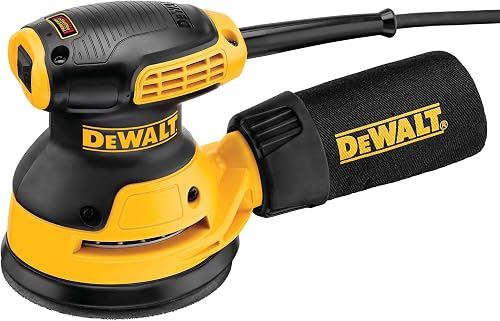
DEWALT Orbital Sander: Best for strong single-speed power
- 5-inch palm sander
- 3.0-amp motor
- 12,000 OPM
- Counterweight design
- Dust bag included
A 3-amp motor at 12,000 OPM gives fast stock removal, and the shorter body helps you get closer to the work piece.
Pros
- Strong 3-amp motor
- Reduced vibration from counterweight
- Rubber over-mold grip
Cons
- Single speed, so less control for fine finishing
- Round pad leaves corners for hand finishing
The DEWALT Orbital Sander suits users who want strong, simple power without a speed dial. Its 3.0-amp motor spins a 5-inch pad at 12,000 OPM, which is fast for removal and general smoothing.
DEWALT uses a separate counterweight to reduce vibration and a rubber over-mold grip in key areas. That mix helps you keep the pad flat during longer passes.
The shorter body design lets you get closer to the work piece, which helps on cabinets and furniture where reach matters. A dust-sealed switch helps protect against dust ingestion.
A dust bag is included, and DEWALT says the sander can also connect to its DWV010 or DWV012 dust collectors.
Trade-off: single speed. With fine grits, you must rely on light pressure and steady motion to avoid marks.
The round pad also leaves inside corners for hand sanding or a detail tool.
WEN 6301 Electric Detailing Palm Sander: Best for detail work
- 3.75 x 5.5-inch pad with angled tip
- 1-amp motor
- 13,500 OPM
- Weighs 2 pounds
- Dust collection port
The angled tip and light 2-pound body suit tight spots, edges and small parts where a larger round pad cannot reach.
Pros
- Angled tip for precision work
- Lightweight 2-pound design
- Velcro base pad for quick changes
Cons
- 1-amp motor is slower on large flat surfaces
- Small pad covers less area per pass
The WEN 6301 suits detailed woodwork, small parts and tight spots. Its 3.75 x 5.5-inch pad with an angled tip reaches into places a 5-inch round pad cannot.
At 1 amp and 13,500 OPM, it is not a heavy stock remover. It is a control tool for edges, inlays, moldings and small repairs where precision matters more than coverage.
The 2-pound weight helps reduce hand fatigue during slow, careful work. A dust collection port helps keep loose sawdust down, and the Velcro base pad makes paper changes simple.
WEN includes one sheet of sandpaper and backs the tool with a 1-year warranty. That is enough to start, but you will want a small set of grits for detail work.
Trade-off: the small pad covers less area, so large tabletops will take longer. Choose it for detail, not for batch sanding full boards.
HYCHIKA 5-Inch Random Orbital Sander: Best for a complete starter kit
- 5-inch pad
- 6 variable speeds
- 13,000 RPM
- 300W motor
- 12 sandpaper discs, 80/120/240 grit
Six speeds plus 12 discs across three grits let you start sanding, refining and finishing without buying abrasives first.
Pros
- 12 discs included in three grits
- Six variable speeds
- Large dust bag
Cons
- Round pad is not ideal for square corners
- Dust bag needs emptying during long sessions
The HYCHIKA 5-Inch Random Orbital Sander suits beginners who want a ready kit. Its 300W motor delivers up to 13,000 RPM across 6 variable speeds, so you can match speed to grit and task.
The kit includes 12 sanding discs: four each in 80, 120 and 240 grit. That spread covers rough smoothing, general sanding and fine finishing in one box.
Eight vacuum holes and a large dust bag help collect debris during use. HYCHIKA says the bag collects about 90% of debris, so empty it during long sessions to keep airflow strong.
The textured rubber grip helps with one-handed control on horizontal and vertical surfaces. Hook-and-loop changes take seconds, which encourages you to move up through grits.
Trade-off: it is a round-pad tool, so square corners still need hand work. It also lacks the pad dampening and sealed-switch details of higher-priced picks.
DEKOPRO Orbital Sander Corded Hand Sander: Best for wide grit range
- 5-inch random orbital sander
- 6 variable speeds
- Up to 14,000 RPM
- 2.5A motor
- 16 sanding discs, 60 to 1000 grit
Six speeds and discs from 60 to 1000 grit cover rough removal through fine polishing in one kit.
Pros
- 16 discs span coarse to fine grits
- Six variable speeds
- Detachable dust box
Cons
- Round pad limits inside-corner work
- You still need to match speed to grit to avoid marks
The DEKOPRO Orbital Sander suits users who want many grits without a separate purchase. Its 2.5A motor reaches up to 14,000 RPM with 6 variable speeds for coarse through fine work.
The kit includes 16 sanding discs across 60, 80, 120, 240, 400 and 1000 grit. That range is useful for rough removal, paint prep, wood sanding and polishing.
A detachable dust box with 8 vacuum holes helps collection, and the transparent box lets you see when it needs emptying. Hook-and-loop paper changes stay fast.
An ergonomic rubber grip and balanced counterweight design help reduce fatigue. Ventilation helps dissipate heat during longer use.
Trade-off: high top speed is easy to misuse with fine grits. Slow the dial down as grit rises, and keep the pad moving.
Round pads also remain less ideal for tight inside corners.
DCK Random Orbital Sander: Best for long bench sessions
- 5-inch pad
- 3.0-amp motor
- 6 speeds, up to 12,000 OPM
- 10 sandpapers, 80-320 grit
- Dust bag included
A 3-amp motor, rubberized grip and low-vibration design support extended sanding on furniture, cabinets and floors.
Pros
- 10 discs from 80 to 320 grit
- Low vibration for longer use
- Ergonomic rubberized grip
Cons
- Built for flat surfaces, not textured drywall
- Round pad needs hand work in corners
The DCK Random Orbital Sander suits bench work that runs long, such as furniture, cabinets and floors. Its 3.0-amp motor delivers up to 12,000 OPM with 6-speed control.
DCK includes 10 sandpapers from 80 to 320 grit, which covers smoothing, removing small imperfections and fine finishing. Hook-and-loop design makes changes quick and lets you reuse papers when they are still good.
The dust bag has a rubber seal at the port for better collection. The rubberized grip and low-vibration design help you keep steady control for hours.
At 3.43 pounds, it is easy to operate with one hand. DCK says it can strip paint, remove rust, clean up furniture and deburr metal, as well as sand wood.
Trade-off: DCK says it is built for flat surfaces and is not suitable for textured drywall or plaster. Round pads also need help from hand sanding in corners.
SKIL 2.0 Amp 1/4 Sheet Palm Sander: Best for square sheet sanding
- 1/4 sheet pad
- 2.0-amp motor
- Pressure control technology
- Clear view dust canister
- Micro-filtration
Pressure control warns you when you push too hard, which helps prevent gouging on flat wood surfaces.
Pros
- Pressure control indicator
- Clear dust canister
- Square pad reaches closer to edges
Cons
- Clamp-style paper changes are slower than hook-and-loop
- Less suited to contoured surfaces
The SKIL 2.0 Amp 1/4 Sheet Palm Sander suits flat wood surfaces where a square pad helps. Its 1/4 sheet pad reaches closer to edges and corners than a round pad.
Pressure control technology warns you when you apply too much pressure. That feedback helps prevent gouging, which is a common problem with sheet sanders on soft wood.
Micro-filtration captures fine dust, and the clear view dust canister shows when to empty it. A built-in vacuum adapter is included for hose use.
The soft-grip design adds comfort and control, and a dust-sealed switch helps extend tool life. A paper punch plate and one sheet of abrasive paper are included.
Trade-off: clamp-style paper changes take more time than hook-and-loop. The square pad is also less suited to contoured surfaces, so keep a round-pad tool for curves.
Dong Cheng 5-Inch Random Orbital Sander 3.2A: Best for bundled accessories
- 5-inch pad
- 3.2A, 380W motor
- 8,000-12,800 OPM, 6 speeds
- 20 sandpapers, 80-320 grit
- Detachable dust bag
Strong 3.2A power plus 20 discs and a tool bag make this a ready-to-use kit for wood and metal sanding.
Pros
- 20 discs included
- Six variable speeds
- Storage bag included
Cons
- Round pad is slower in square corners
- Extra accessories do not replace a vacuum for fine dust
The Dong Cheng 5-Inch Random Orbital Sander suits buyers who want power and accessories in one kit. Its 380W, 3.2A motor delivers 8,000 to 12,800 OPM across 6 speeds.
The kit includes 20 sandpapers across 80, 120, 180, 240 and 320 grit. That is enough to move from rough smoothing to fine finishing without an early reorder.
A detachable dust bag supports on-tool collection, and the sander can connect to a vacuum for longer work. Internal ventilation helps with heat dissipation and dust collection.
The 3.1-pound balanced design and ergonomic rubber handle help control on horizontal and vertical surfaces. A heavy-duty nylon tool bag and carbon brushes are also included.
Trade-off: like other round-pad tools, it leaves tight corners for hand work. The long accessory list is useful, but you should still match grit and speed to the task.
DEWALT Palm Sander: Best for 1/4 sheet flat work
- 1/4 sheet pad
- 2.3-amp motor
- 14,000 OPM
- Foam pad
- Locking dust port
A foam pad and 14,000 OPM help keep a flat sanding plane on boards, doors and tabletops.
Pros
- Foam pad for flatter sanding plane
- Improved paper clamp
- Locking dust port
Cons
- Clamp paper changes take more time
- Not built for contoured shaping
The DEWALT Palm Sander suits flat boards, doors and tabletops that need a square sheet pad. Its 2.3-amp motor sands at 14,000 OPM for fast, even passes.
A foam pad helps keep a flatter sanding plane, which matters when you want a surface that takes stain evenly. The improved paper clamp holds sandpaper securely during use.
Rubber over-mold texture gives a smooth, comfortable grip, and a separate counterweight helps reduce vibration. The reduced overall height gets you closer to your work.
A locking dust port lets you lock a vacuum hose to the sander. DEWALT says the port fits its DWV010 and DWV012 dust collectors directly.
Trade-off: clamp paper changes are slower than hook-and-loop, and the flat pad is not built for contoured shaping. Choose it for square, flat work rather than curves.
How did we compare these palm sanders for woodworking
We compared specs that change daily use: pad shape, speed range, motor size, weight, dust handling and included sandpaper. A score means little if the pad shape does not fit your wood.
We checked motor and speed claims against the job each tool should do. High OPM helps with removal, but fine finishing needs lower speeds and light pressure.
We also weighed practical details. Hook-and-loop pads speed up grit changes.
Clear canisters show when to empty them. Square pads reach edges that round pads miss.
Buyer patterns mattered too. Buyers often mention vibration, dust collection and paper changes, so we gave more weight to tools with counterweights, grips, dust ports and fast paper changes.
Our score weighs specs, features and buyer feedback against what you are shopping for. That is why the BOSCH leads for finish quality, while the WEN leads for detail work at a lower score.
Should you pick a sheet palm sander or a random orbital palm sander
A sheet palm sander is the better pick for flat surfaces and edges. Its square pad covers more flat area per pass and reaches closer to corners.
A random orbital is the better pick for contoured surfaces and general finishing. Its round pad moves smoothly over curves and blends repairs with less risk of flat spots.
Sheet palm sanders for flat wood
Choose a 1/4 sheet model for boards, doors, tabletops and edge work. The SKIL and DEWALT picks in this guide fit that job.
For paper and technique, read how to use a 1/4 sheet sander and what is a 1/3 sheet sander if you want to compare sheet sizes before you buy.
Random orbital palm sanders for curves and blending
Choose a 5-inch random orbital for furniture, curved parts and general smoothing. Most picks in this guide use that pad shape.
If you want to compare the two styles directly, our random orbital sander vs palm sander guide breaks down finish, corners and dust collection.
What speed and grit settings work best for woodworking
Speed and grit must move together. Coarse grits tolerate higher speeds for removal.
Fine grits need lower speeds to avoid swirl marks and heat.
Grit sequence for bare wood
Start at 80 or 120 grit for rough wood, then use 180, then 220, then 320 for finish work. Wipe the surface clean between grits.
For paper choices, see best palm sander sandpaper. The right paper shape and grit matter as much as the sander itself.
Speed settings by task
Use low speeds for 220 grit and finer, and for edges where control matters. Use medium to high speeds for 80 to 120 grit on flat stock.
Variable speed tools in this guide, such as the BOSCH, HYCHIKA, DEKOPRO, DCK and Dong Cheng, let you make that change without swapping tools.
How important is dust collection for a palm sander
Dust collection is not just cleanup. Clogged paper cuts slower, fine dust hides scratches, and airborne dust is hard on lungs and finishes.
Bags and canisters suit short jobs and work where a hose is awkward. A vacuum hose suits long sessions, cabinet work and indoor jobs.
Bags, canisters and vacuum ports
The BOSCH microfilter canister, SKIL clear canister and DEWALT locking dust port all help you see and control dust. Empty them before they pack tight.
For dedicated dust setups, read best palm sander with dust collector. A sealed port and good airflow matter more than a large bag.
Safety habits while sanding
Wear eye protection, hearing protection and a respirator suited to the dust you create. Keep cords behind you, and let the pad stop before you set the tool down.
Turn off and unplug the sander before you change paper or empty a bag. Check the pad and paper for damage before each session.
Which palm sander fits your budget and power setup
Corded palm sanders give you steady power for long sessions, and every pick in this guide is corded. That keeps weight down and avoids battery swaps.
If corded power will not work in your space, compare best cordless palm sander options and best corded palm sanders side by side.
If you want a kit that starts right away
The HYCHIKA, DEKOPRO, DCK and Dong Cheng kits include discs across several grits. That helps you start today and learn which grits you use most.
The BOSCH kit includes a disc and key accessories, but fewer grits. Budget for extra discs if you plan to work through a full grit sequence.
If you want a focused tool for one job
The WEN 6301 is a focused detail tool. The SKIL and DEWALT sheet models are focused flat-surface tools.
A focused tool often beats a general kit for the job it was built for.
For air-powered options, see best pneumatic palm sander. You will need a compressor and air supply, so corded electric fits most home shops better.
How do you use a palm sander on wood without ruining the surface
The best palm sander for woodworking will still leave marks if you press hard, use one grit, or let the pad tilt. Technique protects the surface.
Learn the full routine in how to use a palm sander on wood. It covers grit order, pressure, dust checks and finish prep.
Pressure, motion and pad contact
Hold the sander with a light grip, keep the pad flat, and let the tool move in slow overlapping passes. Do not force the pad into the wood.
For DEWALT users, how to use dewalt palm sander covers the DWE6421 and DWE6411K styles in this guide. For RYOBI sheet tools, read ryobi 1/4 sheet sander how to use.
Paper changes and surface checks
Change paper for every grit step, clean the surface, and run your hand over it to feel scratches. Flip the paper or clean hook-and-loop pads when dust loads the surface.
For replacement pads and parts, see best palm sander replacement parts. A worn pad creates uneven pressure and uneven finishes.
When to stop and switch methods
Stop and switch to hand sanding for inside corners, tight inlays and delicate edges. A palm sander is fast on open surfaces, but hand work gives you control in tight spots.
For brand-specific sheet models, read best makita palm sander and best 1/4 sheet sander to compare pad types before you commit.
How do you care for a palm sander between jobs
Care is simple: clean the pad, empty dust, check the cord, and store the tool where dust will not pack inside it. Small habits extend tool life.
Brush dust from the pad and ports after each session. Empty bags and canisters often, and tap out filters or bags to restore airflow.
Cleaning and storage
Wipe the body with a dry cloth and avoid harsh solvents. Keep paper flat and dry, because bent or damp paper will not sit flat on the pad.
Store the sander in its bag or case when one is included. Hang or lay it so the pad does not carry weight during storage.
Checks before your next session
Check the cord for cuts, the pad for tears, and the paper for loose edges. Test paper fit before you start, and confirm the dust port locks or seals.
These sanders do not involve miter saw setup, so guides like How to Square Up a Miter Saw? and How To Clamp Wood To A Miter Saw? belong to your cutting stage, not your sanding stage. Square and clamp the wood first, then sand it flat.
Which palm sander should you buy for woodworking
Pick the BOSCH ROS20VSC if you want the best all-around finish quality for woodworking. It gives you variable speed, dampening, dust control and a complete kit.
Pick the DEWALT Orbital Sander if you want a strong 3-amp single-speed motor with less to adjust. Pick the WEN 6301 for detail work, and pick the SKIL or DEWALT sheet models for flat boards and edges.
Pick the HYCHIKA, DEKOPRO, DCK or Dong Cheng if you want included discs across many grits and a lower-cost start. Each one covers a different grit range, so match the kit to the work you do most.
Start with how to use a palm sander on wood after you buy, then work through grits in order and check the surface by hand between passes. That habit will do more for your finish than any single feature.
Our top 3 picks at a glance
-
1
-
2
-
3
Frequently asked questions
What is the best palm sander for woodworking?
For most woodworking, a 5-inch random orbital palm sander with variable speed is the best fit, because it blends flat and contoured surfaces and leaves fewer swirl marks. The BOSCH ROS20VSC is our top pick for that balance of control, dust collection and finish quality.
Choose a square sheet palm sander when your work is mostly flat boards with tight edges.
Should I choose a sheet sander or a random orbital palm sander?
Choose a sheet sander for flat surfaces and sharp edges, and a random orbital for curved or contoured wood that needs a blended finish. Square pads reach into corners better, while round pads move smoothly over curves.
Many shops keep one of each, but a beginner often starts with the random orbital.
What grit should I start with on bare wood?
Start with 80 or 120 grit for rough stock removal, then move through 180 and 220, and finish with 320 for a smooth surface before stain or clear coat. Skip grits only when the surface is already flat and free of scratches.
Change grits in order, wipe the surface clean between passes, and check with your hand for scratches you cannot see.
How do I avoid swirl marks with a palm sander?
Use a lower speed with fine grits, keep the pad flat, let the sander move, and do not press down hard. BOSCH says its pad dampening system helps eliminate swirl marks on flat and contoured surfaces.
Work through grits in order, clean the surface between grits, and stop to check the surface under good light.
Do I need dust collection on a palm sander?
Dust collection helps you see the surface, keeps grit from clogging, and lowers the dust you breathe and clean up. A bag or canister works for short jobs, while a vacuum hose suits long sessions.
Empty bags and canisters before they are full, because a packed bag reduces airflow and sanding performance.


