9 Best Sandpaper for Palm and Sheet Sanders (November 2026)
The best palm sander sandpaper include the SANDPROX 1/4 Sheet Sandpaper 4.5"x5.5" 25PCS for coarse stock removal, the HYCHIKA BETTER TOOLS FOR BETTER LIFE 60PCS Triangular for mixed detail sanding, and the XHKDSYMC 50 PCS Mouse Detail Sander Sandpaper for 11-hole mouse sanders.
On this page (5 sections)
The best palm sander sandpaper for most square sheet sanders is SANDPROX 1/4 Sheet Sandpaper, while HYCHIKA is the better fit for compatible triangular detail sanders.
The right choice depends on your sander's shape, hole pattern, backing and grit range.
A palm sander can mean a square 1/4-sheet tool or a smaller mouse-style detail sander.
That shared name causes confusion when ordering replacement paper online.
A square sheet sander usually accepts a flat 4.5 x 5.5 in sheet, while a mouse sander accepts a pointed pad that is much smaller at the tip.
The two formats cannot be swapped, even if brand or grit looks similar.
For choosing between these styles, compare sheet sanders and orbital sanders.
That comparison helps with the tool decision first, because paper follows the tool rather than the other way around.
Before choosing paper, measure the pad and check whether it uses clamps, hook and loop, or a dust-hole pattern.
Measure length and width in inches, then count the holes if the sander has dust extraction.
Check backing as well, because a hook-and-loop sheet will not hold properly on a clamp holder.
If you need a wider overview, our guide to different types of sanders explains how sheet, detail and random orbital tools differ.
You can also compare the best palm sanders for woodworking before ordering replacement abrasives.
Plan the sanding sequence before you buy, then match grits to the surface you have.
Start with the coarsest grit that can remove the problem, then move through medium and fine grits in smaller steps.
For most beginners, a square 1/4-sheet tool with an assorted pack is the easiest starting point.
For corners, edges and small craft work, a mouse sander is easier to control, but only when pad shape and holes match.
Our picks at a glance
-
1
 Best for coarse stock removal
SANDPROX 1/4 Sheet Sandpaper 4.5"x5.5" 25PCS
9.6/10 our score
See it on Amazon -
2
 Best for mixed detail sanding
HYCHIKA BETTER TOOLS FOR BETTER LIFE 60PCS Triangular
9.3/10 our score
See it on Amazon -
3
 Best for 11-hole mouse sanders
XHKDSYMC 50 PCS Mouse Detail Sander Sandpaper
9.1/10 our score
See it on Amazon
- 4
 Check it
SciencePurchase 60 Sandpaper 1/4 Sheets for Palm
Best for simple 3-grit work - 5
 Check it
S&F STEAD & FAST Mouse Sander Sandpaper 70pcs
Best for the widest grit range - 6
 Check it
Dianrui 70 PCS 1/4" Sandpaper Sheets
Best for a broad 1/4-sheet assortment - 7
 Check it
POTUINOM 165 PCS 5 Inch Sanding Discs
Best for 5-inch random orbital tools - 8
 Check it
SACKORANGE 60 PCS 1/4 Sheet Gold Sandpaper
Best for mixed square-sheet jobs - 9
 Check it
Jamiikury 80 Grit Mouse Sander Sandpaper
Best for repeated 80-grit detail work
The best palm sander sandpaper for each sanding job
SANDPROX is the strongest choice for coarse work on a compatible 1/4-sheet tool. HYCHIKA, XHKDSYMC and S&F STEAD & FAST are better matched to detail sanders with specific triangular shapes and hole patterns.
Our score weighs grit range, sheet format, backing, quantity and fit for the searcher's likely sanding job. We checked the stated specifications and features, but we don't treat those details as a substitute for matching the paper to your tool.
| Product | Best for | Size | Grit | Backing | Our score |
|---|---|---|---|---|---|
| SANDPROX 1/4 Sheet Sandpaper 4.5"x5.5" 25PCS | coarse stock removal | 4.5 x 5.5 in | 40 | Hook and loop | 9.6 |
| HYCHIKA BETTER TOOLS FOR BETTER LIFE 60PCS Triangular | mixed detail sanding | 9.3 | |||
| XHKDSYMC 50 PCS Mouse Detail Sander Sandpaper | 11-hole mouse sanders | 9.1 | |||
| SciencePurchase 60 Sandpaper 1/4 Sheets for Palm | simple 3-grit work | Paper | 8.9 | ||
| S&F STEAD & FAST Mouse Sander Sandpaper 70pcs | the widest grit range | 8.7 | |||
| Dianrui 70 PCS 1/4" Sandpaper Sheets | a broad 1/4-sheet assortment | 4.5 x 5.5 in | 8.5 | ||
| POTUINOM 165 PCS 5 Inch Sanding Discs | 5-inch random orbital tools | 8.4 | |||
| SACKORANGE 60 PCS 1/4 Sheet Gold Sandpaper | mixed square-sheet jobs | 5.5 x 4.5 in | 8.2 | ||
| Jamiikury 80 Grit Mouse Sander Sandpaper | repeated 80-grit detail work | 80 | 8.0 |
SANDPROX 1/4 Sheet Sandpaper 4.5"x5.5" 25PCS: Best for coarse stock removal
- 25 sheets
- 4.5 x 5.5 in
- 40 grit
- Hook-and-loop backing
- Aluminum oxide
This 25-piece pack targets rough sanding with 40 grit aluminum oxide sheets. The common 1/4-sheet size and hook-and-loop backing suit compatible palm sanders and hand sanding tools.
Pros
- Common 1/4-sheet size
- 40 grit for rough work
- Hook-and-loop attachment
Cons
- Only 40 grit in the pack
- 25-sheet quantity
SANDPROX is the top pick when your project starts with 40 grit and your tool accepts a 4.5 x 5.5 in 1/4 sheet.
The pack includes 25 aluminum oxide sheets with hook-and-loop backing.
Forty grit is extra coarse, so it suits early shaping and removal of large surface particles.
It is not the paper to use for the final pass on a visible wood surface.
The hook-and-loop design lets you attach the sheet to a matching sander pad or hand sanding tool.
Check that your tool uses this attachment method before ordering, since a clamp-style holder needs a different setup.
The anti-clogging design is meant to help the sheet keep cutting for longer between cleans.
That matters in daily use when you are removing a lot of material and dust builds up quickly.
The 4.5 x 5.5 in size is the common 1/4-sheet size, which makes it a simpler fit for many square palm sanders.
Its size also suits hand sanding and sanding blocks where you want a flat sheet you can fold or hold by hand.
Choose SANDPROX when cutting speed at the rough-sanding stage matters more than having several grit levels in one pack.
For a project that moves from rough work to finish sanding, add a separate medium and fine grit.
Store the sheets flat and dry, and tap off dust or change the sheet when it starts to polish rather than cut.
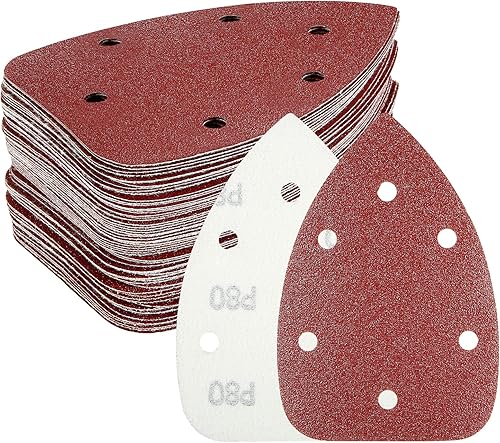
HYCHIKA BETTER TOOLS FOR BETTER LIFE 60PCS Triangular: Best for mixed detail sanding
- 60 sheets
- 60/80/100/120/180/240 grits
- 6 holes
- Hook-and-loop backing
- 140 x 90 mm sheets
HYCHIKA covers coarse, medium and fine detail work in one 60-sheet assortment. Its triangular shape, 6 holes and hook-and-loop backing suit compatible detail sanders.
Pros
- Six grit levels
- 60-sheet assortment
- 6-hole dust pattern
Cons
- Triangular detail-sander shape
- Compatibility depends on tool size and holes
HYCHIKA is the best choice here for triangular detail sanding with a compatible 3.92 in tool.
Its 60 sheets are split evenly across 60, 80, 100, 120, 180 and 240 grit.
That range lets you move from rough sanding to a finer finish without changing to another assortment.
The 6-hole layout also needs to line up with the dust openings on your sander.
The sheets measure 140 x 90 mm and use hook-and-loop backing.
The shape is useful around corners and small surfaces, but it is not a substitute for a square 1/4 sheet.
High-quality alumina abrasive is intended for sanding and polishing tasks on a range of materials.
In practice, the triangular shape helps you reach into steps, edges and narrow recessed areas where a square sheet would bridge over the surface.
The even split of 10 sheets per grit makes planning easier, because you know each stage has the same amount of paper.
That balance suits furniture, trim and small craft projects where you may move up and down in grit more than once.
Choose HYCHIKA when your detail sander matches the triangular size and 6-hole pattern.
For a different pointed pad, compare the hole count and dimensions before buying.
Press the sheet firmly onto the pad, line up the holes, and keep the sander moving to avoid wearing one area too quickly.
XHKDSYMC 50 PCS Mouse Detail Sander Sandpaper: Best for 11-hole mouse sanders
- 50 sheets
- 6.1 x 4.25 in
- 40/60/80/120/180/240 grits
- 11 holes
- Hook-and-loop backing
XHKDSYMC provides six grit levels for small projects, corners and edges. The 6.1 x 4.25 in pads use 11 holes and hook-and-loop attachment.
Pros
- Six grit levels
- 11-hole dust pattern
- 50-piece pack
Cons
- Mouse-style shape
- Not a standard square 1/4 sheet
XHKDSYMC suits a mouse-style detail sander that accepts 6.1 x 4.25 in pads with 11 holes.
The 50-piece set includes 40, 60, 80, 120, 180 and 240 grit aluminum oxide pads.
The six grades cover rough removal, general smoothing and finer finishing.
The 80 grit option is a useful middle choice when you need more cutting action than a fine finishing sheet.
The hook-and-loop backing helps with quick changes, and the 11 holes support dust extraction when they match the sander.
The pointed format works well for corners, edges and small craft projects.
The abrasive is described as durable, abrasion resistant and anti-static, which can help with dust control during longer passes.
The grits are marked on the back, which makes it easier to pick the next sheet from the pack without guessing.
That small detail matters when you are working through a sequence and want to avoid going backwards to a coarser grit.
The 6.1 x 4.25 in size is made for most palm sanders of this mouse style, but you should still measure your own pad.
Choose this set for an 11-hole mouse sander.
It is the wrong format for a standard square palm sander, even though both tools may be called palm sanders.
Keep the pads flat in storage, and replace a sheet when the hook-and-loop backing no longer grips or the abrasive is loaded with dust.
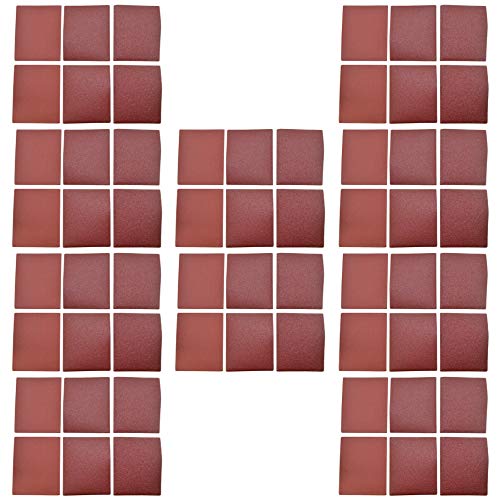
SciencePurchase 60 Sandpaper 1/4 Sheets for Palm: Best for simple 3-grit work
- 60 sheets
- 4.5 x 5.5 in
- 20 each of 60, 100 and 240 grit
- Paper backing
SciencePurchase keeps the assortment simple with three useful stages: rough, medium and fine. Each 4.5 x 5.5 in sheet fits 1/4-sheet palm sanders.
Pros
- Standard 1/4-sheet size
- 60 sheets
- Equal amounts of three grits
Cons
- Only three grit levels
- Paper backing
SciencePurchase is the straightforward option for a 1/4-sheet palm sander with a paper holder.
It includes 60 sheets, with 20 each of 60, 100 and 240 grit, and every sheet measures 4.5 x 5.5 in.
The three grit layout is easy to plan.
Use 60 grit for heavier removal, 100 grit for smoothing, and 240 grit for a fine pass when the surface is ready.
Paper backing suits a clamp style holder, but it does not offer the same attachment method as hook and loop pads.
Make sure your sander can grip a loose sheet securely on all four sides.
The equal split makes this pack predictable, because you will not run out of the middle grit while holding a large amount of fine paper.
That suits jobs where most of the work falls into three clear stages rather than many small steps.
The 4.5 x 5.5 in size fits 1/4-sheet palm sanders, and the sheets are also a practical size for hand sanding in tight areas.
Because the backing is paper, check the clamp condition on your tool before a long session.
A loose clamp can let the sheet shift, which can cause uneven sanding and faster wear at one edge.
Choose this pack when you prefer a simple coarse, medium and fine sequence.
It is less flexible than a six or seven grit assortment when your project needs smaller steps.
Keep sheets dry and flat, and change the paper when dust loading makes the surface feel smooth.
It works on a wide variety of surfaces, so it suits general workshop and home use.
S&F STEAD & FAST Mouse Sander Sandpaper 70pcs: Best for the widest grit range
- 70 pieces
- 40/60/80/100/150/240/320 grits
- 140 x 98 mm size
- 5-hole pattern
- 1 tack cloth
S&F STEAD & FAST offers seven grit levels, including 320 for a finer finish. The 70-piece set also includes 1 tack cloth and uses a 5-hole pattern.
Pros
- Seven grit levels
- 70-piece set
- Includes 1 tack cloth
Cons
- Mouse-sander format
- 5-hole pattern must match the tool
S&F STEAD & FAST is the best fit for a compatible mouse sander when you want seven grit levels.
The 70-piece assortment includes 10 pieces each of 40, 60, 80, 100, 150, 240 and 320 grit, plus 1 tack cloth.
The 320 grit gives you a finer finishing stage than most options in this group.
The 40 grit starts the set with aggressive removal, so you can choose a closer match to the surface instead of jumping between broad grit steps.
The pads measure 140 x 98 mm and use a 5-hole dust-extraction pattern.
Confirm that your tool matches that pattern, because mouse-sander pads are not interchangeable by appearance alone.
The red brown aluminum oxide pads use heavy duty D-weight paper backing and hook and loop attachment for quick changes.
That backing should sit flat on the pad, with the holes aligned before you start sanding.
The tack cloth is a useful addition for wiping dust from a surface between grits.
A clean surface helps you see the scratches left by the previous grit and judge whether you are ready to move on.
Choose this pack for varied detail work on wood, metal, fiberglass and painted surfaces.
The 5-hole layout and 140 x 98 mm size remain the key fit checks.
It suits cabinets, doors, chairs and other small shapes where a pointed pad gives better control than a square sheet.
Dianrui 70 PCS 1/4" Sandpaper Sheets: Best for a broad 1/4-sheet assortment
- 70 sheets
- 4.5 x 5.5 in
- 60/80/120/180/240 grits
- Aluminum oxide
- Fiber paper base
Dianrui gives square palm-sander users five grit levels in a 70-sheet pack. The 4.5 x 5.5 in sheets use aluminum oxide on a fiber paper base.
Pros
- 70 sheets
- Five grit levels
- Common 1/4-sheet size
Cons
- Not for mouse-style detail sanders
- No hook-and-loop backing stated
Dianrui gives square palm-sander users a 70-sheet assortment in the common 4.5 x 5.5 in size.
It includes 60, 80, 120, 180 and 240 grit aluminum oxide sheets.
The pack works well for a project that needs several steps from rough sanding through fine preparation.
The fiber paper base is described as flexible and resistant to tearing, while the three-layer construction includes an anti-clogging coating.
Dianrui states that the sheets can be cut to another size, but cutting changes how the paper sits on the tool.
For a 1/4-sheet palm sander, the dimensions are the simpler fit.
The quantity is useful because the pack is weighted towards the finer grits, with 15 sheets each of 80, 120, 180 and 240 grit and 10 sheets of 60 grit.
That mix suits work on wood furniture, metal and paint surfaces where you may spend more time refining than removing material.
The abrasive grains are described as evenly distributed, which helps with a more uniform scratch pattern across the sheet.
An anti-clogging coating can also help the sheet keep cutting when sanding painted or filled surfaces.
This set is marked for square 1/4-sheet palm sanders and not mouse-style detail sanders.
Choose it when quantity and a broad everyday grit range matter more than hook-and-loop attachment.
Check whether your holder uses clamps or another method before ordering, and keep the sheets flat so the paper back stays firm.
POTUINOM 165 PCS 5 Inch Sanding Discs: Best for 5-inch random orbital tools
- 165 discs
- 5 in diameter
- 40 through 600 grit
- 8 holes
- Aluminum oxide
POTUINOM is a 5 in disc option for random orbital sanders rather than a square palm-sander sheet. Its 165 discs range from 40 to 600 grit.
Pros
- 165 discs
- Wide grit range
- 8-hole dust pattern
Cons
- Disc format
- For random orbital tools, not 1/4-sheet holders
POTUINOM is the outlier here because it uses 5 in sanding discs for random orbital tools, not square palm-sander sheets.
The 165-piece assortment ranges from 40 to 600 grit and uses an 8-hole pattern.
The wide range suits projects moving from rough work to polishing.
The set includes 20 discs each of 60, 80, 120, 150, 240, 320, 400 and 600 grit, plus 5 discs of 40 grit.
The aluminum oxide discs work with compatible 5 in random orbital sanders.
Line up the holes before pressing a disc onto the pad so dust extraction works as intended.
The grits are stamped on the back of each disc, which makes it easier to sort the pack and find the next stage.
That labelling helps in a set this large, where discs can look very similar in the box.
The 8-hole design is meant to remove dust during sanding and keep the workspace cleaner, but only when disc and pad holes line up correctly.
The discs are described for grinding, polishing and de-rusting on metal, wood, plastic, stone, glass and other materials.
Choose POTUINOM if your tool is a 5 in random orbital sander.
If you are deciding between tool types, read our random orbital sander vs palm sander comparison first.
A disc will not fit a square 1/4-sheet holder, so tool format should be settled before you order.
SACKORANGE 60 PCS 1/4 Sheet Gold Sandpaper: Best for mixed square-sheet jobs
- 60 sheets
- 5.5 x 4.5 in
- 60/80/100/120/150/220 grits
- Hook-and-loop backing
- Aluminum oxide
SACKORANGE covers six stages in a 60-sheet 1/4-sheet format. Hook-and-loop backing makes it a practical choice for compatible square palm sanders and sanding blocks.
Pros
- Six grit levels
- 60 sheets
- Hook-and-loop backing
Cons
- 220 is the finest stated grit
- Backing must match the tool
SACKORANGE is a strong square-sheet option for mixed woodworking and automotive sanding.
The 60 sheets measure 5.5 x 4.5 in and include 10 each of 60, 80, 100, 120, 150 and 220 grit.
The six levels create a steady path from semi-aggressive sanding to finer preparation.
Its hook-and-loop backing is useful when your palm sander or sanding block has a matching surface.
The aluminum oxide sheets are also described for paint, primer, body filler, putty, fiberglass and plastic work.
Use the lowest grit needed, then move upward as scratches become less visible.
The blend of aluminum oxide corundum and zirconia alumina is described as giving a rapid and precise cutting action.
A uniform scratch pattern matters when you are preparing a surface for paint, because deep marks from a coarse grit can show through later.
The anti-clogging and load-resistant design is aimed at helping the sheet stay productive for longer between cleans.
That can be useful on filler, primer and painted surfaces, where dust can load the abrasive quickly.
Choose SACKORANGE when you want a 1/4-sheet assortment with hook-and-loop attachment and six common grits.
The 220 grit is fine for many preparation jobs, but it does not reach the 240 or 320 options in some competing packs.
Press the sheet flat onto the pad, align it evenly, and change it when the cut slows or the backing dust builds up.
Jamiikury 80 Grit Mouse Sander Sandpaper: Best for repeated 80-grit detail work
- 50 sheets
- 5.55 x 3.9 in
- 80 grit
- 5 holes
- Hook-and-loop backing
Jamiikury supplies 50 identical 80 grit sheets for mouse-style detail sanders. The pointed 5.55 x 3.9 in shape suits corners and tight areas.
Pros
- 50-sheet pack
- 80 grit for general material removal
- 5-hole pattern
Cons
- One grit only
- Mouse-sander format
Jamiikury is made for repeated 80 grit detail sanding with a mouse-style tool.
The pack includes 50 red aluminum oxide sheets measuring 5.55 x 3.9 in, with 5 holes and hook-and-loop backing.
The pointed shape helps reach corners and narrow areas.
Because every sheet is 80 grit, the pack is easy to manage when one task calls for the same level of cut across many replacements.
The 5-hole pattern must match the dust-extraction openings on your mouse sander.
Its backing also needs a matching hook-and-loop pad.
Eighty grit sits in the middle of the range, so it can remove material without being as aggressive as 40 or 60 grit.
That makes it a practical choice for general smoothing on wood and other surfaces where the shape matters more than a full grit sequence.
The abrasive grains are described as uniformly distributed, and the sheets are intended to hold their shape during use.
A pointed tip gives better access in corners, but it also wears faster, so light pressure helps the sheet last longer.
Shake or tap the sheet to remove dust, and avoid moisture to keep the abrasive effective.
Choose Jamiikury for a focused 80 grit job rather than a full sanding sequence.
If you need coarse and fine stages in one pack, S&F STEAD & FAST or HYCHIKA gives you more choices.
How to match palm sander paper to your tool
The safest buying rule is to match shape, size, attachment and holes before comparing grit or quantity.
A 4.5 x 5.5 in square sheet, a triangular detail pad and a 5 in disc serve different sander designs.
Square 1/4-sheet sanders commonly use sheets around 4.5 x 5.5 in.
Some hold paper with clamps, while others use hook and loop.
The same dimensions do not guarantee the same backing will attach correctly.
A sheet that is the right length may still fail if its backing does not match the pad on your tool.
Mouse and detail sanders use pointed pads, so count the holes and compare pad dimensions.
HYCHIKA uses 6 holes, XHKDSYMC uses 11 holes, and S&F STEAD & FAST and Jamiikury use 5-hole layouts.
Those hole counts are not interchangeable, because dust extraction depends on holes lining up with the sander.
Start by removing the old pad and laying it next to the new one if you can.
Check shape first, then length and width, then hole layout, and only then look at grit.
A 5 in random orbital sander is separate, because it needs a round disc rather than a square or pointed sheet.
For another square-sander comparison, see the guide to the best Makita palm sander.
If you want cordless convenience, our best cordless palm sander guide covers tool choice before you stock up on paper.
Do not order based on the word palm alone, because square and mouse tools share that name but use different paper.
Which grit should you use first?
Start with a coarse grit only when the surface needs material removed, then move to medium and fine grits as the scratches become smaller. A common sequence from the products here is 80, 120, 180 and 240, adjusted for the surface and finish you need.
Use 40 to 80 grit for rough shaping, paint removal or heavy scratches. Move to 100 to 150 grit for general smoothing, then use 180 to 240 grit for finer preparation.
Do not skip too many grit levels when the surface matters. A fine sheet can reduce visible scratches, but it will work slowly if deeper marks remain from the previous stage.
For pointed detail tools, see our guide to the best sandpaper for mouse sander. For worn hook-and-loop pads that no longer hold paper well, compare the best palm sander replacement pads.
How to get more from palm sander paper
Use light, even pressure and keep the sander moving across the workpiece.
Pressing down hard can load the abrasive quickly and may leave uneven marks.
Let the grit do the work, and check the surface often to see whether scratches are getting smaller.
Keep the tool flat on broad surfaces.
On a pointed detail sander, avoid forcing the tip into a corner because the small contact area can wear faster than the rest of the pad.
For square sheets, keep the whole sheet in contact where possible, so the cut stays even across the surface.
Clear dust often and replace paper when the abrasive is clogged or no longer cuts.
A clogged sheet can polish the surface and add heat, which makes the job slower and less predictable.
Tap or shake off loose dust between passes, and wipe the surface to check progress.
Match dust holes carefully, and use suitable eye and breathing protection for the material and workspace.
Line up the holes before you press a hook-and-loop sheet onto the pad, and smooth it flat by hand.
Store spare sheets flat and dry, away from moisture, so paper backing and abrasive stay in good condition.
If your tool uses a soft interface pad, our guide to the best orbital sander interface pad explains where that extra layer helps.
Work in grit order and avoid skipping too many stages, because a fine sheet cannot easily remove deep scratches left by a coarse one.
Verdict: which palm sander sandpaper should you buy?
Choose SANDPROX if your compatible 1/4-sheet tool needs 40 grit for rough work.
Choose HYCHIKA for a 6-hole triangular detail sander, or XHKDSYMC for an 11-hole mouse sander with six grit levels.
Pick SciencePurchase for a simple paper-backed 1/4-sheet sequence, Dianrui for a larger square-sheet assortment, and SACKORANGE for hook-and-loop square sheets.
Choose S&F STEAD & FAST when a 5-hole mouse sander needs seven grit levels.
For a 5 in random orbital sander, POTUINOM is the correct format in this group.
Match pad shape and holes first, then choose the grit range and sheet count that fit your project.
If most work is on flat wood panels and square areas, a square 1/4-sheet pack is usually the simplest choice.
If most work is in corners, on edges or on small shaped parts, a mouse sander pack will give better access.
For a project with only one main stage, a single grit pack can be easier to manage than a large assortment.
Jamiikury fits that case at 80 grit, while SANDPROX fits it at 40 grit for heavier removal.
Look at the finest grit in a pack before you buy, because 220, 240 and 320 grit can lead to different finishing results.
Also check backing, because hook-and-loop and paper-backed sheets suit different holders.
The best paper is the one that fits your tool, matches the dust holes and covers the grit stages you need without forcing large jumps.
Our top 3 picks at a glance
-
1
Best for coarse stock removal
SANDPROX 1/4 Sheet Sandpaper 4.5"x5.5" 25PCS
9.6/10 our score
See it on Amazon -
2
Best for mixed detail sanding
HYCHIKA BETTER TOOLS FOR BETTER LIFE 60PCS Triangular
9.3/10 our score
See it on Amazon -
3
Best for 11-hole mouse sanders
XHKDSYMC 50 PCS Mouse Detail Sander Sandpaper
9.1/10 our score
See it on Amazon
Frequently asked questions
What is the best sandpaper for a palm sander?
The best sandpaper depends on the tool shape, attachment pattern and sanding stage. SANDPROX suits a compatible 1/4-sheet palm sander when you need 40 grit.
For several stages, SciencePurchase, Dianrui or SACKORANGE offer square sheets with assorted grits.
Mouse sanders need pointed pads with matching holes.
What grit sandpaper should I use with a palm sander?
Use 40 to 80 grit for faster material removal, 100 to 150 grit for smoothing, and 180 to 240 grit for a finer surface. Start with the least aggressive grit that can do the job, then move up through the grits instead of skipping several stages.
Check the surface often so you don't remove more material than needed.
Are palm sander sheets and mouse sander pads the same?
No. A square 1/4-sheet palm sander uses a 4.5 x 5.5 in sheet, while a mouse sander uses a pointed pad with a specific hole pattern.
The shapes and dust holes must match the tool.
Measure the pad and count the holes before ordering replacement paper.
How do I choose between hook-and-loop and paper-backed sandpaper?
Choose hook-and-loop when your sander has a matching hook-and-loop pad and you want fast changes. Paper-backed sheets suit tools with clamps or sheet holders.
Backing alone does not confirm fit, so match the sheet size, attachment method and dust-hole layout.
How often should I change palm sander sandpaper?
Change the paper when the abrasive is loaded with dust, the surface feels smooth, or sanding slows even with firm contact. A clogged sheet can polish instead of cut and may add heat.
Use light pressure and clear dust often to get more from each sheet.


