Orbital vs Random Orbital Sander: Which Should You Choose? (November 2026)
Choose a random orbital sander for faster stock removal and a smoother, less patterned finish. Choose a standard orbital sander when square corners, controlled detail work or lower-cost sanding matter more.
On this page (10 sections)
- Orbital vs random orbital sander: which is better?
- How does the sanding motion change the finish?
- Which sander removes material faster?
- Which tool is easier to control?
- Which is better for corners and edges?
- Which products fit common sanding jobs?
- How should you control dust?
- What should you check before choosing?
- How should you use and care for either sander?
- Final choice: orbital or random orbital sander?
Choose a random orbital sander for faster stock removal and a smoother, less patterned finish. Choose a standard orbital sander when square corners, controlled detail work or lower-cost sanding matter more.
The key difference in an orbital vs random orbital sander is how the pad moves. A standard orbital sander follows a fixed orbital path, while a random orbital sander combines orbital movement with changing pad rotation.
That motion affects finish marks, corner access, speed and control. On a tabletop, door or large panel, the random motion usually blends scratch patterns more evenly as you work.
A standard orbital sander can be easier to guide in tight areas. Its predictable path may suit edges and small sections where you need to watch exactly where the pad removes material.
Neither motion fixes poor technique on its own. Pressure, speed, grit choice and steady movement all shape the result as much as the pad pattern does.
Think first about the surface you sand most often. Broad, open work usually favors random motion, while square inside corners and narrow details may call for a standard design.
Power source matters just as much in daily use. Cordless tools suit moving around a project, while corded tools suit a fixed bench where a cable will not snag or pull.
Dust control should also shape your pick from the start. Sanding fills a space quickly, so a working collection system makes setup, cleanup and visibility easier to manage.
For another sander comparison, see orbital versus disc sanders.
Before comparing models, it helps to understand the different types of sanders and the jobs each design handles best.


Orbital vs random orbital sander: which is better?
A random orbital sander is the better all-purpose choice for broad surfaces and smooth finishing. A standard orbital sander makes more sense when you need square-corner access or a simple tool for smaller sanding areas.
A standard orbital sander moves the abrasive pad in a repeated pattern. The predictable motion can make it useful for edges, corners and detail work, but staying too long in one spot can leave visible marks.
A random orbital sander moves the pad in a small orbit while also rotating it in a changing direction. That random motion helps blend sanding marks and makes the tool suitable for removing finish, smoothing wood and preparing surfaces for paint.
Neither tool removes the need for good technique. Use the correct grit, keep the pad flat and avoid pushing down hard enough to slow the abrasive.
How does the sanding motion change the finish?
The fixed motion of an orbital sander can leave a more consistent pattern, while random motion usually blends marks better. The difference matters most when you will apply a clear finish or inspect the surface under bright light.
A standard orbital sander can work well for rough preparation and smaller areas. It is also useful where the shape of the pad helps reach a square inside corner.
A random orbital sander is usually easier to use across a large tabletop, door or panel. Its changing pad direction lowers the chance of repeating one circular pattern, although poor technique can still damage the surface.
Start with a coarser abrasive only when you need material removal. Move through finer grits gradually instead of trying to erase deep scratches with a very fine sheet.
Which sander removes material faster?
Random orbital sanders generally remove material faster across broad surfaces because they combine orbiting and rotation. A standard orbital sander may be slower, but its more controlled motion can be useful for delicate areas.
Speed also depends on the motor, OPM range, abrasive and pressure. A high speed does not automatically produce a better finish, especially on soft wood or a thin coating.
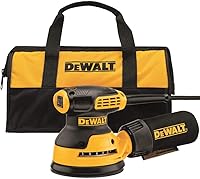
The DEWALT 20V MAX Orbital Sander offers 8,000–12,000 OPM, a brushless motor and cordless operation. Its low-profile height can help you stay close to the work surface, while the 5 in hook-and-loop pad supports quick paper changes.
The BOSCH ROS20VSC uses a 2.5 amp motor with a 7,500–12,000 OPM range. Its pad dampening system is designed for flat and contoured surfaces, so it fits finish work where control matters more than cordless movement.
Which tool is easier to control?
The easier tool is the one whose speed, grip and pad movement match the surface. Use a lower speed for delicate work or heat-sensitive finishes, then increase speed when the surface and abrasive allow it.
Hold the sander flat against the workpiece before starting it. Lift it only after the pad stops, and do not tilt a round pad onto an edge because that can create a hollow or uneven area.
The BLACK+DECKER Orbital Sander has a 2.0 amp motor, a fixed 12,000 OPM speed and a 5 in pad. Its compact body, comfort grip, hook-and-loop paper system and included dust bag suit simple corded sanding projects.
A variable-speed sander gives you more room to adjust. A fixed-speed model can still work well when the material, abrasive and sanding task are consistent.
Which is better for corners and edges?
A standard orbital sander is usually better for square inside corners and narrow detail areas. A random orbital sander is better for open surfaces because its round pad spreads the sanding action across a wider area.
For floor work, compare drum and orbital floor sanders.
A round random orbital pad cannot reach a square inside corner fully. You may need to sand the last section by hand or use a detail tool.
Keep either sander moving near an outside edge. Do not let the pad hang too far over the edge, since uneven contact can round the corner.
If your project includes both broad panels and tight trim, use the random orbital sander for the main surface and finish corners separately. The same planning principle applies to larger tool choices, including How To Choose A Miter Saw? and How To Choose Miter Saw Blade?.
Which products fit common sanding jobs?
Choose by power source, speed control, dust collection and the shape of your work, not by the name alone. For corded picks, see corded random orbital sanders.
The 4 products below are random orbital sanders, so they favor broad surfaces and blended finishes.
The SKIL 5” Random Orbital Sander has a 2.8 amp motor, a 7,000–13,000 OPM variable-speed range and an X-flow transparent cyclonic dust box. Its low-vibration design, soft rubber grip and compact shape suit longer sanding sessions and tight work areas.
The DEWALT is the only cordless option in this group. Its battery-powered design can make setup easier where a cord would get in the way, but the battery and charger are sold separately.
The Bosch includes a sanding pad, sanding disc, vacuum adapter and carrying bag. Its microfilter system is designed to trap particles as small as 1/2 micron, and its corded 120V power suits a fixed workshop setup.
The BLACK+DECKER keeps the package simple with 1 sanding sheet and a dust bag. Its fixed speed is less adjustable than the Bosch, DEWALT and SKIL, but fewer controls can suit a basic project.
The SKIL offers the widest stated speed range, from 7,000 to 13,000 OPM. Its 128 mm disc size is close to the common 5 in class, but check abrasive fit before buying replacements.
How should you control dust?
Use the built-in dust system with a suitable vacuum or dust collector whenever practical. Sanding dust can spread across the work area and settle into the tool, so empty containers before they become packed.
The DEWALT includes a one-handed locking dust bag. Its dust port is designed to fit DWV010 and DWV012 dust collectors, while other 1-1/4 in hoses may need a DWV9000 Universal Quick Connector.
The Bosch includes a microfilter dust canister and vacuum hose adapter. The BLACK+DECKER includes a built-in dust collection bag, while the SKIL uses a transparent X-flow cyclonic dust box that is designed for easy emptying.
Dust collection does not replace protective equipment or ventilation. Wear suitable eye and respiratory protection for the material and follow the coating manufacturer's safety guidance.
For a better seal on uneven or contoured work, an orbital sander interface pad may help in the right setup. Confirm that the pad, abrasive and sander attachment system are compatible before use.
What should you check before choosing?
Start with the surface, then choose the sanding motion, power source and speed range. A large flat panel favors a random orbital sander, while square corners and narrow details may favor a standard orbital design.
Choose cordless power when you need to move around a project without a cord. Choose corded power when you want a steady workshop setup and do not want to manage battery charging.
Choose variable speed when you sand different materials or move between removal and finish work. A fixed-speed tool can be suitable when you want a simple setup for repeatable tasks.
If woodworking is your main use, compare the best random orbital sander for woodworking before deciding. Brand-specific comparisons can also help if you already use compatible tools, such as these guides to the best Bosch random orbital sander and best Makita random orbital sander.
How should you use and care for either sander?
Use light pressure, keep the pad flat and let the abrasive remove material. Heavy pressure can slow the pad, reduce dust collection and create uneven sanding.
Secure the workpiece before sanding. Start the tool before the pad touches the surface, move at a steady pace and avoid holding it in one place.
Change abrasive when it becomes loaded or dull. Begin with a grit that matches the work, then use finer grits for the finish you want.
Empty the dust bag, canister or box before it becomes full. Keep the switch and vents free of dust, and inspect the sanding pad before attaching a new abrasive.
The DEWALT has a dust-sealed switch and replaceable 8-hole hook-and-loop sanding pad. The Bosch, BLACK+DECKER and SKIL also use hook-and-loop attachment systems, so press the abrasive flat and align it correctly before starting.
Our guide on how to use a random orbital sander covers movement, pressure and grit changes in more detail.
Final choice: orbital or random orbital sander?
Pick a random orbital sander for faster broad-surface work and a smoother blended finish. Pick a standard orbital sander when square corners, detail access and predictable pad movement matter most.
For cordless flexibility, choose the DEWALT 20V MAX Orbital Sander. For finish-focused corded work, choose the Bosch ROS20VSC.
Choose the BLACK+DECKER for a simple fixed-speed setup. Choose the SKIL when you want the broadest variable-speed range and a visible cyclonic dust box.
The best choice depends on the surface you sand most often. Match the tool to the work area, abrasive, dust system and power source you can use consistently.
If most of your work is panels, doors and tabletops, random motion will serve you well. It spreads the sanding action and lowers the chance of one repeated pattern showing under a clear finish.
If most of your work is trim, fitted parts and square corners, keep a standard orbital sander in mind. A round random pad cannot reach a square inside corner fully, so hand sanding may still be needed there.
For the DEWALT, remember that battery and charger are sold separately. Its value rises when you already own compatible 20V batteries and can move without a cord.
For the Bosch, plan for a fixed corded setup in the workshop. Its variable speed, pad dampening system and included vacuum adapter fit controlled finish work on flat and contoured surfaces.
For the BLACK+DECKER, expect less adjustment because the speed is fixed at 12,000 OPM. That simplicity can suit repeatable jobs where you do not need to change speed between materials.
For the SKIL, check abrasive fit before buying replacements. Its 128 mm disc size is close to the 5 in class, but matching sheets will keep paper changes smooth.
Set up each tool before you start the job. Attach the abrasive flat, empty the dust container, secure the workpiece and plan your grit progression.
In practice, technique ties the choice together. Use light pressure, keep the pad flat, keep the tool moving and let the abrasive do the removal work.
Frequently asked questions
What is the difference between an orbital and random orbital sander?
An orbital sander moves its pad in a fixed orbit, while a random orbital sander combines orbiting with a rotating pad that changes direction. The random motion reduces visible sanding patterns, so it is usually better for broad finishing work.
A standard orbital sander can suit square corners and detailed areas.
Which gives a smoother finish, orbital or random orbital?
A random orbital sander usually gives the smoother finish because its changing rotation makes repeated circular marks less likely. Your result still depends on the abrasive grit, pressure, speed and surface preparation.
Keep the tool moving and let the abrasive do the work.
Can a random orbital sander replace an orbital sander?
A random orbital sander can handle many jobs associated with an orbital sander, including paint removal, wood preparation and finish sanding. It may not replace the standard tool for every detail task because its round pad cannot reach square inside corners as directly.
Is an orbital sander better for beginners?
A standard orbital sander can feel predictable for small, controlled areas, but a random orbital sander is often more useful as one general-purpose tool. Beginners should focus on light pressure, steady movement, suitable grit changes and dust control with either design.