9 Best Sanders for Refinishing Furniture (November 2026)
The best sanders for refinishing furniture include the SKIL Corded Multi-Function Detail Sander with Micro-Filter for mixed furniture shapes, the BOSCH ROS20VSC Palm Sander for controlled finish sanding, and the DEWALT Orbital Sander for fast flat-panel sanding.
On this page (6 sections)
- The best sanders for refinishing furniture
- Which sander should you use for each furniture surface?
- How to choose a good sander for refinishing furniture
- Sanding steps for a furniture refinishing project
- Verdict: what is the best sander to use for refinishing furniture?
- Then the sanding work will be faster and the final surface will be easier to prepare.
The best sander for refinishing furniture is the SKIL Corded Multi-Function Detail Sander when your project includes corners, edges and curved details.
For large flat surfaces, choose a 5 in random orbital sander to remove old finish more efficiently.
Furniture refinishing usually involves several jobs in one piece.
You may strip paint or varnish from a top, smooth scratches on a leg, clean up a shaped edge and prepare the wood for a new finish.
The best tool depends on the shape of the furniture as much as the motor.
A strong motor on the wrong pad will still struggle in a corner.
A small detail pad on a wide tabletop will work, but it will take much longer.
Matching the pad to the surface is the first decision that matters.
If you need a quick overview of pad shapes and sanding actions, read our guide to different types of sanders.
For a palm-focused comparison, see the best palm sanders for refinishing furniture.
Detail sanders suit corners and contours, while random orbital sanders suit tabletops, shelves, doors and other broad panels.
Many refinishing projects need more than one format.
A chair can have a flat seat, narrow rails and round spindles.
A cabinet door can have a wide fielded panel and a raised edge that needs careful work.
Start by looking at the largest surface on the piece.
That surface usually sets the main tool for the job.
Then check the areas the main tool cannot reach.
Those areas decide whether you also need a detail attachment, a sheet sander or some hand sanding.
Corded sanders give continuous power while you work near an outlet.
That matters during stripping, when a tired tool can slow the whole project.
It also means you should plan where the cord will run.
A cord can catch on a leg or pull the tool at the edge of a panel.
Keep the outlet position in mind before you start a long pass.
Dust control is part of the choice as well.
Fine dust can hide scratches and old finish as you work.
It can also settle on a surface that is ready for stain or paint.
A dust box, bag or vacuum port helps you see the surface and clean up faster.
Speed control matters when one project moves from removal to preparation.
A slower setting can help near a finished edge.
A faster setting can help on an open panel with old coating.
Single-speed tools can still work well when you choose the paper with care.
Your pressure and movement then do more of the work.
Use light pressure and keep the pad moving across the surface.
Heavy pressure can slow the abrasive and make uneven areas.
Stopping often to wipe the surface helps you spot what remains.
That habit saves time at the end, when a missed patch is harder to fix.
Our picks at a glance
-
1
 Best for mixed furniture shapes
SKIL Corded Multi-Function Detail Sander with Micro-Filter
9.7/10 our score
See it on Amazon -
2

-
3
- 4
 Best for tight cornersCheck it
- 5
 Best for simple paint removalCheck it
- 6
 Check it
WEN 6301 Electric Detailing Palm Sander
Best for lightweight detail work - 7
 Check it
SKIL 5” Random Orbital Sander with Cyclonic
Best for variable-speed dust control - 8
 Best for adjustable sanding speedCheck it
- 9
 Best for quarter-sheet finishingCheck it
The best sanders for refinishing furniture
The best choice depends on the surface you are sanding. Detail sanders suit corners and contours, while random orbital sanders suit tabletops, shelves, doors and other broad panels.
SKIL leads this group because its 4-in-1 design covers several furniture shapes. Bosch follows with variable speed and a pad-dampening system for controlled finish work.
Our score weighs specs, features and buyer feedback against the needs of furniture stripping, restoration and final surface preparation.
SKIL Corded Multi-Function Detail Sander with Micro-Filter: Best for mixed furniture shapes
- 1.2 A corded motor
- 14,500 OPM
- 3 additional attachments
- Micro-filtration and 1-1/4 in dust port
Three extra attachments cover broad surfaces, corners, narrow areas and curved contours. Micro-filtration, a dust box and a 1-1/4 in dust port give you flexible dust-control options.
Pros
- Three additional attachments
- Micro-filtration and vacuum port
- 12 sanding sheets included
Cons
- Detail pad format is slower on large flat panels
- Corded operation limits movement
The SKIL Corded Multi-Function Detail Sander with Micro-Filter is the most flexible pick for furniture with mixed shapes. Its 1.2 A motor runs at 14,500 OPM, and the tool includes 3 additional attachments for large surfaces, corners, narrow areas and curved contours.
The attachments change without a tool, which matters when one furniture piece has legs, rails, flat panels and shaped trim. A triangular pad extension can reach tight areas, a finger extension works in narrow spaces, and a flexible pad extension follows curved surfaces.
Dust control is another strength. The micro-filtration system works with the dust box, while the 1-1/4 in dust port gives you the option to connect a vacuum.
The hook-and-loop system makes sheet changes quick. The ergonomic design, soft rubber grip and counterweight balance are aimed at reducing vibration fatigue during longer sanding sessions.
Choose it when one project includes several surface shapes. For wide, flat panels only, a 5 in random orbital sander will usually cover more area per pass.
BOSCH ROS20VSC Palm Sander: Best for controlled finish sanding
- 2.5 A motor
- 7,500 to 12,000 OPM variable speed
- 5 in pad
- Micro-filter dust canister
Variable speed helps you match the sanding pace to the furniture surface. Its pad dampening system is designed to reduce swirl marks on flat and contoured workpieces.
Pros
- Variable speed control
- Dust canister and vacuum adapter
- Sanding pad and carrying bag included
Cons
- Random orbital pad is less suited to tight corners
- Corded operation requires a nearby outlet
The BOSCH ROS20VSC Palm Sander is a strong choice for controlled sanding on flat and contoured furniture surfaces. If your shop has a compressor, compare air-powered orbital sanders.
Its 2.5 A motor offers variable speed from 7,500 to 12,000 OPM, so you can slow the tool for careful preparation or raise the pace for material removal.
Its pad dampening system is designed to reduce swirl marks. That makes it especially useful when the furniture will receive a visible stain or clear finish and the final surface needs careful preparation.
The 5 in pad is a practical middle ground for furniture work. It is broad enough for tabletops and cabinet faces, but still easier to control than a larger sanding tool.
The micro-filter dust canister traps particles as small as 1/2 micron and shows the dust level. Bosch also includes a vacuum adapter, sanding pad, sanding disc and carrying bag.
Choose this model when variable speed and finish control matter most. If the project has many deep corners, pair it with a detail sander or read our guide to the best detail sanders for furniture.
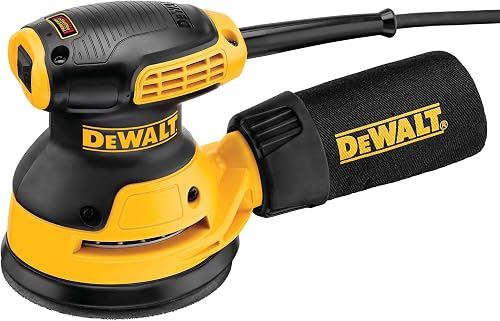
DEWALT Orbital Sander: Best for fast flat-panel sanding
- 3 A motor
- 12,000 OPM
- 5 in hook-and-loop pad
- Separate counterweight
The 3 A motor and 12,000 OPM speed suit broad tabletops, cabinet sides and other flat furniture panels. Its shorter height helps you work closer to the surface.
Pros
- Strong motor for broad surfaces
- Separate counterweight reduces vibration
- Dust bag included
Cons
- Single-speed operation
- Not shaped for deep corners
The DEWALT Orbital Sander suits broad furniture panels where you want strong removal and a simple control layout.
Its 3 A motor spins the 5 in pad at 12,000 OPM.
A shorter height helps you get closer to the workpiece.
The separate counterweight is designed to reduce vibration, while rubber over-mold appears in the main grip areas.
This is a single-speed tool, so the sanding process depends more on your paper choice, pressure and movement.
That can be useful if you prefer a straightforward sander without adjusting a speed dial.
The dust-sealed switch is designed to protect the switch from dust ingestion.
A dust bag is included, and the hook-and-loop pad makes abrasive changes simple.
For refinishing, that speed suits work on tabletops, shelves and cabinet sides.
Keep the pad flat and moving to avoid low spots on the wood.
Let the abrasive cut rather than pressing hard into the surface.
Check the dust bag as you work and empty it before it gets full.
A full bag can reduce collection and make the surface harder to read.
Choose it for tabletops, shelves, cabinet sides and other open surfaces.
It is less suited to narrow corners, where a triangular or finger-style attachment gives you better access.
BLACK+DECKER Detail Sander: Best for tight corners
- 1.2 A motor
- 16,000 OPM
- Detail finger attachment
- 3-position grip and dust collector
The compact shape, detail finger attachment and detail sanding pad help reach cramped areas and awkward angles. The 3-position grip gives you more than one hand position during detail work.
Pros
- Detail finger attachment
- Compact design
- Dust collection canister
Cons
- Less efficient than a 5 in orbital on wide panels
- No variable speed listed
The BLACK+DECKER Detail Sander is built for cramped corners, awkward angles and small furniture details. Its 1.2 A motor runs at 16,000 OPM, and the compact body helps you work where a 5 in round pad cannot fit.
The detail finger attachment reaches narrow spots, while the detail sanding pad fits odd angles. Those shapes can help with chair parts, drawer edges, spindles and small trim areas.
A 3-position grip gives you different hand positions during detail work. The dust collection canister helps keep debris down, and the dust-sealed switch is designed to protect the internal mechanism.
This is a corded detail sander, so it can run continuously while you work near an outlet. It is not the fastest choice for a large tabletop because the detail pad covers less area than a random orbital pad.
Choose it when access is the main problem. For more detail-sanding comparisons, see the best detail sander for furniture guide.
BLACK+DECKER Orbital Sander: Best for simple paint removal
- 5 in random orbital pad
- 12,000 OPM
- Dust bag
- Hook-and-loop paper changes
Random orbital action suits removing paint, stain and varnish from broad wood surfaces before refinishing. The compact body, comfort grip and dust bag support repeated passes.
Pros
- 5 in sanding area
- Fast hook-and-loop changes
- Dust bag included
Cons
- No variable speed listed
- Not a corner-sanding tool
The BLACK+DECKER Orbital Sander is a practical choice for removing paint, stain and varnish from broad wood surfaces.
Its 5 in random orbital pad runs at 12,000 OPM.
Random orbital action helps you prepare a surface without relying on one straight sanding direction.
Keep the tool moving, use light pressure and let the abrasive do the cutting.
The compact body and comfort grip support repeated passes across furniture panels.
The built-in dust bag collects debris as you work, while the hook-and-loop system makes paper changes quick.
The tool is single-speed, so you do not get the slower adjustment offered by variable-speed models.
That makes paper selection and pressure control more important when you move from stripping to finish preparation.
For set-up, fit the paper squarely on the hook-and-loop pad before you start.
A loose or crooked sheet can leave marks and wear faster.
Empty the dust bag during the job to keep collection working well.
Wipe the surface often so you can see old finish that remains.
That simple check helps you change grit at the right stage.
Choose it for simple restoration projects with broad panels and old coating to remove.
Use another tool for tight corners and shaped furniture parts.
WEN 6301 Electric Detailing Palm Sander: Best for lightweight detail work
- 3.75 x 5.5 in pad
- Angled tip
- 13,500 OPM
- 2 lb design
The 2 lb design is easy to hold during detail sanding, while the angled tip helps with precision work. A dust collection port supports connection to dust collection equipment.
Pros
- Lightest listed design
- Angled tip for precision
- Velcro base pad
Cons
- Small pad covers less area
- Less suited to fast stripping of wide panels
The WEN 6301 Electric Detailing Palm Sander is the lightest option in this group at 2 lb. Its 3.75 x 5.5 in pad and angled tip give you a compact shape for precision work.
The pad reaches more area than a very small pointed detail pad while still offering control near furniture edges. The angled tip is useful when a flat rectangular pad cannot sit neatly against the work.
Its motor provides 13,500 OPM, and the Velcro base pad makes sandpaper removal and installation simple. A dust collection port supports attachment to dust collection equipment.
The smaller pad will take longer on a wide tabletop than a 5 in random orbital sander. Its main advantage is reduced hand weight during detailed restoration work.
Choose it when you want a light tool for chair parts, drawer fronts, edges and small furniture surfaces. For wider trim pieces, compare our guide to the best sander for trim work.
SKIL 5” Random Orbital Sander with Cyclonic: Best for variable-speed dust control
- 2.8 A motor
- 7,000 to 13,000 OPM
- Cyclonic dust box
- 3 sanding sheets included
Variable speed lets you use a slower setting for careful finish preparation and a faster setting for broader removal. The transparent X-flow dust container is easy to empty.
Pros
- Variable speed dial
- Cyclonic dust collection
- Vibration control
Cons
- Random orbital pad cannot replace a detail attachment
- Corded operation limits reach
The SKIL 5” Random Orbital Sander with Cyclonic gives you variable speed and a transparent cyclonic dust box. Its 2.8 A motor runs from 7,000 to 13,000 OPM.
Use the lower end of the range for careful finish preparation and the higher end for broader removal when the surface and abrasive allow it. Variable speed gives you more control than a single-speed random orbital sander.
The X-flow dust collector uses cyclone force to collect dust in an easy-to-empty container. The transparent design also lets you see when the box needs attention.
The ergonomic design, soft rubber grip and counterweight balance are intended to reduce vibration fatigue. The compact shape can help in tighter spaces, although the round 5 in pad still cannot replace a detail attachment in a deep corner.
Choose it when dust control and speed adjustment are both priorities. It includes 3 sanding sheets to help you begin the project.
DEWALT Random Orbit Sander: Best for adjustable sanding speed
- 3 A motor
- 8,000 to 12,000 OPM
- 5 in pad
- Locking dust bag
The variable-speed range gives you more control than a single-speed orbital when moving from coating removal to final smoothing. A low-profile design keeps the sander close to the work surface.
Pros
- Variable speed range
- Dust bag and dust collector options
- Separate counterweight
Cons
- More limited in corners than a detail sander
- Dust collector compatibility may require the right connector
The DEWALT Random Orbit Sander is a good fit when you want a 5 in pad with adjustable speed.
Its 3 A motor runs from 8,000 to 12,000 OPM.
The lower setting gives you more control as you approach final surface preparation.
The upper setting supports faster work on broad panels when the coating and abrasive call for it.
A shorter height keeps the sander close to the furniture surface.
The separate counterweight and rubber over-mold grip are designed to improve comfort during repeated passes.
Dust collection includes a one-handed locking dust bag.
The dust port can connect directly to DWV010 or DWV012 dust collectors, and other vacuum systems with 1-1/4 in hoses may need a DWV9000 Universal Quick Connector.
For daily use, set the speed before the pad touches the wood.
That helps you avoid a sudden bite at the start of a pass.
Keep the sander moving across panels and ease off near edges.
Edges can round quickly if the pad stays in one place too long.
Lock the dust bag on firmly and check it during longer jobs.
Empty it before it becomes full to keep the surface clear.
Choose it when adjustable speed and DEWALT dust-collection options fit your workshop.
It remains a round-pad tool, so use a detail sander for corners.
DEWALT Electric Sander: Best for quarter-sheet finishing
- 2.3 A motor
- 14,000 OPM
- 1/4 sheet format
- Locking dust port
The 1/4 sheet format gives you a familiar rectangular sanding surface for finish preparation. Its paper clamp, dust port and reduced height suit controlled work on furniture faces.
Pros
- 1/4 sheet paper format
- 14,000 OPM
- Paper punch and dust bag included
Cons
- Slower paper changes than hook-and-loop discs
- Not designed for curved contours
The DEWALT Electric Sander is the best match here for a traditional 1/4 sheet finishing format. Its 2.3 A motor runs at 14,000 OPM, and the rectangular pad accepts quarter-sheet sanding paper.
The paper clamp helps hold the abrasive during sanding, while the included paper punch helps prepare paper for dust collection. This format can be convenient if you already keep quarter sheets in several grits.
The reduced overall height brings the tool closer to the work surface. A separate counterweight is designed to reduce vibration, and the rubber over-mold adds grip around the sander.
Its locking dust port can connect to a vacuum hose. The dust port is designed for DWV010 or DWV012 dust collectors, while other 1-1/4 in vacuum systems may need a DWV9000 Universal Quick Connector.
Choose it for flat furniture faces where you prefer sheet paper over hook-and-loop discs. It is not the best option for curved contours or deep corners.
Which sander should you use for each furniture surface?
Use a random orbital sander for broad flat panels, a detail sander for corners and shaped areas, and a 1/4 sheet sander when you prefer rectangular paper. Matching the pad to the surface helps you work faster and avoid forcing the tool into places it does not fit.
What is the best sander for furniture refinishing on tabletops?
A 5 in random orbital sander is usually the best sander for furniture refinishing on a tabletop. The DEWALT Orbital Sander, BOSCH ROS20VSC and BLACK+DECKER Orbital Sander all use a 5 in format.
Start with an abrasive suited to the old finish, then use finer paper as the surface becomes smooth. Keep the pad flat and moving so you do not create a low spot or sanding mark.
The Bosch adds variable speed and a pad dampening system. The DEWALT DWE6421 uses a 3 A motor and 12,000 OPM, while the BLACK+DECKER model offers a compact 5 in format for paint, stain and varnish removal.
Which sander is best for furniture corners?
A detail sander is best for furniture corners because its pointed or narrow attachments can reach spaces that a round orbital pad misses. The SKIL Corded Multi-Function Detail Sander includes a triangular pad extension and a finger extension.
The BLACK+DECKER Detail Sander also includes a detail finger attachment and a detail sanding pad. The WEN 6301 uses an angled tip on its 3.75 x 5.5 in pad.
Use light pressure near corners. The pointed end of a detail sander can remove material quickly if you hold it in one place.
Is a random orbital sander good for refinishing furniture?
Yes, a random orbital sander is good for refinishing furniture when the surface is broad and reasonably open. Its 5 in pad can remove old coating and prepare wood faster than a small detail pad.
It is not a complete solution for every furniture shape. You may still need a detail sander for inside corners, narrow rails, curved parts and areas near raised trim.
For cabinet-focused projects, compare the best sanders for cabinets and cabinet doors. If you prefer a premium dust-control system for cabinet work, our best Festool sanders for cabinets guide covers that separate category.
How to choose a good sander for refinishing furniture
A good sander for refinishing furniture should match the surface shape, give you control over material removal and offer a practical way to manage dust. Motor power matters, but pad shape and speed control often matter more for restoration work.
Match the pad to the furniture
Choose a 5 in random orbital sander for tabletops, cabinet doors, shelves and wide sides. Choose a detail sander for corners, narrow strips and curved contours.
A 1/4 sheet finishing sander sits between those jobs. Its rectangular paper format suits flat faces and edges, but it is not shaped for deep curves.
Decide whether variable speed matters
Variable speed is useful when one project includes both coating removal and final preparation. The SKIL SR211601 runs from 7,000 to 13,000 OPM, the Bosch ROS20VSC runs from 7,500 to 12,000 OPM, and the DEWALT DWE6423 runs from 8,000 to 12,000 OPM.
Single-speed sanders can still work well. You control the result with the abrasive grit, pressure and speed of your passes.
Plan dust collection before sanding
Furniture refinishing creates fine dust, so check how the sander collects it before you start. Some picks use a dust box or canister, while others include a dust bag or a port for a vacuum.
The SKIL detail sander combines micro-filtration with a 1-1/4 in dust port. Bosch includes a micro-filter canister and vacuum adapter, while the SKIL random orbital uses a transparent cyclonic dust box.
Dust collection reduces loose debris, but it does not replace eye protection, suitable respiratory protection and cleanup. Follow the tool and finish manufacturer's safety guidance.
Use the right paper and pressure
Begin with a grit that can remove the old finish without cutting deeper than needed. Move to finer grits as the surface becomes even and ready for stain, paint or another finish.
Do not lean heavily on the sander. Extra pressure can slow the abrasive, increase heat and make it easier to create uneven areas.
Inspect the surface often by stopping the tool and wiping away dust. A clean surface makes it easier to see remaining finish and sanding marks.
Sanding steps for a furniture refinishing project
The basic process is to inspect the piece, remove loose finish, sand broad surfaces, detail the edges and finish with a finer abrasive. Work in stages instead of trying to remove every mark with one aggressive pass.
First, remove hardware and identify areas that should not be sanded. Keep the tool flat on broad panels, and use a detail attachment only where the furniture shape requires it.
On a tabletop, start with a random orbital sander. On chair spindles, drawer edges and narrow rails, use a detail sander or sand by hand where the powered tool cannot sit safely.
Use a vacuum or dust box as you work, and empty the collector before it becomes full. Keep the pad and paper clean enough to cut rather than rub.
Before applying a new finish, inspect the entire piece under clear light. Remaining old coating, cross-grain scratches and dust can show through the final surface.
Verdict: what is the best sander to use for refinishing furniture?
The SKIL Corded Multi-Function Detail Sander is the best sander to use for refinishing furniture when the piece has mixed shapes and hard-to-reach areas.
Its attachments cover broad detail work, corners, narrow surfaces and curved contours.
That range helps when one piece has flat panels and shaped trim.
You can change the attachment as the shape changes, rather than forcing one pad everywhere.
Pick the BOSCH ROS20VSC when variable speed and finish control are most important.
Its speed range helps you move from removal to careful preparation with one tool.
Choose the DEWALT Orbital Sander or BLACK+DECKER Orbital Sander for broad flat panels, and choose the BLACK+DECKER Detail Sander or WEN 6301 for tight furniture details.
That split is the practical way to think about the group.
A 5 in orbital covers open surfaces faster.
A detail tool reaches the places a round pad misses.
For a project that includes cabinets, doors and trim, start with the surface-specific recommendations in Best Miter Saw For Furniture Making only when cutting is also part of the work.
For sanding alone, choose the pad shape that matches the largest surface and keep a detail option available for the areas it cannot reach.
Plan the grit changes before you start the job.
Use coarser paper to remove old finish, then move to finer paper as the surface evens out.
Keep pressure light and keep the pad moving.
Stop to wipe and inspect the surface under clear light.
Remaining finish, scratches and dust are easier to spot at that stage.
Plan dust collection as part of the set-up, not as an afterthought.
A dust box, bag or vacuum port keeps debris down and helps you see the work.
Keep the cord position in mind during long passes on a large piece.
A cord that pulls or catches can affect control at the edge.
The right choice is not only about motor size.
Pad shape, speed control and dust handling shape the result as much.
Match those factors to the furniture in front of you.
Then the sanding work will be faster and the final surface will be easier to prepare.
Our top 3 picks at a glance
-
1
Best for mixed furniture shapes
SKIL Corded Multi-Function Detail Sander with Micro-Filter
9.7/10 our score
See it on Amazon -
2
-
3
Frequently asked questions
What is the best sander for refinishing furniture?
The SKIL Corded Multi-Function Detail Sander is the best sander for refinishing furniture when the piece has corners, narrow areas and curved contours. For large flat tabletops and cabinet sides, a 5 in random orbital sander usually covers more surface per pass.
Choose the pad shape that matches the furniture before choosing motor size.
Is a palm sander or orbital sander better for furniture refinishing?
A random orbital sander is usually better for removing old finish from broad flat panels, while a palm or detail sander gives you more control near edges and in corners.
Many furniture projects need both types. Use the larger orbital for open surfaces, then switch to a detail or sheet sander for areas the round pad cannot reach.
What type of sander is best for removing old finish?
A 5 in random orbital sander is a strong choice for removing paint, stain or varnish from broad wood surfaces. The BLACK+DECKER Orbital Sander is described for those tasks, while the DEWALT Orbital Sander offers a 3 A motor and 12,000 OPM.
Use controlled passes and avoid holding the pad in one spot.
What grit should you use when refinishing furniture?
Start with a grit suited to the coating and surface condition, then move to finer paper as the furniture becomes smooth. Coarser paper removes material faster, while finer paper prepares the surface for a new finish.
Keep the sander moving and change paper when it stops cutting cleanly.
Can you use a detail sander on large furniture?
Yes, but a detail sander will usually take longer on a large tabletop or cabinet side because its pad covers less area. It is more useful for corners, narrow edges, shaped areas and final preparation.
Use a 5 in random orbital sander for open panels when the surface allows it, then use the detail sander where the round pad cannot reach.