9 Best Woodworking Bench Vises (November 2026)
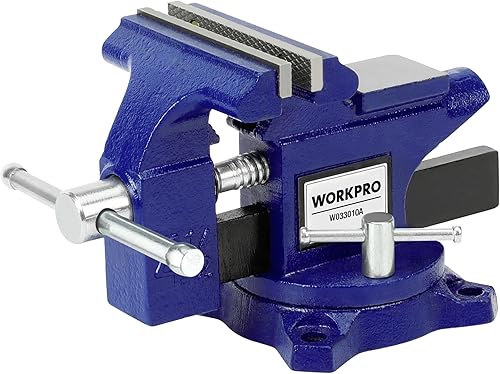
The best woodworking bench vises include the WORKPRO Bench Vise for most home workshops, the AV Steel 4-1/2" Bench Vise with 240° for heavy bench work, and the WORK IQ TOOLS IQ Vise 360° Articulating Bench for multi-angle work.
On this page (4 sections)
The best woodworking bench vise for most workshops is the WORKPRO Bench Vise, with a 240-degree swivel base, multi-jaw design and 4.5-inch jaws.
Choose Groz for portable woodworking, the IQ Vise for unusual angles or ZGJDYSM for a wide front-mounted opening.
A good woodworking bench vise holds boards steady for planing, sawing, chiseling, drilling and joinery.
It also matters at the start of a job, when you need to set stock square and keep it from creeping under tool pressure.
The right choice depends on how you mount it, how wide your stock is and whether the jaws need to protect finished wood.
A fixed bench vise can feel simple and rigid for repeated work in one shop.
A swivel or articulating vise can change your angle without releasing the workpiece, which helps with carving, repair and awkward pieces.
A portable vise can move between a bench, a table and a jobsite, but its hold depends on the surface it clamps to.
Before you compare extra features, match the jaw width, opening and mounting style to the bench you already have.
For general home shop work, a full size swivel vise often gives the best mix of reach, stability and flexibility.
For a small studio or a bench still being built, a compact, wooden or front-mounted design may fit better.
If you also need lighter-duty holding tools, our guide to woodworking clamps explains how clamps and bench vises work together.
For setup details, see woodworking bench vise use.
Care is simple but important, such as keeping jaw faces clean, checking mounting bolts and using liners on finished surfaces.
Our picks at a glance
-
1
-
2

-
3
 Best for multi-angle work
WORK IQ TOOLS IQ Vise 360° Articulating Bench
9.4/10 our score
See it on Amazon
- 4
 Check it
WORKPRO Dual Jaws Table Vise 2.5"
Best for portable table mounting - 5
 Check it
PONY 4 Inch Heavy Duty Bench Vise
Best for maximum clamping force - 6
 Check it
Groz 6-Inch Portable Woodworking Vise
Best for portable woodworking - 7
 Best for scratch-sensitive woodCheck it
- 8
 Best for building a custom viseCheck it
- 9
 Check it
ZGJDYSM 11-Inch Front-Mounted Woodworking Vise
Best for wide front-mounted openings
The best woodworking bench vises for different benches
The best woodworking bench vise depends on the workbench and the task.
A full-size swivel vise suits general shop work, while a portable or front-mounted model can fit a smaller or custom bench.
Bench size matters as much as jaw size.
A vise that is too large can crowd a small table, while a compact vise may not reach across a wide board.
Mounting style also changes how the vise feels in daily use.
A bolt-down vise is steady for repeated planing and sawing, while a clamp-on vise trades some rigidity for portability.
Jaw surface is another dividing line between the picks.
Metal jaws suit mixed shop work, while wooden jaws or liners help protect soft and finished stock.
Our score weighs specs, features and buyer feedback against what you're shopping for.
We checked the supplied product information and compared jaw size, opening, mounting, materials and useful woodworking features.
That approach keeps the focus on practical fit rather than headline numbers alone.
A high clamping force claim does not help if the opening is too narrow for your boards.
Likewise, a wide opening is less useful if the bench cannot support the vise securely.
Use this list as a shortlist first, then check the bench thickness, handle clearance and jaw protection for the model you prefer.
| Product | Best for | Jaw width | Jaw opening | Material | Our score |
|---|---|---|---|---|---|
| WORKPRO Bench Vise | most home workshops | 4.5 in | 4.25 in | Iron | 9.7 |
| AV Steel 4-1/2" Bench Vise with 240° | heavy bench work | 4.5 in | Cast iron | 9.6 | |
| WORK IQ TOOLS IQ Vise 360° Articulating Bench | multi-angle work | 5 in | Hardened steel and cast aluminum | 9.4 | |
| WORKPRO Dual Jaws Table Vise 2.5" | portable table mounting | Ductile iron | 9.2 | ||
| PONY 4 Inch Heavy Duty Bench Vise | maximum clamping force | 4 in | Ductile iron | 8.9 | |
| Groz 6-Inch Portable Woodworking Vise | portable woodworking | 6 in | Cast iron | 8.7 | |
| Fetcoi Woodworking Bench Vise | scratch-sensitive wood | 7.87 in | Wood | 8.4 | |
| HFS | building a custom vise | Cast iron | 8.2 | ||
| ZGJDYSM 11-Inch Front-Mounted Woodworking Vise | wide front-mounted openings | 7.9 |
WORKPRO Bench Vise: Best for most home workshops
- 4.5-inch jaws
- 240-degree swivel base
- Multi-jaw design for flat stock and pipes
- Large anvil area
The WORKPRO combines a broad jaw opening, swivel positioning and jaws shaped for both flat materials and pipes. It fits general woodworking and mixed workshop tasks.
Pros
- Swivel base
- Multi-jaw grip
- Large anvil area
Cons
- Permanent mounting may suit it better than frequent relocation
The WORKPRO Bench Vise is the best all-around choice because it covers the common needs of a home woodworking bench.
Its 4.5-inch jaws open to 4.25 inches, giving you room for many boards, blocks and small assemblies.
The multi-jaw design holds both flat materials and pipes or tubes.
For woodworking, that flexibility matters if the vise also serves general repair jobs around the shop.
Its 240-degree swivel locking base lets you reposition a workpiece without removing it from the jaws.
That can save time when you want to change grain direction or reach a new face during a task.
The large anvil area adds a place for light bench tasks, and the iron body is made for heavy use.
The throat depth of 2-11/32 inches shapes how deep you can clamp from the jaw edge.
Jaw opening and throat depth together decide whether thick stock sits square or strains at one corner.
Mount it where the handle can turn freely and where the swivel base will not strike a wall or another tool.
Add jaw liners when your work has a finished surface that could be marked.
Keep the jaw faces free of grit and check the mounting hardware now and then, since a stable base is part of accurate work.
AV Steel 4-1/2" Bench Vise with 240°: Best for heavy bench work
- 240-degree swivel base
- 3.75-inch maximum jaw opening
- Built-in pipe jaws
- 3.25-inch square anvil
AV Steel adds pipe jaws and a rear anvil to a cast-iron vise with a 240-degree swivel base. Its permanent mounting design suits a dedicated bench.
Pros
- Flexible positioning
- Pipe jaws and anvil
- High clamping force claim
Cons
- Permanent mounting is less convenient for portable setups
The AV Steel is best for a dedicated bench that needs a heavy cast-iron vise with flexible positioning.
Its 240-degree swivel base gives you several working angles, while the built-in pipe jaws handle round stock.
The vise has a 4.5-inch jaw width, a 3.75-inch maximum opening and a 2-11/32-inch throat depth.
A 3.25-inch square anvil provides a flat surface for light shaping work.
AV Steel gives a 10.56 lb overall weight and a permanent mounting design.
That makes it a better match for a stable workbench than a folding table or a bench you move often.
Choose it when the vise will stay installed and you want woodworking plus drilling or pipe-cutting ability.
The pipe jaw range of 5/8 to 1-7/8 inches helps explain its mixed use in a shop.
For woodworking, the swivel can keep a board in place while you change your stance or tool angle.
Check the bench thickness and mounting space before drilling.
Make sure the handle clears the bench apron through the full swivel range, and keep the anvil surface clean for light hammering work.
WORK IQ TOOLS IQ Vise 360° Articulating Bench: Best for multi-angle work
- 360-degree articulating ball and socket
- 8 locking positions
- 5-inch smooth parallel jaws
- Swap-in jaw pads
The IQ Vise rotates, tilts and swivels for work that needs more than a straight-on hold. Its pad system also gives woodworking projects a way to protect delicate surfaces.
Pros
- Wide angle adjustment
- Quick Cam lever
- Interchangeable jaw pads
Cons
- Accessories such as the light and magnifier are separate
The IQ Vise is best when your work needs several angles.
Its 360-degree articulating ball and socket rotates, tilts and swivels the workpiece, then a Quick Cam lever locks the position.
Eight fixed working positions are rated to 130 ft-lb of torque.
The 5-inch smooth parallel jaws use dual-sided Flex-Fit pads, and the pads can be changed for different workpiece shapes.
This vise uses hardened steel and cast aluminum and bolts to a workbench.
Its integrated ports can accept the brand's work light, magnifier and phone holder, although those accessories are separate.
Pick it for carving, repair and detail work where a straight-on vise makes access awkward.
The smooth jaws are a plus for wood that you do not want serrations to mark.
For routine planing of long boards, a simpler fixed or swivel vise may be easier to mount and use.
The articulating design adds setup steps, since you may need to set an angle and lock it before each cut or shaving.
Keep the ball and socket area clean and check that the Quick Cam lever locks fully before applying force.
WORKPRO Dual Jaws Table Vise 2.5": Best for portable table mounting
- 2.5-inch serrated jaws
- 1.5-inch smooth jaws
- 360-degree swivel base and head
- Clamp-on or bolt-down mounting
This compact table vise offers two jaw types and can clamp to a table or bolt to a workbench. Its smaller size helps when bench space and storage room are limited.
Pros
- Two jaw sets
- Portable design
- 360-degree adjustment
Cons
- Smaller jaws than full-size bench vises
The WORKPRO Dual Jaws Table Vise is best for a small bench, table or temporary work area.
It weighs 7.7 lb and supports either clamp-on or bolt-down installation.
Its 2.5-inch serrated jaws hold pipes and rough stock, while the 1.5-inch smooth jaws give smaller woodworking pieces a gentler contact surface.
Both the base and head rotate 360 degrees.
The ductile iron body and hardened carbon steel jaws provide up to 660 lb of clamping force.
The compact 8.7 x 6.9 x 3.5-inch size helps when you need to store the vise after each project.
Choose it for hobby work, repairs and portable setups.
It is less suitable when you regularly clamp wide boards or need the reach of a full-size woodworking vise.
The two jaw sets are the main reason to pick this model over a single jaw table vise.
Serrated jaws bite well on rough material, while smooth jaws reduce the risk of marking smaller parts.
Clamp-on use needs a table edge that is thick and stable, so test the surface before heavy work.
Bolt-down use suits a bench you plan to keep in one place, and the swivel can help you reach all sides of a small piece.
PONY 4 Inch Heavy Duty Bench Vise: Best for maximum clamping force
- 4,400-pound clamping force claim
- 360-degree swivel base
- Replaceable pipe jaws
- Built-in anvil
PONY is aimed at demanding bench work, with a 360-degree base, ductile iron body and an enclosed rear design. It also includes mounting bolts and nuts.
Pros
- Heavy-duty construction
- Swivel base
- Pipe jaws and anvil
Cons
- More vise than many light woodworking tasks require
The PONY is best for heavy bench work that needs a strong hold.
Its 4,400 lb clamping force claim and ductile iron body put it toward the demanding end of this group.
A 360-degree rotatable base helps you change the working angle.
Replaceable pipe jaws hold round materials, and the built-in anvil supports light hammering and shaping.
The enclosed rear design helps keep dust and debris away from internal parts.
PONY also includes mounting bolts and nuts, which can simplify installation on a suitable bench.
Choose it if your workbench also handles metalwork, pipe work or forceful shaping.
For light joinery and small boards, its heavy-duty design may be more than you need.
The 4-inch jaw width and opening give it a full size presence on the bench.
That size suits thicker stock, but it also needs clear space for the handle and swivel.
A round guide bar is intended to keep sliding smoother over time.
Keeping the enclosed rear clean and the pipe jaws seated will help the vise stay reliable in a dusty shop.
Groz 6-Inch Portable Woodworking Vise: Best for portable woodworking
- 6-inch jaws
- 4.5-inch opening
- Built-in screw clamp
- Toe-in jaws for wooden liners
Groz gives woodworkers two mounting choices: a permanent bolt-down setup or a built-in screw clamp for moving between work surfaces. Pre-drilled jaws accept wooden liners.
Pros
- Two mounting methods
- Wide jaws
- Wooden-liner ready
Cons
- Portable clamp capacity depends on the work surface
The Groz is the best portable woodworking vise because it supports both permanent and temporary mounting.
You can bolt it through the cast slots or use the built-in 2-5/32-inch screw clamp on another work surface.
Its 6-inch jaws open 4.5 inches, giving it more jaw width than several general-purpose picks here.
The toe-in jaw profile is designed to meet at the top first, and the body and sliding jaw are pre-drilled for wooden liners.
The cast iron construction is intended to reduce vibration during planing, sawing, chiseling and sanding.
Chrome-plated guide rods, screw and handle support smoother operation and corrosion resistance.
Choose Groz if you work in more than one location or do not want to dedicate one bench to the vise.
Confirm that the temporary work surface is thick and stable enough for the clamp.
Wooden liners are a key part of this design, since they protect both the workpiece and the vise.
They also give you a replaceable surface if the liner gets dented or rough.
For bolt-down use, check that the slots align with your bench and that the handle can turn without hitting the apron.
Fetcoi Woodworking Bench Vise: Best for scratch-sensitive wood
- Solid beech wood construction
- 7.87-inch jaw opening
- Two G-type fixing clips
- Four metal limit blocks
Fetcoi uses wooden clamping surfaces instead of metal jaws, which can help protect finished or delicate workpieces. Its clips and limit blocks support tabletop use.
Pros
- Wooden clamping surface
- Wide opening
- Portable tabletop setup
Cons
- Less suited to heavy metalworking tasks
The Fetcoi is best when protecting wood matters more than metalworking strength.
Its solid beech wood clamping surface is less likely to mark a finished workpiece than bare metal jaws.
The vise has a 7.87-inch jaw opening and weighs 13 lb.
It includes 2 G-type fixing clips, 4 metal limit blocks with 0.6-inch holes and a small wood plate for tabletop work.
Its 18.5 x 11 x 2.7-inch format suits counters, garage tables and workshop desks.
The wooden body makes it a practical fit for carving, planing, cutting joints and other home projects.
Pick it for small studios, scratch-sensitive work and portable tabletop use.
Choose a cast-iron vise instead when you need pipe jaws, an anvil or heavier force.
The wide opening is useful for boards that would exceed a small metal jaw.
The limit blocks and clips add clamping positions for parts that do not sit well in the main jaws alone.
Because the clamping surface is wood, keep it clean and watch for dents that could affect how stock seats.
This is a focused woodworking tool, and it works best when surface protection is your main concern.
HFS: Best for building a custom vise
- 17-inch clamping capacity
- 3 TPI Acme threads
- Cast iron flange and nut
- Precision-machined lead screw
HFS is a vise screw assembly for building a custom workbench vise rather than a complete ready-to-mount vise. It suits a project where you want to make the wooden jaws and bench layout yourself.
Pros
- Long clamping capacity
- Acme-thread screw
- Custom bench design
Cons
- Handle is not included
- Requires a custom vise build
HFS is best for woodworkers who want to build a custom vise into their own bench.
It is a vise screw assembly, not a complete ready-to-mount vise with finished jaws.
The lead screw measures 1-3/16 inches in diameter and uses single-lead Acme threads at 3 threads per inch.
The stated clamping capacity is 17 inches less the thickness of the jaw, and the total length is 22.8 inches.
The cast iron flange and threaded nut have a black powder coating.
The precision-machined screw is designed to run smoothly, but the 1-inch handle is not included.
Choose HFS when you already have a bench design and want to make the wooden jaws and mounting layout yourself.
Buy a complete vise if you want to start clamping without a custom build.
A custom build lets you set jaw width, wood type and bench position to suit your work.
It also means you need to plan the hardware, handle and support structure before the first test.
The Acme thread form is suited to a screw that will carry clamping load.
Check that the flange and nut fit your bench design, and budget time for fitting the screw assembly into place.
ZGJDYSM 11-Inch Front-Mounted Woodworking Vise: Best for wide front-mounted openings
- 11-inch maximum opening
- Aluminum body
- Guide rail structure
- Fixing screws and tools included
ZGJDYSM is a front-mounted woodworking vise with an 11-inch maximum opening and an aluminum body. Its included mounting hardware helps with a built-in bench installation.
Pros
- Very wide opening
- Light aluminum body
- Mounting hardware included
Cons
- Bench must suit a front-mounted installation
The ZGJDYSM is best for a front-mounted woodworking bench vise with a wide opening.
Its 11-inch maximum opening gives you room for larger boards and assemblies that smaller vises cannot reach.
The aluminum body is designed to balance low weight with strength and corrosion resistance.
A guide rail structure and precision-machined aluminum components support smooth opening and closing.
The vise measures 18 inches long, 7 inches wide and 1.9 inches thick.
The package includes 6 fixing screws, 2 hole openers, a hex wrench and a socket wrench.
Choose it when you are building or modifying a bench for a front-mounted vise.
Measure the apron, jaw position and available handle clearance before cutting the bench.
A front-mounted vise changes how you stand at the bench, since the jaws sit at the front face rather than on top.
That layout can suit wide panels and assemblies that need support from the bench top.
The included hardware helps with installation, but the bench structure still needs to carry the load.
Plan the mounting screws carefully and test the handle motion before final tightening.
Which woodworking bench vise should you choose?
The WORKPRO Bench Vise is the best woodworking bench vise for most buyers because it combines useful jaw size, a 240-degree swivel base and a multi-jaw design.
It is the simplest general recommendation for a stable home workshop.
Choose the Groz if you move between work surfaces.
Its clamp-on and bolt-down mounting gives you more flexibility than a permanent vise.
Choose the IQ Vise for multi-angle work, especially when rotating or tilting the workpiece will improve access.
That model is better for carving and repair than for long, straight planing work.
Pick the ZGJDYSM for a custom front-mounted bench with an 11-inch opening.
Its layout suits a bench built around a front vise, rather than a vise bolted on top.
For a compact table setup, the WORKPRO Dual Jaws Table Vise offers two jaw types and 360-degree movement.
Its smaller jaws and lighter weight make it easier to store between projects.
For scratch-sensitive wood, the Fetcoi uses a wooden clamping surface.
That trade-off is worth it when finished surfaces matter more than metalworking strength.
If you want maximum clamping force for mixed shop work, the PONY is the heavier, more forceful option.
If you want to build your own vise, the HFS screw assembly is the custom route.
Match the pick to your bench first, then check jaw protection and handle clearance.
What should you check before buying a woodworking bench vise?
The most important checks are jaw width, jaw opening, mounting method and workpiece protection. Match each one to your bench before comparing extra features.
How wide should woodworking vise jaws be?
A 4 to 6-inch jaw width covers many home woodworking jobs. The WORKPRO has 4.5-inch jaws, the PONY has 4-inch jaws and Groz has 6-inch jaws.
A wider jaw does not automatically hold every project better. Check the opening and throat depth too, especially if you work with thick boards or large assemblies.
Is a swivel base useful for woodworking?
A swivel base is useful when you need to change the angle of a board without removing it. The WORKPRO and AV Steel rotate 240 degrees, while the PONY and WORKPRO table vise rotate 360 degrees.
A swivel base also needs clearance around the vise. Leave enough room for the base, handle and workpiece before you bolt it down.
Should you use jaw liners?
Jaw liners help protect soft, finished or freshly shaped wood from marks. Groz is pre-drilled for wooden liners, while the IQ Vise uses interchangeable pads and Fetcoi has wooden clamping surfaces.
You can also use suitable removable liners with a general-purpose vise. Keep the liners clean so grit does not press into the workpiece.
How should you mount a vise to a workbench?
Mount the vise to a solid section of the bench with the jaws aligned to the bench edge.
Confirm the mounting holes, bench thickness and handle clearance before drilling.
A clamp-on vise needs a stable table edge and enough depth for its clamp.
A bolt-down vise is better for repeated force and permanent shop work.
Jaw width should match the boards you clamp most often.
A 4 to 6-inch jaw covers many home woodworking jobs, but opening and throat depth matter just as much.
Check whether the vise accepts wooden liners or interchangeable pads.
Liners help protect soft, finished or freshly shaped wood from marks and dents.
For a swivel vise, leave room around the base so it can turn without hitting a wall or a tool.
For a front-mounted vise, measure the apron and jaw position before you cut the bench.
Keep mounting bolts snug and jaw faces clean, since grit can scar a workpiece.
For a bench that also supports cutting tools, see our guide to the Best Miter Saw Bench and the instructions for How To Build A Miter Saw Bench?.
Final verdict on the best woodworking bench vise
Pick the WORKPRO Bench Vise for a general-purpose workshop.
Choose the Groz for portable woodworking and the ZGJDYSM for a wide front-mounted opening.
Choose the Fetcoi when wooden jaws are the priority, or the HFS when you are building a vise into a custom bench.
For multi-angle repair and carving work, the IQ Vise is the more flexible option.
For a small table or temporary setup, the WORKPRO Dual Jaws Table Vise keeps things compact.
For heavy mixed shop work, the PONY and AV Steel bring more force and metalworking features.
Match the final pick to your bench, your stock size and how much you want to protect finished surfaces.
Our top 3 picks at a glance
-
1
-
2
-
3
Best for multi-angle work
WORK IQ TOOLS IQ Vise 360° Articulating Bench
9.4/10 our score
See it on Amazon
Frequently asked questions
What is the best woodworking bench vise for most people?
The WORKPRO Bench Vise is the strongest general pick because it combines 4.5-inch jaws, a 4.25-inch opening, a 240-degree swivel base and a multi-jaw design. Choose Groz if portability matters more, or ZGJDYSM if you need an 11-inch front-mounted opening.
What should you look for in a woodworking bench vise?
Check the jaw width, maximum opening, mounting method and jaw surface first. Woodworkers should also consider whether the vise accepts wooden liners, protects finished stock and positions the work at a useful angle.
A swivel base helps with access, while a fixed vise can feel simpler for repeated work.
Is a woodworking vise different from a bench vise?
A woodworking vise is shaped around holding wood without marking it, often with wooden liners, broad jaws or front mounting. A general bench vise may add pipe jaws, serrated faces and an anvil for mixed tasks.
Either type can work for woodworking if the jaws and mounting fit your bench.
Should a woodworking bench vise swivel?
A swivel base helps when you need to change the work angle without removing the board. The WORKPRO and AV Steel models offer 240-degree movement, while the WORKPRO table vise and PONY offer 360-degree adjustment.
A fixed vise can still be a good choice for a simple, permanent setup.
How do you mount a woodworking bench vise?
Use a solid bench section and follow the vise's mounting layout. Bolt-down models need matching holes and suitable hardware, while clamp-on models can attach to a table edge.
Keep the jaws aligned with the bench and check that the handle has room to turn before tightening every fastener.


