Orbital Sander vs Disc Sander: Which Should You Choose? (November 2026)
Choose an orbital sander for handheld surface finishing and a disc sander for stationary shaping and edge work. In this orbital sander vs disc sander comparison, the job you do most often should decide, since one tool smooths large flat areas and the other shapes small parts against a fixed disc.
On this page (13 sections)
- Orbital sander vs disc sander: the quick verdict
- The two side by side
- How an orbital sander finishes wood
- How a disc sander shapes parts
- Handheld finishing vs stationary shaping
- Speed control and what it means
- Dust control on each type
- Grit choice from coarse to fine
- Power source and where you work
- Who should buy an orbital sander
- Who should buy a disc sander
- Safety, setup and daily care
- Orbital sander vs disc sander: which should you choose?
Choose an orbital sander for handheld surface finishing and a disc sander for stationary shaping and edge work. In this orbital sander vs disc sander comparison, the job you do most often should decide, since one tool smooths large flat areas and the other shapes small parts against a fixed disc.
For floor projects, compare drum and orbital sanders for floors.
You add a disc sander when you hold small parts still and shape them with both hands. You add an orbital sander when you walk around a table, door or panel and let the pad do the work.
Different types of sanders help you see that split. One group moves with you, and the other group stays fixed to the bench.
Our score weighs specs, features and buyer feedback against what you're shopping for. We compared the models below on power, speed control, dust handling and everyday fit.

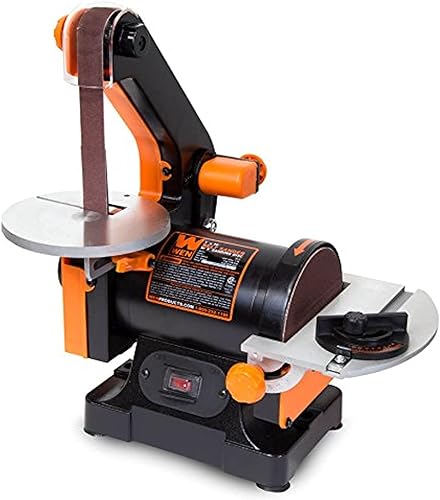 Best for stationary shaping and edges
WEN Benchtop Belt and Disc Sander
Orbital sander vs disc sander: the quick verdict
Pick the orbital sander if most of your sanding is finishing, and pick the disc sander if most of your sanding is shaping. The orbital sander vs disc sander choice comes down to who moves, you or the workpiece.
An orbital sander uses a round pad that spins and orbits at the same time. That motion leaves a smoother surface with fewer scratches than a plain spinning disc.
A disc sander uses a flat disc that spins in one direction. You press a small part against it to shape, round or clean an edge.
Our picks show that split clearly. The DEWALT 20V MAX Orbital Sander and the SKIL 5” Random Orbital Sander with Cyclonic cover handheld finishing.
The WEN Benchtop Belt and Disc Sander covers stationary work.
The two side by side
The orbital sander wins on finishing large surfaces, and the disc sander wins on repeatable shaping of small parts. Put them side by side and the main gap is portability.
An orbital sander weighs a few pounds and goes where the work is. The DEWALT model weighs 2.5 pounds, and the SKIL model weighs 3.4 pounds.
A disc sander stays on the bench and the part comes to it. The WEN model weighs 16 pounds and measures 11.5 x 11.5 x 15.5 inches, so it needs a fixed spot.
| Feature | Orbital sander | Disc sander |
|---|---|---|
| Main job | Finish flat surfaces | Shape small parts and edges |
| Movement | Tool moves over work | Work moves against fixed disc |
| Typical pad or disc | 5 inch round pad | 5 inch flat disc |
| Best for | Tabletops, doors, panels | Edges, ends, small shapes |
| Dust control | Bag, box or vacuum port | Dust ports on the unit |
If you compare an orbital sander vs a disc sander on speed alone, you will miss the point. The SKIL orbital sander runs at 7,000 to 13,000 OPM, and the WEN disc runs at 3,450 RPM, but those numbers describe different motions.
How an orbital sander finishes wood
An orbital sander finishes because its pad spins and orbits at the same time. That combined motion spreads the abrasive action and helps you keep a smooth, even surface.
Random orbit action also lowers the risk of deep circular scratches. You still need the right grit sequence, but the pad motion does much of the work for you.
The DEWALT 20V MAX Orbital Sander lets you set speed from 8,000 to 12,000 OPM. Lower speeds suit fine finishing, while higher speeds suit faster removal.
Its low-profile height helps you get close to the work surface for precise sanding. That shape matters on edges and narrow parts where a tall body would block your view.
The SKIL 5” Random Orbital Sander with Cyclonic runs from 7,000 to 13,000 OPM. Its wider range gives you more room to match speed to the material.
How a disc sander shapes parts
A disc sander shapes because the part stays still in your hands while the disc runs. You hold the workpiece against the spinning disc and control the cut with pressure and angle.
For a drill-mounted option, see sanding disc attachments for drills.
That setup suits small wooden parts, end grain, and edges that need a flat or rounded profile. Both hands stay free to guide the part.
The WEN Benchtop Belt and Disc Sander gives you a 5 inch disc at 3,450 RPM. It also gives you a 1 x 30 inch belt at up to 3,160 FPM for longer edges.
Its 2.3A motor supports both surfaces. A sturdy beveling work table supports the workpiece on the disc and the belt.
A miter gauge is included for angled workpieces. That helps when you need repeatable angles on small parts.
Handheld finishing vs stationary shaping
Handheld finishing favors the orbital sander, and stationary shaping favors the disc sander. Most woodworkers need both at different stages of a build.
You shape a part first, then you finish it. The disc sander helps during shaping, and the orbital sander helps during finishing.
An orbital sander can also remove saw marks and level a surface before you move to fine grits. It works on large panels that would never fit on a benchtop disc.
A disc sander can clean up edges and ends quickly. It gives you a fixed reference surface, so each pass removes material in a controlled way.
If you read about the best type of sander for woodworking, you will see the same pattern. Most shops keep a handheld sander for finishing and add a stationary sander when shaping grows.
Speed control and what it means
Variable speed on an orbital sander lets you match the finish to the task. High speed removes material faster, while low speed gives finer control.
The DEWALT model covers 8,000 to 12,000 OPM. That range suits everything from smoothing to final passes before stain.
The SKIL model covers 7,000 to 13,000 OPM. Its low end helps on delicate work, and its high end helps when you need faster removal.
A disc sander runs at a fixed speed in this comparison. The WEN disc runs at 3,450 RPM, and its belt runs at up to 3,160 FPM.
Fixed speed suits shaping, since you control removal with pressure. Variable speed suits finishing, since the same tool must handle coarse and fine grits.
Dust control on each type
Dust control is easier to manage on an orbital sander, because most models connect to a bag, box or vacuum. A disc sander also has dust ports, but dust can still spread around the bench.
The SKIL model uses an X-flow dust collector with cyclone force. Dust collects in a transparent container that you can empty.
The DEWALT model has a one-handed locking dust bag. Its dust port fits directly to DWV010 or DWV012 dust collectors.
For other vacuum systems with 1-1/4 in hoses, DEWALT points to the DWV9000 Universal Quick Connector. That detail matters if you already own a shop vacuum.
The WEN model has two separate dust ports for maximum vacuuming efficiency. You can connect vacuum attachments to the belt and disc sides.
Whichever tool you choose, empty the bag or box often. A full container lowers suction and leaves more dust on the surface.
Grit choice from coarse to fine
Grit choice matters more than brand when you want a clean finish. Start coarse for removal, then step through finer grits without skipping too far.
A disc set helps you make those steps. The WORKPRO 80-Piece Sanding Disc Set gives you 5-inch 8-hole discs for orbital sanders.
Its title lists grits from 60 through 400. That range covers rough shaping through fine finishing on wood, plastic, metal and other materials.
Aluminum oxide abrasive gives a fast cut and a smooth finish. The 8-hole backing supports dust extraction when your pad and vacuum match.
Use coarse grits to remove saw marks and level a surface. Move to medium grits to smooth the scratches, then use fine grits before stain or clear finish.
Power source and where you work
Power source decides how freely you can move around the workpiece. Cordless suits site work, and corded suits bench work near an outlet.
The DEWALT 20V MAX Orbital Sander runs on a 20 volt battery. Battery and charger are sold separately, so check what you already own.
Its brushless motor supports runtime and efficiency. A dust-sealed switch helps protect against dust ingestion.
The SKIL model runs on corded electric power at 120V with a 2.8 amp motor. You get steady power without watching a battery gauge.
The WEN model also runs on electric power at 120 volts. Its 2.3A motor drives the belt and disc from one bench spot.
Match the tool to your space. A cordless orbital sander suits on-site finishing, while a benchtop disc sander suits a fixed shop bench.
Who should buy an orbital sander
Buy an orbital sander if you finish furniture, doors, cabinets or tabletops. Those jobs need a tool that moves over a large surface.
Our guide to the best handheld sanders for wood helps you narrow the field by pad size, speed and dust options. Start there if finishing is your main task.
Choose the DEWALT model if you want cordless freedom and a low profile. It suits users who already own 20V batteries.
Choose the SKIL model if you want a corded tool with a cyclonic dust box. It suits indoor finishing where dust control matters.
Skip the orbital sander as your only tool if your main need is shaping small parts. It can smooth an edge, but it cannot give you the fixed disc surface of a stationary sander.
Compare the orbital sander vs oscillating sander if you also use detail tools. That choice affects tight corners and small profiles, not broad finishing.
Who should buy a disc sander
Buy a disc sander if you shape small parts, clean edges and work with end grain. Those jobs need a fixed surface and two hands on the part.
The WEN model suits hobby shops and small workshops. Its 1 x 30 inch belt and 5 inch disc cover most shaping tasks.
Its heavy-duty base helps prevent walking and wobbling. That matters when you press a part against the disc with steady pressure.
Its compact design makes transport and storage easier than a floor model. You still need a stable bench and room for dust ports.
Skip a benchtop disc sander if your main job is finishing large panels. You will still need a handheld sander for broad surfaces.
If you compare a circular sander vs orbital sander, you will see another handheld option for flat work. A disc sander is a different category, since it stays fixed and shapes parts.
Safety, setup and daily care
Set up either sander with dust control, eye protection and a stable work surface. Good habits protect your lungs and keep the finish clean.
Wear eye protection and a dust mask or respirator when you sand. Wood dust can irritate your lungs, especially indoors.
For an orbital sander, check that the disc is seated flat on the pad. An uneven disc can cause vibration and uneven scratches.
For a disc sander, keep your hands clear of the spinning disc. Hold small parts with a firm grip, and never reach over the disc.
Empty dust bags and boxes often. Clean the pad, ports and switches so dust does not build up inside the tool.
Store discs flat and dry. Heat and moisture can warp pads and lower the cut of the abrasive.
Read our guide on how to choose a miter saw if you plan cuts before you sand. A clean cut leaves less work for the sander.
Learn how to choose a miter saw blade before you start a project with tight joinery. Better cuts mean finer sanding later.
Orbital sander vs disc sander: which should you choose?
Choose the orbital sander for finishing and the disc sander for shaping, and add the second tool when your projects demand it. That rule keeps you from buying power you will not use.
If you finish more than you shape, start with an orbital sander. The DEWALT 20V MAX Orbital Sander gives you cordless control, and the SKIL model gives you cyclonic dust collection.
If you shape more than you finish, start with the WEN Benchtop Belt and Disc Sander. Its belt and disc give you two stationary surfaces for small parts.
Add discs in many grits, such as the WORKPRO set, before you add a second sander. Grit steps often fix a rough finish faster than a new tool.
Compare the detail sander vs orbital sander if tight corners are your main problem. Detail tools reach into small spaces, while orbital sanders finish broad areas.
Pick the tool that matches your next project, not the tool with the highest speed number. Your finish will show the difference.
Frequently asked questions
Is an orbital sander better than a disc sander?
Neither tool is better for every job, because they do different work. An orbital sander finishes large flat surfaces by hand, while a disc sander shapes small parts against a fixed disc.
Choose based on the task you do most, not on which tool sounds stronger.
Can a disc sander replace an orbital sander?
A disc sander cannot replace an orbital sander for table tops, doors or large panels. You move the orbital sander over the surface, while the workpiece moves against a fixed disc.
Most shops that shape parts still need a handheld sander for final smoothing.
What grit should I use on an orbital sander?
Start coarse for removal, then move through medium grits before you finish with fine grits. A set that spans 60 to 400 grit lets you change discs as the surface improves.
Always test the grit step on scrap wood first, so you do not skip a step and leave deep scratches.


