How to Secure Round Stock on a Miter Saw
Secure round stock by giving it a flat reference face, a cradle or V support, and a clamp placed away from the blade path. Never hold a dowel, pipe, or round profile by hand while it can roll or spin.
On this page (13 sections)
- Can you cut round stock on a miter saw at all?
- What stops a dowel from rolling on the fence?
- How do you clamp a cylinder without blocking the blade?
- Where should you put the stop for repeat cuts?
- How do you hold small round parts safely?
- What angled cuts need extra care on round profiles?
- How do you cut long dowels and handles without flex?
- How do you control dust and chips when cutting rounds?
- What mistakes cause round stock to kick or roll?
- How do you secure the saw itself before cutting rounds?
- What is the safest way to hold wood on a miter saw?
- Which products help with securing round items in a miter saw?
- How should you finish a round stock cut and check the result?
Secure round stock with a flat reference face, a cradle or V support, and a clamp away from the blade path. Never hold it by hand while it can roll or spin.
A flat board sits in one position. A cylinder sits in many, and vibration can change the one you set.
Can you cut round stock on a miter saw at all?
Yes, you can cut round stock on a miter saw if you can fix its position and keep your hands clear. You need a stable face, side support, and a clamp outside the blade path.
Dowels, handles, small PVC pipe, and turnings roll because contact with a flat fence is a line, not a broad face. Test a short piece first and try to nudge it by hand.
If it shifts, the blade will likely move it too.
Never rely on hand pressure. Keep the guard in place, check the mark, clamp, and blade path with the saw off, and follow the saw manual for stock limits.
What stops a dowel from rolling on the fence?
A V block, cradle, or flat reference face stops a dowel from rolling. It holds the cylinder at one height and side position, so the blade meets the same surface each time.
For a small dowel, cut a snug V groove in a scrap block. That gives the fence a flat face to reference.
Foam can add grip for light cuts, but it does not replace a clamp.
For a larger tube, use two side blocks as a channel under a top clamp. Set the piece, tighten the clamp, then try to roll it by hand.
If it rolls, fix the cradle before changing tension.
How do you clamp a cylinder without blocking the blade?
Clamp a cylinder from the top or side so it stays clear of the blade path. Lower the saw with power off to confirm it will not hit the clamp at full drop.
Read How To Clamp Wood To A Miter Saw? for flat stock positions. With round stock, the clamp must resist rolling, not just push the piece to the fence.
Clamping the cradle block often gives better control for a dowel in a cradle. Keep the clamp on the long side and tighten in small steps to avoid denting softwood.
Where should you put the stop for repeat cuts?
Put the stop where the long side of the stock meets it, not where the round surface can slip past. A stop gives the end of the piece a flat face to rest against.
For repeat lengths, clamp a small block to the fence behind the cradle and slide each dowel in until its end touches it. Then clamp from the top.
Set the stop first, then test with scrap. Keep the fence flat and clean, since sawdust behind a cradle can tilt it.
How do you hold small round parts safely?
Hold small round parts with a cradle and clamp, never with fingers near the blade. Small parts have little mass, so vibration can move them fast.
For parts under a few inches, a block cradle with a V groove and top clamp is the safest simple setup. The groove fixes height and the block gives a flat top for the clamp.
If the part is too short, glue or tape it to a carrier strip and clamp the carrier. Test the bond with a light pull, since a loose part can spin under the blade.
Support long, thin dowels at both ends to reduce flex.
What angled cuts need extra care on round profiles?
Angled cuts need extra care because the contact point moves as the blade enters a curved surface. A miter or bevel can make a round piece climb, roll, or bind if the cradle does not lock it.
Test the angle on scrap in both directions. A cylinder can roll toward the fence on one angle and away on the other.
Lock the miter and bevel before clamping, and go slowly on the first cut. For repeat angles, mark the fence face of a dedicated cradle so you do not flip it.
How do you cut long dowels and handles without flex?
Cut long dowels and handles with support at the cut and at the far end. Flex can make a straight cut bend or bind.
Use a roller stand to hold the piece level with the saw table. The support should hold it up without pushing it sideways.
Measure from the blade to the mark, since round stock can sit at a different height in a cradle. Check How to Cut Long Boards with a Miter Saw? for support ideas.
How do you control dust and chips when cutting rounds?
Control dust with a vacuum that starts with the saw and runs a few seconds after you stop. Round stock can throw fine dust that drifts into the room.
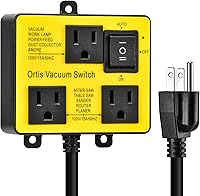
An automatic switch helps because you need no free hand to start the vacuum. It starts after a short delay and keeps running after the blade stops to clear leftover dust.
That Ortis switch has two tool outlets, so you can run a saw and another tool without an extra socket. Its actuation threshold can be set to 30W or 60W, and the shutoff delay to 3, 7, or 10 seconds.
Those choices matter when a small tool draws less power than a large shop saw.
The second Ortis model uses a fixed 1 second start delay and a 7 second shutoff delay in auto mode. It also has two tool outlets and three vacuum modes: auto, off, and on.
That fixed timing suits a shop where one saw and one vacuum do most of the work.
The KTNNKG model adds remote control with two remotes and a stated 328 ft range. The vacuum outlet powers on when the tool reaches 30W, with a 1 second start delay and a 7 second off delay in auto mode.
All three switches list a max rating of 120V and 15A, with limits of 1875W for the Ortis models and 1800W for the KTNNKG model. Check your saw and vacuum ratings before wiring.
Mount the switch where you can see its mode lights but it will not collect heavy dust. Wear eye protection for every cut, and use a respirator when the material or dust level calls for it.
What mistakes cause round stock to kick or roll?
The most common mistake is holding round stock by hand pressure alone. Vibration can reduce friction until the piece is free to roll.
A second mistake is clamping the offcut side. As the cut finishes, that side can fall or flip and pull the kept piece with it.
Clamp the long side and support the offcut. A third mistake is a loose miter or bevel lock, so lock both and tug the head lightly to confirm.
Check Why Does a Sliding Miter Saw Kick Back? if you use a slider. A dull or wrong blade also pushes instead of cutting.
How do you secure the saw itself before cutting rounds?
Secure the saw itself before you worry about the stock. A saw that shifts on its stand changes the blade path.
Read How To Secure A Miter Saw? for mounting and stand checks. Read How To Secure Miter Saw To Table? if your saw sits on a bench.
Check the mounting bolts, stand feet, and fence mount. Keep the area clear of chips, since a chip under a cradle block can tilt it.
What is the safest way to hold wood on a miter saw?
The safest way to hold wood on a miter saw is a clamp on the fence side, with your hands on the handle and off the stock. That rule covers flat boards and round stock alike.
The guide at What Is the Safest Way to Hold Wood on a Miter Saw? covers hand placement, clamp choice, and fence reference. Round stock adds the cradle and roll check on top.
Keep your hands at least 6 inches from the blade path. Wear eye protection and check that the guard closes fully after each cut.
Which products help with securing round items in a miter saw?
The right product keeps the vacuum running without taking your attention off the clamp. The three switches cover adjustable timing, fixed timing, and remote control.
Pick the first Ortis model if you want control over start threshold and shutoff delay. Its 30W or 60W threshold and 3, 7, or 10 second delays let you match a small tool or a large saw.
Pick the second Ortis model for a simpler fixed setup with a 1 second start delay and 7 second shutoff delay. Pick the KTNNKG model if the switch will sit far from the saw.
All three use 14AWG power cords and V0 grade flame retardant housings. Check motor ratings before wiring.
How should you finish a round stock cut and check the result?
Finish the cut by holding the saw down until the blade stops. Releasing early can let a round offcut shift and strike the blade as it slows.
Let the offcut drop or lift it out after the blade stops. Do not pull it up while the blade is still moving.
Check the kept face for burn marks, chatter, or a curved line. Burns suggest a slow feed or dull blade, and chatter suggests movement in the cradle or clamp.
Measure from the cradle reference, using the same point every time. Sand or file the edge only after the piece is clear of the saw.
Frequently asked questions
Can I cut a round dowel on a miter saw?
Yes, if you can stop it from rolling and spinning. Use a cradle, V block, or a flat face against the fence, clamp it firmly, and keep the clamp clear of the blade.
A short test piece helps you confirm the setup before the final cut.
What is the best way to hold a round workpiece?
Clamp it so the blade contacts a stable face first. For small dowels, a V groove or foam-lined cradle adds grip.
For larger tubes, support both sides, set a stop for repeat cuts, and never reach near the blade to steady the piece during the cut.
Why does round stock roll on a miter saw?
A cylinder touches the fence and table on a narrow line. Saw vibration and blade direction can push it sideways.
Once it moves, the side reference changes, the cut can drift, and the offcut can spin or kick.
Do I need dust control for round stock cuts?
Yes, round stock can throw fine dust when it is wood, and cutting dust should be captured at the source. An automatic vacuum switch can start your vacuum when the saw starts and keep it running briefly after you stop.