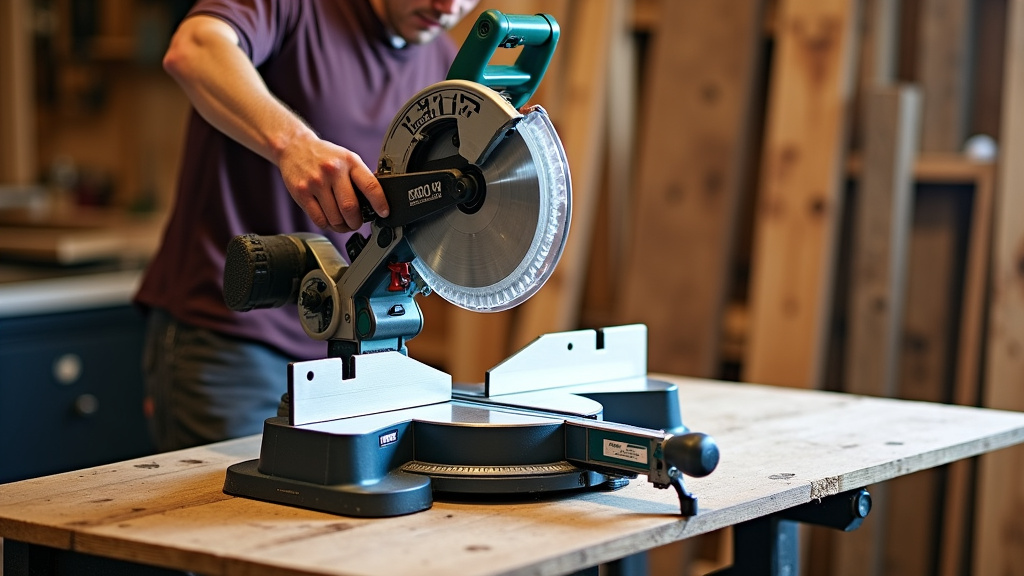
You’ve learned that a dual bevel miter saw is a versatile tool for making precise angled cuts. Its ability to tilt both left and right eliminates the need to flip your workpiece, saving you time and improving accuracy. This feature is especially useful for crown molding, trim work, and picture frames. Understanding its mechanisms and advantages helps you choose the right saw for your projects.
Now that you know the benefits, consider how a dual bevel miter saw can enhance your woodworking or construction tasks. If you frequently make complex angled cuts, adding this tool to your workshop could greatly improve your efficiency and the quality of your work.
Frequently Asked Questions
Can a single-bevel miter saw achieve the same cuts as a dual-bevel?
While a single-bevel saw can make angled cuts, it can only tilt in one direction. To achieve opposing bevels, you would need to manually flip your workpiece. This adds an extra step and can reduce accuracy, especially on longer materials.
Are dual bevel miter saws harder to use for beginners?
Not necessarily. The core operation is very similar to a single-bevel saw. The main difference is the added flexibility and control over bevel angles. Many models offer clear angle indicators that make setup straightforward.
What safety precautions are specific to dual bevel miter saws?
Always wear safety glasses and hearing protection. Ensure your workpiece is securely clamped before cutting. Keep your hands clear of the blade path, and never force the saw through material. Maintain good control of the saw handle during the entire cutting operation.
Is a sliding feature necessary on a dual bevel miter saw?
A sliding feature allows the saw head to move forward and backward, increasing the cross-cutting capacity. While not strictly “necessary” for all tasks, it’s very useful if you frequently cut wider boards, like shelving or deck planks.
How do I maintain my dual bevel miter saw for optimal performance?
Regularly clean dust and debris from the saw, especially around the bevel mechanism and blade guard. Inspect the blade for sharpness and replace it when dull. Check and tighten any loose bolts or fasteners. Lubricate moving parts according to your manufacturer’s instructions.