9 Best Belt Sanders for Woodworking (November 2026)
The best belt sanders for woodworking include the SKIL 6 Amp 3"x18" Belt Sander for most large flat surfaces, the WEN 6307 Variable Speed Detailing File Sander for tight corners and details, and the BUCKTOOL Bench Belt Disc Sander for Woodworking for a dedicated benchtop station.
On this page (5 sections)
Finding the right belt sander for woodworking starts with the surface you sand most often. For large, flat boards and panels, the SKIL 6 Amp 3"x18" Belt Sander is a strong fit because its 6 A corded motor, pressure control indicator, auto-track belt alignment and flush edge sanding help keep the belt centred and let the abrasive do the work.
For floor refinishing, compare our sander guide for hardwood floors.
Detail work needs a different shape, so choose the WEN 6307 for tight corners or small contours. Pick BUCKTOOL or WEN for a dedicated benchtop station, and choose DEWALT when cordless mobility matters more than a fixed power cord.
A belt sander removes material quickly, so belt size, speed control, dust setup and work position matter more than a long feature list. If you are comparing different types of sanders, match the tool to the surface first.
Check belt tracking before you start, keep the sander moving, and use light pressure so the tool cuts evenly instead of digging.
Our picks at a glance
-
1

-
2
 Best for tight corners and details
WEN 6307 Variable Speed Detailing File Sander
9.7/10 our score
See it on Amazon -
3
 Best for a dedicated benchtop station
BUCKTOOL Bench Belt Disc Sander for Woodworking
9.6/10 our score
See it on Amazon
- 4
 Best for cordless large-job sandingCheck it
- 5
 Check it
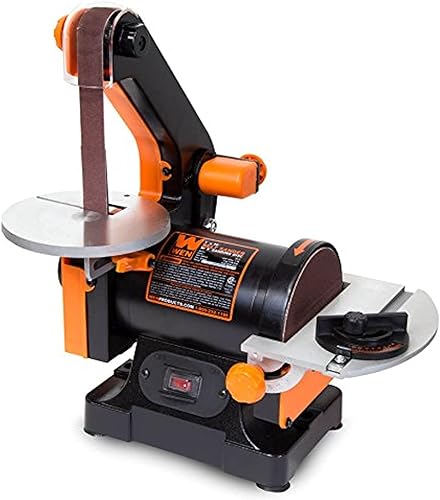
WEN Benchtop Belt and Disc Sander
Best for compact belt-and-disc work - 6
 Check it
Woodskil 4.3A Belt Disc Sander Combo
Best for adjustable benchtop angles - 7
 Check it
Jellas 7Amp Handheld Belt Sander
Best for variable-speed handheld use - 8
 Check it
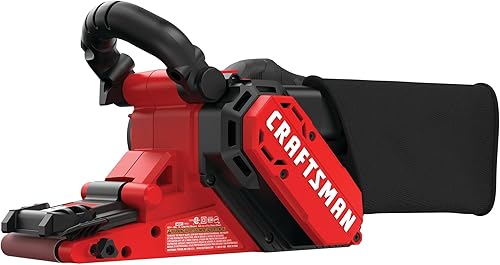
CRAFTSMAN Electric 7 Amp Belt Sander
Best for close edge sanding - 9
 Best for handheld and bench flexibilityCheck it
Which belt sander is best for woodworking projects?
The SKIL is the best all-around choice for broad wood surfaces, while the WEN 6307 is better for detail work and the benchtop picks suit controlled edge shaping. For blade shaping, compare belt sanders for knife making.
Small shops and larger workshops will not need the same machine. A handheld model suits boards that stay in place, while a benchtop belt and disc sander suits repeatable edge work where the workpiece moves instead of the tool.
We compared belt size, power, speed control, dust handling and setup flexibility against common woodworking tasks. Broad panels need a wider belt and steady removal, while contours need a narrow belt that can reach into tight spaces without gouging the surrounding surface.
Speed matters because it changes how fast material comes off and how careful you must be near an edge. Lower speeds help with control around details, while higher speeds suit rough removal on stock that can take it.
Dust handling is part of control too, since a cleaner view helps you judge the surface as you work. Some models use a dust bag, some accept a vacuum hose or dust port, and benchtop models may have separate ports for belt and disc.
Our score weighs specs, features and buyer feedback against what you are shopping for. The picks are ordered from highest score to lowest score.
In practice, the best pick is the one whose belt size and work position fit your normal projects. If most of your work is flat boards, a full size handheld belt keeps things simple.
| Product | Best for | Belt size | Power | Dust control | Our score |
|---|---|---|---|---|---|
| SKIL 6 Amp 3"x18" Belt Sander | most large flat surfaces | 3 x 18 in | 6 A, 120 V corded electric | Micro-filtration and 1-1/4 in vacuum hose compatibility | 9.7 |
| WEN 6307 Variable Speed Detailing File Sander | tight corners and details | 1/2 x 18 in | 2 A corded electric | 9.7 | |
| BUCKTOOL Bench Belt Disc Sander for Woodworking | a dedicated benchtop station | 5 A, 120 V corded electric | 9.6 | ||
| DEWALT 20V MAX* Belt Sander | cordless large-job sanding | 20 V battery powered | Dust bag and AirLock-compatible dust collection system | 9.6 | |
| WEN Benchtop Belt and Disc Sander | compact belt-and-disc work | 2.3 A corded electric | 9.4 | ||
| Woodskil 4.3A Belt Disc Sander Combo | adjustable benchtop angles | 4.3 A corded electric | 8.9 | ||
| Jellas 7Amp Handheld Belt Sander | variable-speed handheld use | 3 x 21 in | 7 A, 120 V corded electric | 8.8 | |
| CRAFTSMAN Electric 7 Amp Belt Sander | close edge sanding | 3 x 21 in | 7 A corded electric | 8.3 | |
| VEVOR 7A Belt Sander 3" x 21" | handheld and bench flexibility | 3 x 21 in | 7 A, 120 V corded electric | 8.1 |
Best belt sander for woodworking picks
The SKIL leads for general board sanding, but each product below solves a different workshop problem. Read the belt size and setup details before choosing.
SKIL 6 Amp 3"x18" Belt Sander: Best for most large flat surfaces
- 6 A corded electric power
- 3 x 18 in sanding belt
- Pressure control technology
- Auto-track belt alignment
- Micro-filtration and vacuum compatibility
The SKIL combines a 3 x 18 in belt with pressure guidance and automatic belt alignment. It fits general woodworking where you need steady removal across broad wood surfaces.
Pros
- Pressure control indicator
- Auto-track belt alignment
- Flush edge sanding
- Vacuum compatible
Cons
- Corded operation
- Medium grit included
The SKIL 6 Amp 3"x18" Belt Sander is the strongest general pick for broad woodworking surfaces. To compare belt and drum formats, see belt sander vs drum sander.
Its 6 A, 120 V corded motor gives you a full-size belt format for removing material across boards, panels and other flat wood surfaces.
Pressure control technology warns you when excessive pressure is applied. That matters because pressing harder can make it easier to dig into wood instead of letting the abrasive do the work.
The auto-track belt alignment keeps the belt centered, while flush edge sanding lets the 3 in belt work close to an edge. Micro-filtration captures fine dust particles, and the sander fits standard 1-1/4 in vacuum hoses.
Choose this model when you want a simple corded machine with guidance for pressure and belt position. Its medium grit and 5.5 lb weight make it a practical starting point for general wood sanding.
WEN 6307 Variable Speed Detailing File Sander: Best for tight corners and details
- 1/2 x 18 in pivoting belt
- 1080 to 1800 FPM variable speed
- 55-degree belt pivot
- Tool-free belt changes
- Three abrasive belts included
The narrow pivoting belt reaches tight corners, contours and awkward angles. Its variable speed dial and compact 2.4 lb body suit detail sanding rather than broad stock removal.
Pros
- 55-degree pivot
- Variable speed
- Auto-tracking belt
- Three belts included
Cons
- Narrow belt covers less surface
- Not the first choice for broad boards
The WEN 6307 Variable Speed Detailing File Sander is the best choice for narrow work. Its 1/2 x 18 in belt reaches tight corners, contours and awkward angles that a wider belt may not fit.
For curved edges, oscillating spindle sanders offer another approach.
The belt pivots up to 55 degrees, and the variable speed dial ranges from 1080 to 1800 feet per minute. Use the lower end when you need more control around a detail, then raise the speed when the work allows faster removal.
Its auto-tracking system avoids manual belt adjustments, while tool-free belt installation makes grit changes easier. The compact 2.4 lb body is easier to position in confined spaces than the wider handheld picks.
Three abrasive belts, a dust port attachment and a two-year warranty are included. Choose it for detail work, not as your only sander for large boards.
BUCKTOOL Bench Belt Disc Sander for Woodworking: Best for a dedicated benchtop station
- 4 x 36 in belt
- 8 in disc
- 5 A motor
- 3/4 HP direct drive
- 0 to 45-degree tilting worktable
- Dual dust ports
This benchtop machine combines a long belt with an 8 in disc for shaping, beveling and edge work. Its tilting worktable, miter gauge and dual dust ports fit a fixed workshop setup.
Pros
- Long 4 x 36 in belt
- 8 in disc adds shaping options
- Tilting worktable
- Dual dust ports
Cons
- Needs benchtop space
- Less portable than handheld models
The BUCKTOOL Bench Belt Disc Sander is best for a fixed woodworking station with both belt and disc sanding. Its 4 x 36 in belt and 8 in disc give you separate surfaces for long edges, shaping and bevel work.
The 5 A direct-drive motor has a 3/4 HP rating and a 3450 RPM disc speed. The belt can sit horizontally or vertically, and the cast aluminum worktable tilts from 0 to 45 degrees.
A miter gauge helps hold an angle on the workpiece. Two dust ports support connection to a dust collector, while the cast aluminum base with rubber feet is designed to limit vibration.
Choose this machine when you have room for a benchtop setup and want more support than a handheld tool provides. If you already own a bench grinder, a belt sander attachment is another setup to consider.
It is less suitable when you need to carry the sander from room to room.
DEWALT 20V MAX* Belt Sander: Best for cordless large-job sanding
- 20 V MAX battery power
- Brushless motor
- Variable speed trigger
- 25-speed selection dial
- Tool-free belt release
- AirLock dust collection compatibility
The DEWALT is aimed at cordless work where moving around a jobsite matters. Its variable controls, quick belt release and two-handed auxiliary handle support larger sanding tasks without a power cord.
Pros
- Brushless motor
- Cordless operation
- 25-speed selection dial
- Quick-release belt system
Cons
- Tool only
- Battery-powered setup required
The DEWALT 20V MAX* Belt Sander is the cordless pick for large sanding jobs. Its brushless 20 V MAX motor and battery power remove the need to work beside an outlet, while the included configuration is tool only.
A variable speed trigger and 25-speed selection dial let you adjust the sander to the application. Lower settings help when you need more care near an edge, and higher settings suit faster removal on broader surfaces.
The quick-release system supports tool-free belt changes, so you can spend less time swapping abrasives between stages of a job. The overmolded auxiliary handle supports two-handed operation, which helps keep the tool steady during longer passes.
Dust control includes a DEWALT dust bag and a swivel dust port. The tool also supports the DEWALT AirLock dust collection system, which is sold separately, so check which parts you already own.
This model suits users who move around a jobsite or work away from a fixed outlet. It also suits those already using the battery platform, since the tool only package assumes a compatible battery and charger are ready to go.
Keep the belt tracking centred, let the sander move across the surface, and avoid leaning on it with extra force. Light, steady pressure usually gives a more even result.
WEN Benchtop Belt and Disc Sander: Best for compact belt-and-disc work
- 1 x 30 in belt
- 5 in sanding disc
- 2.3 A motor
- Two dust ports
- Miter gauge and beveling worktable
This compact benchtop unit gives you both a 1 x 30 in belt and a 5 in disc. It suits smaller workshops that need edge sanding, beveling and deburring without a larger machine.
Pros
- Two sanding surfaces
- Compact benchtop design
- Two dust ports
- Miter gauge included
Cons
- Shorter belt than larger benchtop picks
- Requires a fixed workspace
The WEN Benchtop Belt and Disc Sander is the compact benchtop option. Its 1 x 30 in belt and 5 in disc give a small workshop two sanding surfaces without the larger footprint of the BUCKTOOL.
The 2.3 A motor provides up to 3160 FPM on the belt and 3450 RPM on the disc. In daily use, that means the belt side suits edge smoothing and shaping, while the disc side suits smaller end grain and bevel work where a flat disc surface is easier to control.
A heavy-duty base helps prevent walking and wobbling, which is useful when the workpiece needs steady support. A fixed machine also makes it easier to keep your hands clear and to repeat the same angle across several matching pieces.
The machine includes a miter gauge, an 80-grit sanding disc and a 100-grit sanding belt. Two dust ports support vacuum attachments, and the beveling worktables provide support for angled workpieces during sanding.
Choose it for small-shop edge work, beveling and deburring. It fits users who want a station for shaping small parts rather than a tool for sanding large faces.
If you often sand large faces or long edges, a wider handheld or longer benchtop belt may suit you better. This is the trade off of a compact design.
You gain easier storage and a smaller footprint, but you give up the longer sanding area that helps with broad stock.
Woodskil 4.3A Belt Disc Sander Combo: Best for adjustable benchtop angles
- 4 x 36 in belt
- 6 in disc
- 0 to 90-degree belt position
- 0 to 45-degree worktable
- Dual dust ports
- Miter gauge
The Woodskil gives a long belt and a 6 in disc with adjustable belt and table positions. It fits shaping and contour work when you want a benchtop machine with two sanding surfaces.
Pros
- 0 to 90-degree belt adjustment
- Long belt
- Dual dust ports
- Miter gauge included
Cons
- Heavier 25 lb benchtop design
- Less portable than handheld sanders
The Woodskil 4.3A Belt Disc Sander Combo is best when adjustable benchtop angles matter. Its 4 x 36 in belt and 6 in disc cover long edges and smaller shaping work.
The belt adjusts from 0 to 90 degrees, and the worktable adjusts from 0 to 45 degrees with a miter gauge. That range helps when a project needs a flat platen style pass in one position and a more vertical shaping pass in another.
Its motor reaches up to 3570 RPM, with a stated belt speed of 1732 FPM. Higher speed can remove material faster, but it also rewards a light touch and steady movement so the surface stays flat.
Separate dust exhaust ports serve the belt and disc sides. A transparent guard helps you check belt condition, and the machine includes a steel base and two sanding papers.
Choose Woodskil for a workshop where belt position changes are part of the work. It suits contour sanding and shaping when you want both a long belt and a disc on one station.
Its 25 lb weight makes it a stationary tool rather than a portable sanding solution. Set up is worth doing carefully, with the base stable and the worktable locked before you start.
That steady set up is what makes a benchtop machine more accurate than a handheld tool for repeat edge work.
Jellas 7Amp Handheld Belt Sander: Best for variable-speed handheld use
- 7 A, 120 V motor
- 3 x 21 in belt
- 6 speed dials
- 10 sanding belts
- Dust bag and vacuum adapters
- Two C clamps for bench use
The Jellas combines a full-size 3 x 21 in belt with six speed settings and a dust collection setup. The included clamps let it switch between handheld and benchtop use.
Pros
- 7 A motor
- Six speed settings
- 10 sanding belts included
- Dust bag and vacuum adapters
Cons
- Corded operation
- Larger handheld body than detail sanders
The Jellas 7Amp Handheld Belt Sander fits projects that need both power and variable speed. Its 7 A, 120 V motor and 3 x 21 in belt suit broad wood surfaces, while six speed dials let you adjust the working pace.
The package includes 10 aluminum oxide sanding belts: 2 each in 40, 60, 80, 120 and 180 grit. That range covers coarse removal through finer sanding without buying several belt packs first.
The detachable dust bag connects with 35 mm and 32 mm vacuum adapters. A vacuum set up keeps the work area cleaner, while the bag gives a simpler option when you do not want to drag a hose across the job.
Two metal C clamps let you turn the tool over and fix it to a table for bench use. That flexibility suits users who sand large panels by hand on one day and small edges on a bench the next.
Choose Jellas when you want one corded tool that can move between handheld and clamped setups. Start with a lower speed near edges and raise it only when the surface allows faster removal.
CRAFTSMAN Electric 7 Amp Belt Sander: Best for close edge sanding
- 3 x 21 in belt
- 7 A corded motor
- Angled belt design
- Tool-free belt release
- Three-position overmolded handle
- On-board dust bag
The CRAFTSMAN uses an angled belt design to sand closer to adjoining surfaces. Its 3 x 21 in format and 800 FPM maximum speed fit straightforward material removal on wood.
Pros
- Angled belt design
- 7 A motor
- Tool-free belt changes
- Three-position handle
Cons
- No variable speed control listed
- On-board dust bag rather than a larger collection system
The CRAFTSMAN Electric 7 Amp Belt Sander is a straightforward pick for close edge sanding. Its angled 3 x 21 in belt design helps it work near adjoining surfaces, while the 7 A corded motor supports fast material removal.
The maximum belt speed is 800 FPM. That fixed speed suits straightforward removal on wood where you want the tool to work at a consistent pace without adjusting settings between passes.
Tool-free belt release makes belt changes simpler, and the three-position overmolded handle gives you more ways to position your hands during use. Different hand positions can help with comfort when you reach across a panel or work close to a wall.
An on-board dust bag is included with the sander, along with one sanding belt. The bag is a simple way to catch some debris, though it will need emptying during longer jobs.
Choose this model when a close-sanding shape and familiar controls matter more than variable speed. It suits users who want a full size handheld belt sander for general wood sanding near edges and adjoining surfaces.
Care is mostly about pressure and movement. Let the angled belt get close to the surface, keep the tool moving, and avoid forcing it into corners.
That approach helps the design do what it is meant to do without digging into the wood.
VEVOR 7A Belt Sander 3" x 21": Best for handheld and bench flexibility
- 3 x 21 in belt
- 7 A motor
- Six speeds from 630 to 1200 FPM
- Two bench clamps
- Two dust bags
- 10 sanding belts
The VEVOR works as a handheld or benchtop sander with two clamps. Six speed settings, two dust bags and 10 belts make it a flexible option for mixed woodworking tasks.
Pros
- Handheld and benchtop use
- Six speed settings
- Two dust bags
- 10 belts included
Cons
- Heavier at 8.8 lb
- Corded operation
The VEVOR 7A Belt Sander is the flexible choice for handheld and benchtop use. Its 3 x 21 in belt and 7 A motor support broad woodworking tasks, while two clamps let you secure it to a work surface.
Six speeds range from 630 to 1200 FPM. Lower speeds suit more controlled detail sanding, while higher speeds help with faster removal of rough surfaces.
That range helps when one tool must handle both careful edge work and faster stock removal.
The package includes 10 sanding belts in 40, 60, 80, 120 and 180 grit, with 2 of each grit. Having several grits in the box makes it easier to move from rough removal to smoother finishing without stopping to source more belts.
It also includes two dust collection bags and a vacuum adapter. The bags are handy for portable work, while the adapter lets you connect a vacuum when you want a cleaner set up at the bench.
Choose VEVOR if you want a mixed setup without buying a separate benchtop sander. Clamping the tool down gives you a stable station for small parts, while handheld use suits larger boards that cannot move easily.
At 8.8 lb, it is heavier than the Jellas and may feel less convenient for extended handheld work. That weight can be a trade off during long sessions, so it suits users who value flexibility over the lightest possible handheld feel.
How should you choose a belt sander for woodworking?
Choose a belt sander by matching the belt size and control system to the workpiece. Broad boards favor a 3 x 18 in or 3 x 21 in handheld belt, detail work favors a narrow file belt, and fixed edge shaping favors a benchtop belt-disc machine.
What belt size fits your woodworking?
A 3 x 18 in belt is a balanced size for general surface sanding. The SKIL uses this format, while the Jellas, CRAFTSMAN and VEVOR use 3 x 21 in belts for a longer sanding path.
A 4 x 36 in belt gives the BUCKTOOL and Woodskil more length for benchtop edge work. A 1 x 30 in belt keeps the WEN benchtop unit smaller, and the WEN 6307's 1/2 x 18 in belt reaches narrow spaces.
If you are choosing between a handheld and fixed machine, read our belt sander vs planer guide before buying. A belt sander removes surface material, while a planer changes board thickness and creates a flat reference face.
Is variable speed useful on a belt sander?
Variable speed is useful when one project includes both controlled detail work and faster material removal. The WEN 6307 ranges from 1080 to 1800 feet per minute, the DEWALT has a 25-speed selection dial, and the VEVOR offers six speeds from 630 to 1200 FPM.
A fixed-speed tool can still work well when your tasks are consistent. The CRAFTSMAN reaches 800 FPM, while the SKIL focuses on pressure control and belt tracking rather than a listed variable-speed system.
Use a lower setting near delicate edges and a higher setting only when the workpiece and abrasive allow it. Keep the sander moving to reduce the risk of creating a low spot.
Do you need a benchtop belt sander?
You need a benchtop belt sander when stable support, repeatable angles or a disc surface matter more than portability. BUCKTOOL and Woodskil offer longer belts, tilting tables and miter gauges, while the WEN 6515T keeps the belt and disc surfaces compact.
A handheld sander is more useful for floors, large panels, installed boards or workpieces that cannot move easily. The Jellas and VEVOR can add bench use with clamps, giving you more flexibility without a dedicated machine.
For baseboard work, pair the sander decision with the rest of the setup. Our guide to what tools you need to install baseboards covers the wider tool list.
How does dust collection affect a woodworking sander?
Dust collection affects cleanup and airborne debris, so look for a dust bag, vacuum adapter or dedicated port that fits your workspace. The SKIL fits standard 1-1/4 in vacuum hoses, and the Jellas includes two vacuum adapters.
The DEWALT supports an AirLock system, while BUCKTOOL and Woodskil have dual dust ports. The CRAFTSMAN includes an on-board dust bag, and the VEVOR includes two dust bags plus a vacuum adapter.
Dust collection does not replace eye protection, hearing protection or safe work habits. Follow the sander's instructions and keep the work area clear of loose material.
Which belt sander is easiest to control?
The easiest model to control depends on the work. The SKIL gives a pressure control warning and auto-track belt alignment, the WEN 6307 has a narrow pivoting belt, and the DEWALT adds variable control with a two-handed auxiliary handle.
A wider belt removes more material, but it also needs careful movement across the surface. Start with light pressure, keep the tool moving, and let the abrasive do the cutting.
The Jellas and VEVOR add speed settings, while the CRAFTSMAN uses a three-position handle. Choose the control feature that matches the way you plan to hold and move the tool.
More guides on this topic
- Best Mini Belt Sanders
- Best Makita Belt Sanders
- Best Variable Speed Belt Sanders
- Best Milwaukee Belt Sanders
- Best Corded Belt Sanders
- Best Belt Sanders with Dust Collection
- Best Heavy Duty Belt Sanders
- Best Handheld Belt Sanders
- Best Makita Cordless Belt Sanders
- Best Cordless Belt Sanders
- Best Makita Corded Belt Sanders
Use these guides to narrow the choice by size, power source or work style. Mini and handheld guides help when storage or portability matters, while corded and cordless guides help when reach and set up time matter most.
Variable speed guides are useful if your projects mix careful detail work with faster removal. Heavy duty guides suit thicker stock and longer sessions, while dust collection guides suit indoor shops where cleanup is a concern.
Brand specific guides can help if you already own batteries, belts or accessories from the same maker. Matching a sander to your existing set up can save time and reduce extra purchases.
Start with the surface you sand most often, then check belt size and control options against that work. If most jobs are broad boards, a full size belt makes sense.
Also think about where the work happens. A fixed bench suits repeatable shaping and angles, while a handheld tool suits floors, panels and installed boards.
Take your time with dust control and care as well. A vacuum adapter or dust bag can make sanding cleaner, and light pressure with steady movement helps every belt last longer.
Which is the best belt sander for woodworking?
The SKIL is the best belt sander for woodworking if you need one corded tool for broad, flat surfaces. Its 6 A motor, pressure guidance, auto-track belt and flush edge sanding cover the core needs of many wood projects.
Pick the WEN 6307 for tight corners, BUCKTOOL or WEN for a benchtop station, and DEWALT for cordless work. Choose Jellas or VEVOR when variable speed and flexible setup matter more than the simplest handheld design.
For most users, the decision comes down to work position and belt size. Broad boards favour a 3 x 18 in or 3 x 21 in handheld belt, while detail work favours a narrow file belt that can reach contours.
Speed control is the next thing to weigh. Variable speed helps when a project includes both careful edge work and faster removal, while a fixed speed tool can still suit consistent tasks.
Dust control and care also affect the result. A dust bag, vacuum adapter or dust port helps keep the workspace cleaner, and light pressure lets the abrasive cut evenly.
Choose the model that matches your normal projects, not just the longest list of features. If most of your work is flat surfaces, the SKIL covers that need well.
Our top 3 picks at a glance
-
1
-
2
Best for tight corners and details
WEN 6307 Variable Speed Detailing File Sander
9.7/10 our score
See it on Amazon -
3
Best for a dedicated benchtop station
BUCKTOOL Bench Belt Disc Sander for Woodworking
9.6/10 our score
See it on Amazon
Frequently asked questions
What is the best belt sander for woodworking?
The SKIL 6 Amp 3 x 18 in Belt Sander is the best belt sander for woodworking for most large, flat surfaces. Its 6 A corded motor, pressure control indicator, auto-track belt alignment and flush edge sanding suit general board work.
Choose the WEN 6307 for narrow detail sanding, or a benchtop belt-disc model for fixed workshop shaping.
What belt size is best for woodworking?
A 3 x 18 in or 3 x 21 in belt suits many broad woodworking tasks because it covers more surface than a detail file sander. A 4 x 36 in belt on a benchtop machine gives a longer sanding area for fixed-station work.
A 1/2 x 18 in belt is better for tight corners and contours.
Is a belt sander good for finishing wood?
A belt sander is useful for fast material removal and smoothing broad wood surfaces, but it needs controlled pressure and movement. Start with a suitable coarse or medium belt, keep the sander moving, and follow with a finer sanding method when the surface needs a smoother finish.
The right approach depends on the wood and the finish you plan to apply.
Do belt sanders need dust collection?
Dust collection helps reduce airborne sanding debris and cleanup. The SKIL accepts standard 1-1/4 in vacuum hoses, while the DEWALT supports an AirLock dust collection system and the Jellas and VEVOR include dust bags plus vacuum adapters.
Wear suitable eye and respiratory protection and follow the tool instructions.
What is the difference between a belt sander and an orbital sander?
A belt sander uses a moving abrasive belt for faster material removal across larger surfaces. An orbital sander uses a smaller pad with an orbital motion and is often chosen for controlled surface smoothing.
Our belt sander vs orbital sander comparison explains which tool fits common woodworking tasks.


