9 Best Air Powered Orbital Sanders (November 2026)
The best air powered orbital sanders include the Ingersoll Rand 328B 8" Dual-Action Orbital Air for broad flat surfaces, the ZFE 1/2/3 Inch Random Orbital Air Sander for flexible detail work, and the Gedu Professional Air Random Orbital Palm Sander for overhead sanding.
On this page (6 sections)
The best air powered orbital sander for broad flat surfaces is the Ingersoll Rand 328B 8" Dual-Action Orbital Air. Its 8-inch pad and 0.25 hp motor suit material removal, while the ZFE mini models are better for spot sanding and the 3M is aimed at industrial finishing.
Air sanders trade electrical simplicity for continuous pneumatic power. That means less worry about cords or battery charge during a long session, but you do need a compressor, a hose, regulated pressure and enough airflow to keep the tool working at the speed you set.
Pad size is the first decision because it sets your coverage and your control. An 8-inch pad moves quickly across a flat panel, yet it is harder to steer around curves, edges and smaller parts than a 5-inch or 6-inch pad.
Orbit and speed matter next, and they work together in daily use. A larger orbit tends to cut more aggressively, while speed control lets you drop the pace for a finer finish when the surface is already close to ready.
Air consumption is easy to overlook until the compressor starts to fall behind. Match the stated CFM and pressure need to what your compressor can supply continuously, not just what it lists in a short burst.
If you need a wider overview, start with our guide to different types of sanders. Buyers comparing premium pneumatic and electric tools may also want our guide to the best high end orbital sander.
Used this way, the right air sander is not simply the fastest one on paper. It is the one whose pad, orbit, speed and air needs fit the surfaces you sand most often.
When the job is a wide flat panel, the 328B makes sense as the starting point. When the job is detail, repair or a smaller workpiece, a compact or mid-size pad will usually feel easier and give a cleaner result.
Our picks at a glance
-
1
 Best for broad flat surfaces
Ingersoll Rand 328B 8" Dual-Action Orbital Air
9.7/10 our score
See it on Amazon -
2
 Best for flexible detail work
ZFE 1/2/3 Inch Random Orbital Air Sander
9.6/10 our score
See it on Amazon -
3
 Best for overhead sanding
Gedu Professional Air Random Orbital Palm Sander
9.4/10 our score
See it on Amazon
- 4
 Check it
ZFE Random Orbital Sander 5" & 6"
Best for two pad sizes - 5
 Check it
3M Non-Vacuum Random Orbital Sander
Best for industrial finishing - 6
 Check it
Ingersoll Rand 300G 6" Random Orbital Air
Best for light finishing - 7
 Check it
TOOLPEAK 5-inch air palm random orbital sander
Best for standard 5-inch discs - 8
 Check it
SI FANG Mini Air Sander 1/2/3 Inch
Best for small-area touch-ups - 9
 Check it
Autolock 5 Inches Air Random Orbital Sander
Best for one-hand control
The best air powered orbital sanders for each job
The best air powered orbital sander depends on the surface area, finish and compressor capacity. Larger pads cover flat panels faster, while small pads give better control around tight spots.
Our score weighs specs, features and buyer feedback against the needs of someone shopping for an air powered orbital sander. We compared the stated pad sizes, motors, speeds, air requirements and intended uses.
| Product | Best for | Pad size | Motor | Maximum speed | Our score |
|---|---|---|---|---|---|
| Ingersoll Rand 328B 8" Dual-Action Orbital Air | broad flat surfaces | 8 in | 0.25 hp | 825 rpm | 9.7 |
| ZFE 1/2/3 Inch Random Orbital Air Sander | flexible detail work | 15,000 rpm | 9.6 | ||
| Gedu Professional Air Random Orbital Palm Sander | overhead sanding | 6 in | 12,000 rpm | 9.4 | |
| ZFE Random Orbital Sander 5" & 6" | two pad sizes | 10,000 rpm | 9.2 | ||
| 3M Non-Vacuum Random Orbital Sander | industrial finishing | 5 in | 0.28 hp | 9.0 | |
| Ingersoll Rand 300G 6" Random Orbital Air | light finishing | 6 in | 10,000 rpm | 8.7 | |
| TOOLPEAK 5-inch air palm random orbital sander | standard 5-inch discs | 5 in | 10,000 rpm | 8.5 | |
| SI FANG Mini Air Sander 1/2/3 Inch | small-area touch-ups | 15,000 rpm | 8.3 | ||
| Autolock 5 Inches Air Random Orbital Sander | one-hand control | 5 in | 12,000 rpm | 8.0 |
1. Ingersoll Rand 328B 8" Dual-Action Orbital Air: Best for broad flat surfaces
Ingersoll Rand 328B 8" Dual-Action Orbital Air: Best for broad flat surfaces
- 0.25 hp motor
- 8 in pad
- Up to 825 rpm
- 5/32 in orbit
- Variable speed
The 8-inch pad and 0.25 hp motor suit heavy material removal on flat surfaces. Variable speed, dual-action motion and low vibration add control for automotive, metal and woodworking tasks.
Pros
- Largest pad here
- Variable speed
- Designed for flat-surface material removal
Cons
- Air compressor not included
- Lower maximum rpm than smaller detail sanders
The Ingersoll Rand 328B is the strongest choice when you need broad coverage and material removal on flat surfaces. Its 8-inch pad, 0.25 hp motor and 5/32-inch orbit give it the largest working area in this group.
The tool reaches up to 825 rpm and uses dual-action pad motion with variable speed. For an explanation of the motion, see orbital vs random orbital sanders.
That combination gives you room to slow the tool for finish work or adjust it for surface preparation.
Its ergonomic grip and low-vibration design support control during longer jobs. Ball-bearing construction adds balance, while the body is designed to withstand drops, harsh chemicals and demanding work environments.
This pneumatic sander fits automotive body work, metal fabrication and woodworking. It is sold individually, and the air compressor is not included, so confirm your compressor setup before choosing it.
Buy it for large flat panels and heavy material removal. Choose a smaller 5-inch or 6-inch tool when the work requires more maneuvering around edges and smaller parts.
2. ZFE 1/2/3 Inch Random Orbital Air Sander: Best for flexible detail work
ZFE 1/2/3 Inch Random Orbital Air Sander: Best for flexible detail work
- 1, 2 and 3 in pad sizes
- 15,000 rpm
- 4 CFM air consumption
- 15 buffing pads
- 18 sandpapers
Three pad sizes cover focused sanding, polishing and spot work. The compact pneumatic tool includes polishing pads, sandpapers, backing plates, a screw and a screwdriver.
Pros
- Three pad sizes
- Low stated air consumption
- Accessories for sanding and polishing
Cons
- Small pads cover less area
- Best suited to detail work
The ZFE 1/2/3 Inch Random Orbital Air Sander is the most flexible pick for focused sanding and polishing. Its 1-inch, 2-inch and 3-inch pad sizes let you match the tool to a small work area instead of using a large disc everywhere.
The sander reaches 15,000 rpm and states 4 CFM air consumption. Its eccentric double-rotation polishing method is intended to produce a more even finish, while low vibration helps with controlled detail work.
The set includes 15 buffing pads, 18 sandpapers, 3 backing plates, a screw and a screwdriver. That range makes it useful for spot sanding, solder-joint removal, rust spots, furniture, woodwork, molds and automotive detailing.
Set-up is straightforward in concept, but pad choice matters more than it first seems. The 1-inch plate suits the tightest spots, the 2-inch plate is a middle option for small edges, and the 3-inch plate covers a little more ground when space allows.
For care, keep the small discs clean and check that the chosen plate seats firmly before you start. That helps the tool stay predictable on curved or close work where a loose pad would be hard to control.
The trade-off is coverage, since these pads remove less material per pass than larger tools. Pick this model when access and control matter more than covering a broad panel quickly.
3. Gedu Professional Air Random Orbital Palm Sander: Best for overhead sanding
Gedu Professional Air Random Orbital Palm Sander: Best for overhead sanding
- 6 in pad
- 12,000 rpm
- Low-vibration design
- Low center of gravity
- Composite plastic body
The lightweight 6-inch palm sander is shaped for vertical and overhead work. Its low center of gravity, balanced pad and low-vibration design support longer sanding sessions.
Pros
- 6-inch coverage
- Low center of gravity
- Designed for vertical and overhead use
Cons
- Higher stated air demand
- Air compressor not included
The Gedu Professional Air Random Orbital Palm Sander fits vertical and overhead sanding because its design focuses on balance and low vibration. The 6-inch pad provides useful coverage without the broad footprint of the 8-inch Ingersoll Rand.
Its air motor reaches 12,000 rpm, and the stated air consumption is 10.5 CFM at 90 psi. The low center of gravity and lighter air-motor assembly help make overhead handling less demanding.
The sander has a composite plastic body and heat-treated steel components. Its 3/16-inch orbit is suited to sanding and finishing across construction, automotive, fabrication, mold work, woodworking and furniture manufacturing.
That 6-inch size is a useful middle ground for many users. It covers more area than a 5-inch pad on doors, panels and furniture parts, while still feeling manageable when you need to move around a workpiece.
For overhead work, balance matters as much as weight on its own. A low center of gravity can reduce the wrist effort that builds up during longer passes above shoulder height.
The higher stated airflow requirement deserves attention. Check the compressor's usable CFM before buying, especially if you plan to sand continuously rather than in short bursts.
4. ZFE Random Orbital Sander 5" & 6": Best for two pad sizes
ZFE Random Orbital Sander 5" & 6": Best for two pad sizes
- 5 and 6 in backing plates
- 10,000 rpm
- Dust bag
- 24 sandpapers
- 3 polishing pads
This ZFE gives you 5-inch and 6-inch backing plates for changing coverage between detail and general sanding. The set also includes sandpapers, polishing pads, microfiber cloths, a washing mitt and a dust bag.
Pros
- Two backing plate sizes
- Dust bag included
- Light 1.5 lb body
Cons
- Air demand is not stated here
- Accessory set adds items you may not need
The ZFE Random Orbital Sander 5" & 6" is a practical choice when you want to switch between two coverage levels. It includes 5-inch and 6-inch backing plates, so you can use the smaller size for more control and the larger size for faster work.
The pneumatic palm sander reaches 10,000 rpm and has a built-in regulator for speed control. Its 1.5-pound body and low-vibration design support palm control during sanding, polishing and deburring.
The set includes 24 sandpapers, 3 polishing pads, 2 microfiber cloths, a washing mitt, a 1-meter vacuum tube and a dust bag. It suits wood, composites, metal, furniture, fiberglass and painted surfaces.
The two plates make this a sensible kit for someone who does mixed work. A 5-inch disc is easier to place near edges and repairs, while the 6-inch disc speeds up flatter areas once the surface is open.
For set-up, match the abrasive to the plate you fit first, then adjust speed gradually. Starting a little slower helps you judge the tool on a new material before moving up to full pace.
Choose it if the extra backing plate is useful to your projects. If you already own abrasives and want a more industrial tool, the 3M or Ingersoll Rand options may be a better match.
5. 3M Non-Vacuum Random Orbital Sander: Best for industrial finishing
3M Non-Vacuum Random Orbital Sander: Best for industrial finishing
- 0.28 hp motor
- 5 in pad
- 3/16 in orbit
- 12,000 rpm
- Stikit disc pad
The 5-inch 3M pneumatic sander combines a 0.28 hp motor with a 3/16-inch orbit for general sanding and finishing. It is a non-vacuum tool for industrial or occupational use.
Pros
- Stikit disc pad included
- Balanced aluminum body
- Designed for continuous pneumatic use
Cons
- Non-vacuum design
- For industrial or occupational use only
The 3M Non-Vacuum Random Orbital Sander is the clearest fit for industrial or occupational finishing work. Its 0.28 hp motor, 5-inch pad and 3/16-inch orbit are aimed at general sanding and finishing on wood, composites and metal.
The tool reaches 12,000 rpm and uses a precision-balanced motor for smooth operation. Its aluminum body and composite cover are designed to reduce the risk of cracked housings, while the low-profile shape supports palm control.
A 3M Stikit disc pad is included for adhesive-backed sanding discs. The tool is non-vacuum, operates at 90 psi and states 17 SCFM airflow, so compressor capacity is especially important.
That airflow figure puts this model in a different class from the lower-demand tools here. A compressor that can feed it steadily will give much better results than one that keeps recovering between passes.
The non-vacuum design also shapes how you plan the job. In a production setting where extraction is not required, it keeps the set-up simple, but you still need to manage dust around the work area.
3M identifies this model for industrial or occupational use only, not consumer sale or use. Choose it when that setting matches your work, rather than treating it as a general home-shop option.
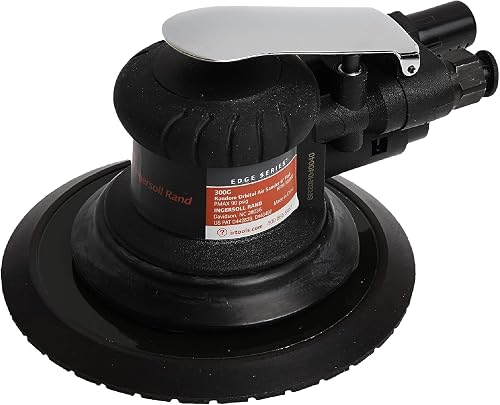
6. Ingersoll Rand 300G 6" Random Orbital Air: Best for light finishing
Ingersoll Rand 300G 6" Random Orbital Air: Best for light finishing
- 0.20 hp motor
- 6 in pad
- 10,000 rpm
- 3/16 in orbit
- 360-degree swivel vacuum adapter
The 300G focuses on light sanding, feather edging and rust removal on wood, metal and automotive surfaces. Its 6-inch pad, lightweight body and vacuum adapter suit general finishing work.
Pros
- Lightweight body
- Vacuum adapter
- 6-inch finishing coverage
Cons
- Air compressor not included
- Lower motor rating than the 328B
The Ingersoll Rand 300G is a balanced choice for light sanding, feather edging and rust removal. Its 6-inch pad, 0.20 hp motor and 3/16-inch orbit suit preparation and finishing on wood, metal and automotive surfaces.
It reaches up to 10,000 rpm and weighs 1.9 pounds according to the product description. A contoured grip, diffused rear exhaust and low-vibration design support control while you work.
The 360-degree swivel vacuum adapter can connect to a compatible vacuum system. For matching options, see orbital sanders with vacuum attachments.
That gives this model a different dust-management path from the 3M non-vacuum sander. Connecting extraction can help you see the surface more clearly as you work, which is useful during feather edging and other fine prep tasks.
The lighter body also helps when the work is spread across a panel rather than in one spot. Moving the tool in steady, overlapping passes is easier when the sander does not feel top heavy.
The 300G is sold individually, and the air compressor is not included. Pick it for general finishing and maneuverability, or choose the 328B when the job is mainly broad-panel material removal.
7. TOOLPEAK 5-inch air palm random orbital sander: Best for standard 5-inch discs
TOOLPEAK 5-inch air palm random orbital sander: Best for standard 5-inch discs
- 10,000 rpm
- 5 in hook and loop pad
- Dual-action motion
- 1/4 in air inlet
- 8 CFM consumption
The TOOLPEAK uses a standard 5-inch hook and loop pad for woodworking, metal work and auto body preparation. Its dual-action motion and composite housing suit users who want a compact palm grip.
Pros
- Common 5-inch pad size
- 8 CFM stated consumption
- Adjustable sanding speed
Cons
- No vacuum system is stated
- Air compressor not included
The TOOLPEAK 5-inch air palm random orbital sander suits buyers who want a compact tool with a common 5-inch hook and loop pad. The pad size works for woodworking, metal work, furniture, auto body preparation and finishing.
Its dual-action motion is designed for smooth, swirl-free sanding, while the motor reaches 10,000 rpm. The composite housing provides a palm grip with vibration dampening.
TOOLPEAK states 8 CFM air consumption and a 1/4-inch air inlet. That is less demanding than the stated airflow for the Gedu and 3M, but you should still compare the figure with your compressor's continuous output.
A standard 5-inch pad is a practical advantage if you already stock those discs. You can move between grits for removal, refinement and finishing without changing the whole set-up.
The palm shape suits smaller parts and repairs where a large flat pad would be awkward. It also helps around edges, though you still need to keep the pad flat to avoid dips in the finish.
Choose this model when 5-inch abrasives already fit your workflow. For variable speed and an accessory-heavy set, consider the Autolock or ZFE alternatives.
8. SI FANG Mini Air Sander 1/2/3 Inch: Best for small-area touch-ups
SI FANG Mini Air Sander 1/2/3 Inch: Best for small-area touch-ups
- 1, 2 and 3 in backing plates
- 15,000 rpm
- 4 CFM air consumption
- 45 sanding discs
- 3 backing pads
The SI FANG mini sander is made for spot sanding, rust removal, deburring and detail polishing. Its small pads and included sanding discs work best on focused areas rather than full-panel correction.
Pros
- Compact detail pads
- Low stated air consumption
- Sanding and polishing accessories included
Cons
- Not intended for broad surfaces
- Needs an air compressor with sufficient airflow
The SI FANG Mini Air Sander 1/2/3 Inch is built for spot sanding, small repairs and detail polishing. Its 1-inch, 2-inch and 3-inch backing plates make it easier to work on rust spots, solder joints, furniture edges, molds and small automotive areas.
The tool reaches 15,000 rpm, states 4 CFM air consumption and has a 4 mm orbit diameter. The included set contains 45 sanding discs, 3 backing pads, a screw and a screwdriver.
It can also work with sponge or wool pads for polishing, waxing and glaze sealing. The small pad sizes are the main trade-off, since they are not intended for full-car paint correction or broad-panel sanding.
The three sizes let you scale the work to the repair in front of you. Use the smallest plate for a tight rust spot, then move up only when the surrounding area gives you room to work safely.
Because the discs are small, patience matters more than pressure. Light, steady passes will usually give a more even result than pushing the tool into the surface.
This is a pneumatic tool, not a battery or electric tool. Confirm that your compressor can deliver sufficient airflow before buying, especially if you plan to use it continuously.
9. Autolock 5 Inches Air Random Orbital Sander: Best for one-hand control
Autolock 5 Inches Air Random Orbital Sander: Best for one-hand control
- 5 in pad
- 12,000 rpm
- Adjustable air regulator
- Low-vibration design
- Sanding and polishing accessories
The Autolock combines a 5-inch pad with an adjustable air regulator and a palm-style body. The set includes a sanding pad, sandpaper, sponge pads, microfiber cloths, a washing mitt and connectors.
Pros
- Adjustable air control
- 5-inch coverage
- Accessories for sanding and polishing
Cons
- Heavier than some compact options
- Air consumption is not stated here
The Autolock 5 Inches Air Random Orbital Sander is a useful fit for one-hand palm control and general auto, furniture, wood and metal work. Its 5-inch pad gives more coverage than a mini sander while staying easier to position than an 8-inch tool.
The adjustable air regulator controls sanding, polishing and waxing speed, and the tool reaches 12,000 rpm. Its low-vibration, low-height design supports palm handling during detailed work.
The set includes a hook and loop sanding pad, wrench, trachea quick connector, 7 pieces of 120-grit sandpaper, 3 sponge pads, 2 microfiber cloths, a washing mitt, a manual and a color box.
One-hand control is a real benefit on smaller jobs. When you can guide the sander and steady the workpiece with your other hand, it is easier to follow a line or work around a curve.
The regulator also helps you change tasks without changing tools. Lower the speed for polishing or waxing, then raise it for straightforward sanding on wood or metal.
Air consumption is not stated here, so verify compressor compatibility before ordering. Choose it for a 5-inch palm tool with accessories and adjustable air control.
How to match an air sander to your compressor
Your compressor should meet the sander's stated airflow requirement at the working pressure you plan to use. Tank size can help with short bursts, but continuous sanding depends more on the compressor's usable CFM.
The stated requirements vary widely in this group. The ZFE mini and SI FANG mini models state 4 CFM, TOOLPEAK states 8 CFM, Gedu states 10.5 CFM, and the 3M states 17 SCFM at 90 psi.
Use a regulator to set the pressure required by your tool. The SI FANG and ZFE mini data specify 90 psi, while the Gedu data also specifies 90 psi.
If the compressor cannot keep up, the tool may slow during a long pass. For steady work, leave capacity above the stated requirement rather than choosing a compressor that only reaches the number under ideal conditions.
Which pad size should you choose?
Choose an 8-inch pad for broad, flat surfaces, a 5-inch or 6-inch pad for general sanding, and a 1-inch to 3-inch pad for spot work. Pad size changes both coverage and how easily you can control the tool around edges.
The Ingersoll Rand 328B covers the most area with its 8-inch pad. The Gedu and Ingersoll Rand 300G use 6-inch pads, while the 3M, TOOLPEAK and Autolock use 5-inch pads.
Mini sanders use less abrasive area per pass, but they reach tight locations more easily. The ZFE and SI FANG models are better for detail work, polishing and small repairs than for smoothing a whole panel.
For more 6-inch comparisons, see our guide to the best six inch orbital sander. If you are comparing Festool options, our best Festool random orbital sander comparison and best Festool 6 inch orbital sander guides cover that group separately.
How to get a smoother finish from a pneumatic orbital sander
Use the correct abrasive for the surface and let the orbital motion do the work. Keep the pad flat, move at a steady pace and avoid pressing down hard enough to slow the tool.
Start with a coarser abrasive only when you need material removal, then move through finer grits as the surface improves. A small pad can help with focused repairs, but a larger pad is more efficient on broad flat work.
Adjust the air control gradually. The Autolock, Ingersoll Rand 328B and other models here offer speed control or regulators, which can help you match the tool to the material and finish.
A variable-speed option is useful when one tool must handle both removal and finishing. Our guide to the best variable speed orbital sander explains what to compare.
Air sander setup and care
Disconnect the air supply before changing a pad or backing plate. Check the hose, fittings and pad before each job, and keep abrasive surfaces dry when the tool instructions require it.
Pneumatic tools need clean, regulated airflow. Use the tool's stated inlet and pressure requirements, and follow the manufacturer's lubrication instructions for the specific model.
A short check at the start of a session can save time later. Look for a worn pad, a damaged hose or a fitting that does not seat properly, since any of those can make the sander feel uneven.
When you change discs, keep the pad surface free of dust so the new abrasive sits flat. A flat seat gives more even contact and helps the orbital motion produce a consistent finish.
Set the pressure with a regulator rather than relying on the compressor gauge alone. That gives you a steadier speed and makes it easier to repeat the same setting on the next job.
Control dust with the tool's stated design and your work-area setup. The Ingersoll Rand 300G includes a swivel vacuum adapter, the ZFE 5-inch and 6-inch set includes a dust bag, and the 3M model is explicitly non-vacuum.
For non-vacuum tools, plan for dust to spread into the air. Good ventilation, a cleared floor and a workpiece that is secured before you start will make the job safer and cleaner.
Wear eye protection, hearing protection and suitable respiratory protection for the material and dust involved. Keep the work area clear, secure the workpiece and release pressure before disconnecting the hose.
Store per instructions
Verdict: which air powered orbital sander should you buy?
The Ingersoll Rand 328B is the best air powered orbital sander for broad flat-surface removal, while the ZFE 1/2/3 Inch is the better choice for small sanding and polishing areas. Choose the Gedu for overhead 6-inch work, the 3M for industrial finishing and the 300G for light general finishing.
If your work is mostly flat panels, start with the 328B. Its 8-inch pad covers more ground, and the variable speed helps you move from preparation to a finer finish without swapping tools.
If your work is mostly repairs, edges and small parts, start with a mini sander instead. The ZFE and SI FANG models give you fingertip control where a large pad would be hard to place.
Pick the TOOLPEAK or Autolock when you want a 5-inch palm sander. The TOOLPEAK suits buyers who already use standard 5-inch hook and loop discs, while the Autolock adds an adjustable regulator and a broader accessory set.
Look beyond the badge when you make the final choice. Pad size, orbit, stated airflow and whether the tool is vacuum or non-vacuum will affect your daily results more than the headline speed.
For jobsite cutting tools, compare the Best Battery Powered Miter Saw For Jobsite Use and Best Battery Powered Miter Saw For Contractors guides. For sanding, make the final choice by matching pad size and airflow to your actual work.
Our top 3 picks at a glance
-
1
Best for broad flat surfaces
Ingersoll Rand 328B 8" Dual-Action Orbital Air
9.7/10 our score
See it on Amazon -
2
Best for flexible detail work
ZFE 1/2/3 Inch Random Orbital Air Sander
9.6/10 our score
See it on Amazon -
3
Best for overhead sanding
Gedu Professional Air Random Orbital Palm Sander
9.4/10 our score
See it on Amazon
Frequently asked questions
What is the best air powered orbital sander for most users?
The Ingersoll Rand 328B is the strongest general pick here for broad flat-surface removal because it has an 8-inch pad, a 0.25 hp motor, variable speed and dual-action motion.
Choose a 6-inch or 5-inch model when you need easier handling on smaller workpieces.
How much air does an orbital sander need?
Air needs vary by model. The mini ZFE and SI FANG sanders state 4 CFM, TOOLPEAK states 8 CFM, Gedu states 10.5 CFM, and 3M states 17 SCFM at 90 psi.
Match the sander's airflow requirement to your compressor's usable output, not only its tank size.
What size air sander is best for auto body work?
A 5-inch or 6-inch random orbital air sander suits many auto body preparation and finishing tasks because the pad balances coverage with control. The 8-inch Ingersoll Rand 328B is better for broad flat panels and heavier material removal.
Mini 1-inch to 3-inch sanders suit spot work.
Are air powered orbital sanders better than electric sanders?
Air powered orbital sanders can run continuously while connected to a suitable compressor, but they require an air hose, regulated pressure and enough airflow. Electric sanders avoid compressor matching and are easier to start in a small shop.
The better choice depends on your existing tools and the work area.


